
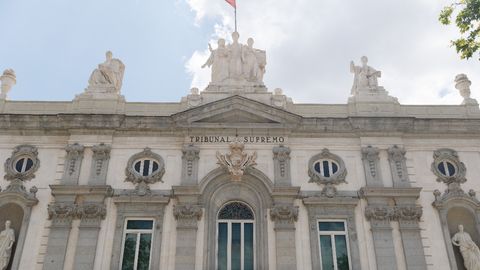
The Supreme Court has made it clear that grandparents can deduct from a child’s inheritance the maintenance and education expenses of their grandchildren when the father has not taken care of them, despite having the obligation and financial possibility to do so. And the fact is that, although those who receive the help are the grandchildren, the father also benefits because he has not had to assume those expenses, and therefore it is understood that these quantities are collatable.
This is established in its ruling of October 1, 2026 (which can be consulted at this link), in which the conflict over the mother’s inheritance between one of the children and his brother and his parents is resolved. When the mother died, will It was indicated that the expenses he had assumed in raising his grandchildren would have to be deducted from this son’s inheritance after he became a widower and remarried.
Specifically, he intended to deduct the expenses of food, clothing, accommodation and education of the three minors, even after they reached the age of majority, in addition to other amounts related to a bank debt that his parents had paid for him.
The grandparents assumed the expenses of their grandchildren that corresponded to the father
The Supreme Court explains that, according to article 154 of the Civil Code, it is the obligation of parents to support their children, assuming the costs of food, housing, clothing, medical care and education. Only when the parents cannot fulfill that obligation due to legally established circumstances can it pass to other family members, such as grandparents.
In this case, it was proven that the grandparents took care of their three grandchildren because their son did not comply with that obligation, without there being any evidence that there was any circumstance that prevented him from doing so. Therefore, even if the money was allocated to the needs of minors. The Court considers that the grandparents were assuming expenses that corresponded to the father.
These amounts, therefore, must be taken into account when distributing the inheritance, since article 1043 of the Civil Code establishes that the amounts that parents have paid to settle their children’s debts are collatable.
In this case, the ruling indicates that these expenses, when the father fails to comply with the obligation, can also be considered amounts intended to pay his debts.
It is not necessary that there be a prior ruling that requires the father to pay child support.
The Supreme Court also makes it very clear that there is no need for a prior judicial solution in which the father is forced to pay alimony so that they can be included in the distribution of the inheritance.
As he explains, the obligation of parents to support their children arises directly from the law, so it does not depend on a judge previously recognizing it. Specifically, it points out that “the obligation to collate is not conditional on the existence of a prior judicial resolution that declares the right to food and quantifies its amount.”
On the other hand, although the grandparents, as indicated by the son, had taken care of the grandchildren voluntarily, this does not prevent this help from having economic consequences in the distribution of assets.
The Supreme Court confirms that the five-day leave for care is generated for each new causative event and is not limited to 5 days a year
The Supreme Court clarifies that the old improvements for displacement are not automatically added to the new five-day leave for caring for family members
In fact, the Court remembers that, although the expenses had been incurred out of love for the minors, they also served to cover an obligation that corresponded to their father, preventing him from having to pay it with his own money.