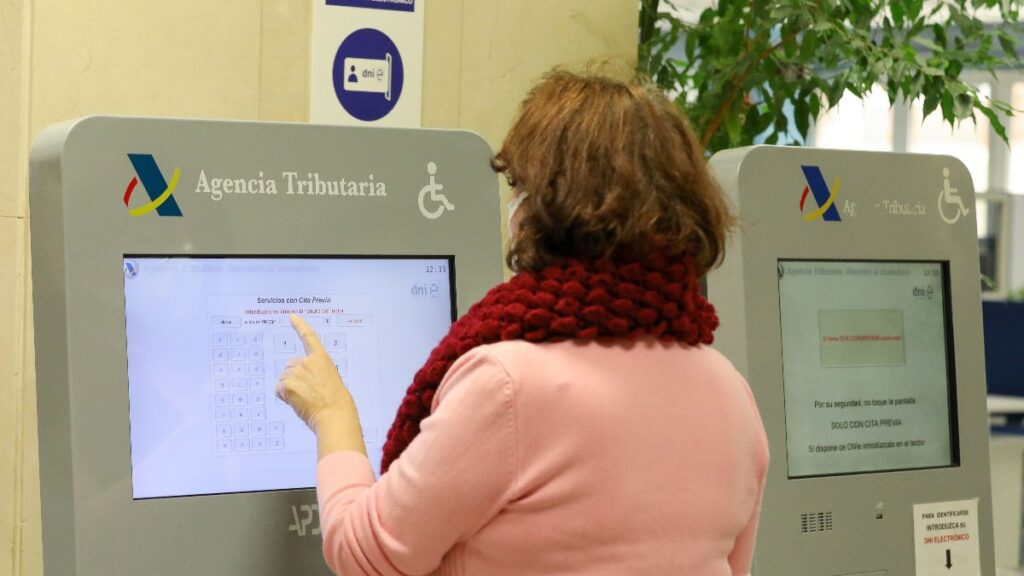
The Income tax return campaign 2025 It begins this April 8, 2026 and, like workers, retirees and pensioners, they must be accountable to the Treasury, although there are exceptions. Just as tax policy changes every year, new pensioners also arrive who are unaware and need to know who is exempt from submitting the draft Income Tax.
According to article 17 of Law 35/2006 on Personal Income Tax or IRPF (can be consulted in this Official State Gazette) pensions for retirement, permanent disability, widowhood, orphanhood or for family members are full income from work in the eyes of the Tax Agency, so they must be taxed. That is, all those who exceed the income limit set in article 96 of the aforementioned law will be required to submit the declaration.
Pensioners exempt from filing the declaration due to the income limit
As a general rule, they are not required to file the Income Tax return if the income exceeds 22,000 euros gross and comes from a single source. In practice, the majority of retirees who exclusively collect the Social Security pension remain below that limit and are not required to declare. Above that figure, the declaration is mandatory.
Now, the situation changes when the pensioner receives income from more than one source (for example a public Social Security pension and a private pension or capital gains). If you have several payers and the second or subsequent payers jointly pay more than 1,500 euros annually, the exempt limit is 15,876 euros. Above that amount there is an obligation to declare even if the total sum does not reach 22,000 euros.
The logic is that, with a single payer, Social Security applies the personal income tax withholdings taking into account all the pensioner’s income. With several payers, each one withholds what they pay without knowing the rest of the income, which can generate imbalances that the Treasury regularizes in the declaration.
Pensioners who, in addition to the pension received in Spain, receive any Social Security benefit from another country, are also required to declare.
Pensions that are not taxed in any case
There are pensioners for whom the exemption does not depend on the amount collected. Article 7 of Personal Income Tax Law 35/2006 establishes that certain benefits are completely excluded from the tax:
- Pensions for permanent absolute disability and for severe disability, provided that the “injury or illness that had been the cause of those completely disqualified the recipient from any profession or trade.”
- Extraordinary public pensions derived from acts of terrorism, as well as those arising from medals or decorations awarded for said acts. In this same sense, the exemption is extended to widow’s pensions when their origin is linked to acts of terrorism.
- Orphan’s pensions and, similarly, pensions in favor of grandchildren and siblings under 22 years of age or who are incapable of all work, provided they come from public Social Security schemes or passive classes.
- Pensions in favor of family members derived from acts of terrorism or recognized as a consequence of permanent disability (in the degrees of absolute or severe disability), including benefits intended for family members under 22 years of age.
- Likewise, pensions are exempt in favor of those people who have suffered injuries or mutilations as a result of the Civil War.
Also included are benefits derived from birth, child care and infant care, along with other non-contributory family benefits and passive orphan’s assets. Although these measures do not strictly fall within the concept of “pensions” according to Law 35/2006, they do form part of the exempt benefits.
The Minimum Living Income always requires declaration
Pensioners who receive the Minimum Vital Income (IMV) have the obligation to present the Income Tax return even if the result is zero and even if their total income is below the previous thresholds. The regulations that regulate the IMV expressly require it as a condition to maintain the benefit.
Even if you don’t have to, it may be worth reviewing the draft
A pensioner who does not exceed the limits has no obligation to present the declaration, but the draft may be returned and by not submitting it he may lose money that corresponds to him. If the Social Security has applied more personal income tax withholding than appropriatethe Treasury returns the difference, but only if the declaration is submitted.
Many retirees with the right to a refund do not collect it because they assume that, being exempt from declaring, they have nothing to do. Before discarding the declaration, it is worth consulting the draft in the electronic headquarters of the Tax Agency. If the result is “returnable”, submitting it costs nothing and can mean additional income.
For those who want to adjust the withholding that Social Security applies monthly to their pension and avoid surprises in the Income, there is the possibility of requesting a change of withholding directly from the INSS.