

Add NewsWork in 
Social Security has once again set a maximum in May with spending allocated to the payment of contributory pensions. The monthly payroll now amounts to 14,365.8 million euros, a level that confirms the increasing weight of this item within the public system and which continues to be driven, above all, by retirement pensions.
Three out of every four euros of that payroll go to retirement. Specifically, this benefit accounts for 73.3% of expenditure, with 10,533 million euros paid in the month. Behind them are widow’s pensions, which take 2,283.1 million, and permanent disability pensions, with 1,326.1 million. Much lower are orphanhood, with 185 million, and benefits for family members, with 38.5 million.

CCOO and UGT threaten with mobilizations due to the Social Security blockade of partial retirement in Public Administrations
Why it is advisable to keep your payroll for ten years to claim your pension
In total, the system paid 10,480,593 contributory pensions to nearly 9.5 million people in May. Of them, 6.7 million are for retirement, 2.3 million for widowhood, 1.05 million for permanent disability, 335,154 for orphanhood and 46,794 for family members.
However, these figures only reflect an average. The pension that each beneficiary receives depends on their work career, the bases for which they have contributed and the regime in which they were included. Therefore, within the same system, the distances between some pensioners and others continue to be enormous.
The highest average pension
The average pension for the system as a whole stood at 1,370.7 euros per month in May, 4.6% more than a year before. It is the average that includes all contributory benefits: retirement, permanent disability, widowhood, orphanhood and favor of relatives.
In the specific case of retirement, the average amount now reaches 1,572 euros per month, 4.4% more than in May 2025. It is received by more than two-thirds of pensioners and it is, by far, the one that eats up the majority of the expense.
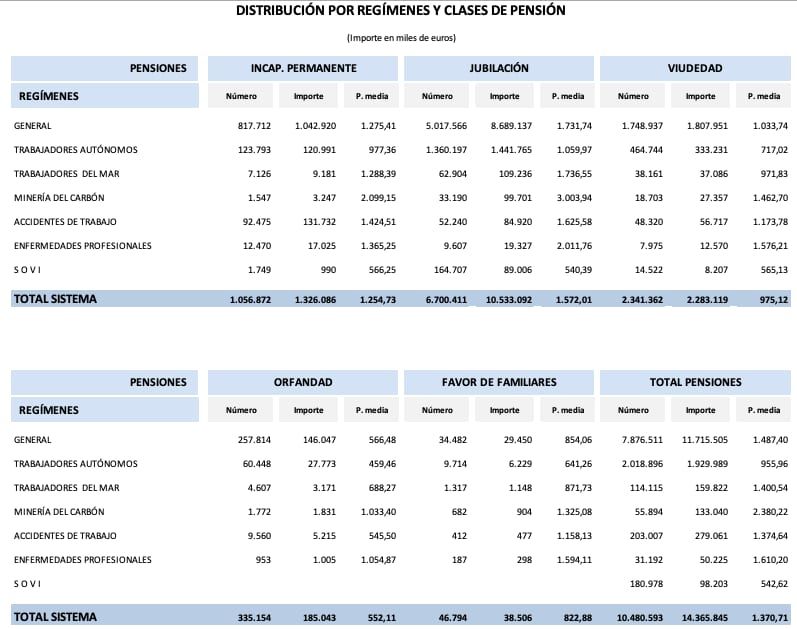
By regime, the General maintains an average retirement pension of 1,731.7 euros per month. The gap with self-employment remains considerable: in the Special Regime for Self-Employed Workers the average remains at 1,060 euros, barely six out of every ten euros of what a retiree from the General Regime earns.
But the highest amount is once again in Coal Mining. Retirees from this regime earn an average of 3,003.94 euros per month, practically double the general retirement average, and for the first time above the 3,000-euro barrier. The Sea Regime also exceeds the average, with 1,736.55 euros per month. Regarding widowhood, the average pension remained at 975.1 euros per month in May.
It is worth remembering that mining traditionally has higher contribution bases than other activities, which explains the higher amount of its pensions. It is not a privilege fallen from the sky, but rather the reflection of salaries and contributions that were far above average at the time.
The average pension rises again
The average also continues to grow month by month, and it does so due to the so-called substitution effect: the pensions that are new to the system tend to be higher than those that cause withdrawal, because they come from careers with higher contribution bases. According to the latest available data, from April, the average amount of new retirement registrations stood at 1,644.1 euros, well above the average for the whole.
That drip is noticeable in the still photo. In May, the average retirement pension rose to 1,572 euros, compared to 1,569.7 in April. The system as a whole also advanced, from 1,368.4 euros the previous month to the current 1,370.7. They are tenths every month, but they always point in the same direction.
Delayed retirements increase
In the first four months of 2026, 126,643 new retirement registrations were registered. Of them, 12.3% were voluntary delayed retirements, that is, workers who decided to delay their exit from the labor market to collect money later. The data represents almost a point and a half more than at the end of 2025 and no less than 7.5 points above what was seen in 2019.
As a consequence of this voluntary delay and less anticipation, the average age of access to retirement is now 65.5 years, when in 2019 it was 64.4. It must be taken into account that in 2022 new incentives came into force to reward those who extend their career and the early retirement framework was reorganized. Of course, the ordinary route continues to be the majority: 69% of the new retirees accessed at their corresponding age, a total of 87,430 people.
Social Security also boasts deadlines. The average time for resolution of retirement files was 9.28 days in April, the last month with data, far from the 90 days set by the regulations as a limit.
Gender Gap Plugin
In May, more than 1.5 million pensions have the supplement to reduce the gender gap, specifically 1,520,292. In 73.4% of the cases, the owners are women, which translates into 1,115,690 beneficiaries. The average monthly amount of this supplement is 76.9 euros.
Of the total supplemented pensions, 23.8% correspond to those who have one child (361,971), just half to beneficiaries with two children (764,211), 17.7% to those who have three (268,431) and the remaining 8.3% to families with four children or more (125,677).
The complement, regulated in article 60 of the General Law of Social Security and effective since February 2021, it consists of a fixed amount of 36.9 euros per month per child after the revaluation applied this year. The application must be submitted at the same time the pension is requested.
Passive Classes
Along with Social Security contributions, the public system includes Passive Class pensions, which mainly affect military personnel and officials of the General Administration of the State, the Administration of Justice, the General Courts and other constitutional bodies, in addition to officials transferred to the autonomous communities.
Its monthly payroll rose in April, the latest data available, to 1,775.1 million euros, 6.5% more than a year before, which represents an additional 105 million. The number of pensions in force was 739,072, some 14,577 more than twelve months ago, with an annual variation of 2%. Altogether, this regime distributes its benefits among 709,606 pensioners, according to data from the State Passive Classes Portal.