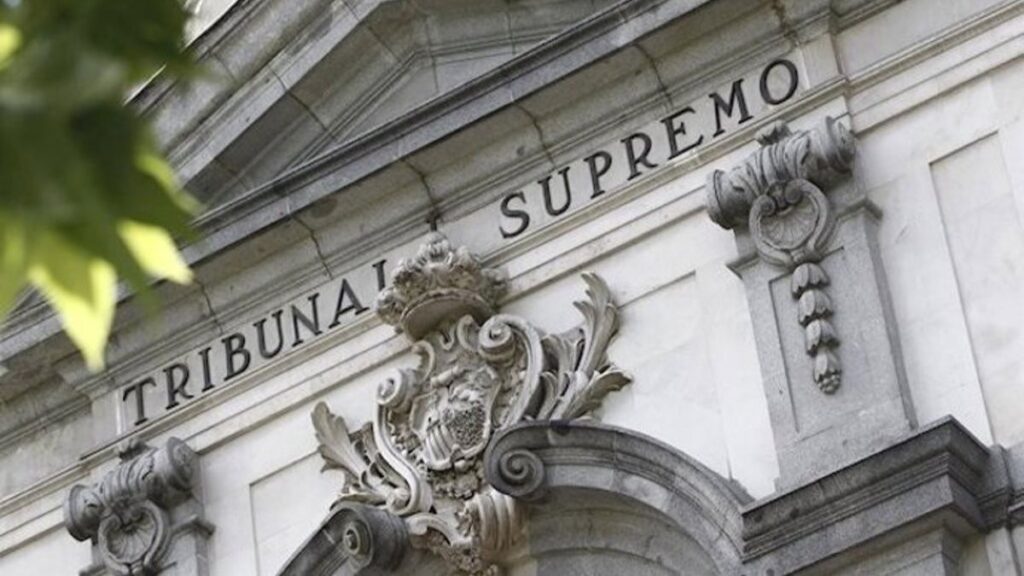


The Supreme Court (TS) has agreed with Social Security and has refused to recognize a widow’s pension to a woman who, for 22 years, lived with her partner and had two children with him. According to the STS ruling 1892/2026, the relationship was never officially registered as a de facto couple nor formalized before a notary, two requirements that the General Social Security Law (LGSS) requires in order to collect the benefit.
The ruling, handed down at the end of April, upholds the appeal presented by the National Social Security Institute (INSS) and the General Treasury of Social Security (TGSS), annulling the previous ruling of the Superior Court of Justice of Madrid (TSJM), which had recognized the right to collect the pension.
The Supreme Court allows delaying the start of the 5-day leave to care for family members and opens the door to its fractional enjoyment
Social Security may withdraw the non-contributory pension ex officio and claim the extra amount collected without going to court.
The plaintiff lived with her partner from 1998 until his death in 2020. They had two children together and bought a 50/50 house where they lived together throughout the relationship. After the death of her partner, the woman applied for a widow’s pension from Social Security but the INSS denied it in 2022 upon understanding that the couple did not comply with what the norm establishes.
He accredited the coexistence of more than 20 years
During the judicial procedure, the woman presented registration certificates, housing registration documents, proof from the community of owners and testimonies that demonstrated stable and continuous cohabitation.
The Social Court number 37 of Madrid rejected the claim in June 2024 considering that the law requires not only that the minimum cohabitation of 5 years be proven but that it be demonstrated that the couple was formally constituted by registration in the registry at least two years prior to death.
The Superior Court of Justice of Madrid reversed this ruling in 2024 and did recognize the right to collect the pension. The court understood that the evolution of the norm, especially the RD Law 2/2024 It allowed the formal requirement to be made more flexible in the case of common children.
The court pointed out that for benefits such as the Minimum Living Income (IMV) or certain unemployment benefits, registration is no longer required in those cases, it should be extended to the widow’s pension.
The Supreme Court refuses to relax the requirement
The Supreme Court has rejected this interpretation and has reaffirmed its previous doctrine, since it remembers that it is necessary to differentiate between stable and continuous cohabitation on the one hand and the legal formalization of the couple on the other. Both must attend to generate the collection of the benefit.
The ruling affects that documents such as registration certificates, the family book or the existence of common children can prove cohabitation but not the legal obligation to register the de facto couple or formalize it by public deed. The ruling highlights that the 2024 reform only eliminated this requirement for certain assistance aid such as unemployment benefits or the IMV but not for the widow’s pension, since this is for life.
The magistrates also rule out applying an interpretation with a gender perspective that allows the formal requirement to be ignored. Although they recognize that the majority of recipients of widow’s pensions are women, they maintain that the courts cannot “create a legal regime different from that legally provided” or interpret the norm “contra legem.”