The average price of electricity for this Friday, May 8, 2026 plummets after two consecutive increases, reaching 64.69 euros per megawatt hour (euros/MWh). Compared to the rate set on Thursday, May 7, electricity reduces its price by 25.56%, that is, it is paid at 22.22 euros less, since That day the price was 86.90 euros/MWh according to data published by the Iberian Energy Market Operator (OMIE).
What time is electricity cheaper this Friday?
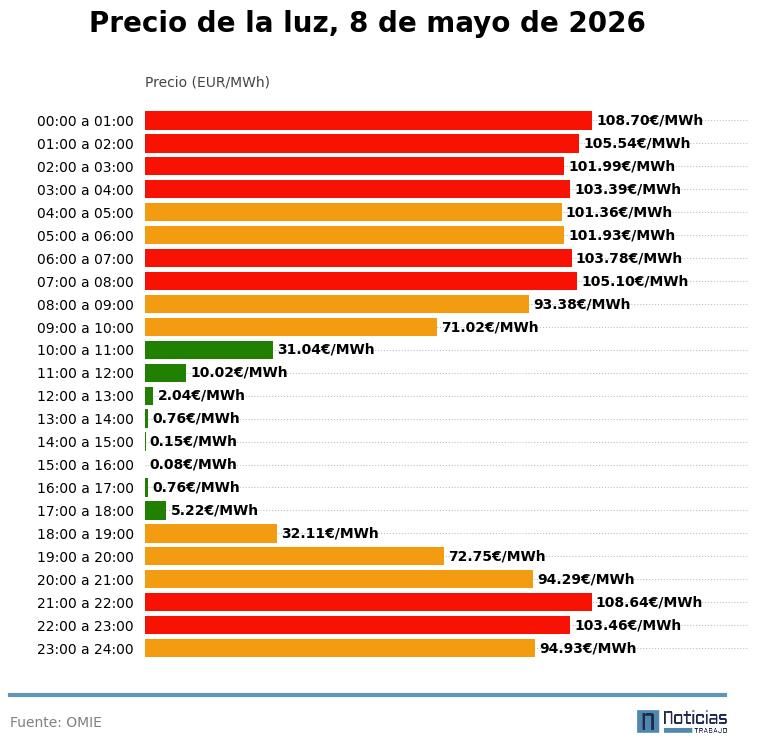
The cheapest price to consume electricity will be concentrated in the section from 3:00 p.m. to 4:00 p.m., with a price of 0.08 euros/MWh. After this section, the next cheapest hour, in which electricity will cost 0.15 euros, will be between 2:00 p.m. and 3:00 p.m. Although the price is close to 0 euros or is negative, it does not mean that the electricity is free.
The price of electricity today, Saturday, May 9, 2026 in the PVPC plummets, although there are 8 sections above 100 euros
The price of electricity this Saturday, May 9, drops and leaves 6 sections below the euro
When is electricity most expensive this Friday?
If we talk about the highest price of the day, this will be from 00:00 to 01:00 hours with a price of 108.70 euros/MWh. Another time when it is not recommended to turn on appliances is between 9:00 p.m. and 10:00 p.m., when it will have a price of 108.64 euros. Here it is important to avoid excessive use of electricity at home.
Price of electricity by hour, Friday, May 8
To save on your bill, it is important to know the price of electricity hour by hour during the 24 time slots of the day. It must be taken into account that the highest cost of electricity will occur at night and in the early morning, as well as that the best time to save is during midday, as can be seen in the following list and graph prepared with official OMIE data.
| time zone | Price (euros/MWh) |
|---|---|
| 00:00 to 01:00 | 108.70 |
| 01:00 to 02:00 | 105.54 |
| 02:00 to 03:00 | 101.99 |
| 03:00 to 04:00 | 103.39 |
| 04:00 to 05:00 | 101.36 |
| 05:00 to 06:00 | 101.93 |
| 06:00 to 07:00 | 103.78 |
| 07:00 to 08:00 | 105.10 |
| 08:00 to 09:00 | 93.38 |
| 09:00 to 10:00 | 71.02 |
| 10:00 to 11:00 | 31.04 |
| 11:00 to 12:00 | 10.02 |
| 12:00 to 13:00 | 2.04 |
| 1:00 p.m. to 2:00 p.m. | 0.76 |
| 2:00 p.m. to 3:00 p.m. | 0.15 |
| 15:00 to 16:00 | 0.08 |
| 16:00 to 17:00 | 0.76 |
| 17:00 to 18:00 | 5.22 |
| 18:00 to 19:00 | 32.11 |
| 19:00 to 20:00 | 72.75 |
| 20:00 to 21:00 | 94.29 |
| 9:00 p.m. to 10:00 p.m. | 108.64 |
| 22:00 to 23:00 | 103.46 |
| 23:00 to 24:00 | 94.93 |
Evolution of the price of electricity during the first 8 days of May
During the first 8 days of May, the average price of electricity has been 64.16 euros, so it can be said that we now pay 50.63 euros more on average, since exactly a year ago the average price was 13.54 euros.
Compared to a year ago, today electricity is 285.95% more expensive (47.92 euros more), since on May 8, 2025 The pool price was set at 16.76.
| Date | 2025 | 2026 | Difference in euros/MWh |
|---|---|---|---|
| May 1 | 13.29 | 57.87 | 44.58 |
| May 2 | 10.94 | 43.64 | 32.70 |
| May 3 | 16,17 | 48.13 | 31.96 |
| May 4 | 11 | 69.71 | 58.71 |
| May 5 | 10.89 | 64.34 | 53.45 |
| May 6 | 10.24 | 78.02 | 67.96 |
| May 7 | 19.01 | 86.90 | 67.89 |
| May 8 | 16.76 | 64.69 | 47.92 |
The CNMC warns of a deficit of 198 million in the electrical system while the price of electricity remains under pressure in Spain
The Spanish electricity system closed 2025 with a provisional deficit of almost 198 million euros, according to the CNMC, after regulated revenues were not enough to cover all the costs of the system. Although more than 800 million from previous surpluses were used to reduce the imbalance, total costs continued to exceed revenues, reflecting the pressure that the energy market in Spain continues to endure. In addition, the regulator also detected temporary imbalances in both electricity and renewables, with pending payments to producers and a coverage coefficient of less than 100%.
This scenario coincides with a day marked by volatility in the price of electricity in Spain, conditioned by high electricity demand and the evolution of the wholesale market. Although the system deficit does not directly influence the daily price paid by consumers, it does show the structural tensions of the electricity model, especially in a context of strong dependence on renewables, high regulated costs and the need to maintain investments in networks and generation.