The average price of electricity for this Saturday, May 9, 2026 is 33.80 euros per megawatt hour (MWh) in the wholesale market, according to data published by the Iberian Energy Market Operator (OMIE). The weekend thus begins with a significant drop of 47.75% compared to Friday, which translates into paying about 30.89 euros less for the ‘pool’.
To avoid confusion, it must be understood that this amount refers to the wholesale market, which does not include concepts such as taxes or tolls. These are only included in the Voluntary Price for Small Consumers (PVPC), which is the one that affects consumers with a regulated or indexed rate in the free market and is published late in the afternoon by Red Eléctrica.
The price of electricity skyrockets this Monday and leaves four hours above 100 euros
The price of electricity today, Sunday, May 10, 2026 in the PVPC rises and leaves 6 sections above 100 euros
When is electricity cheaper this Saturday?
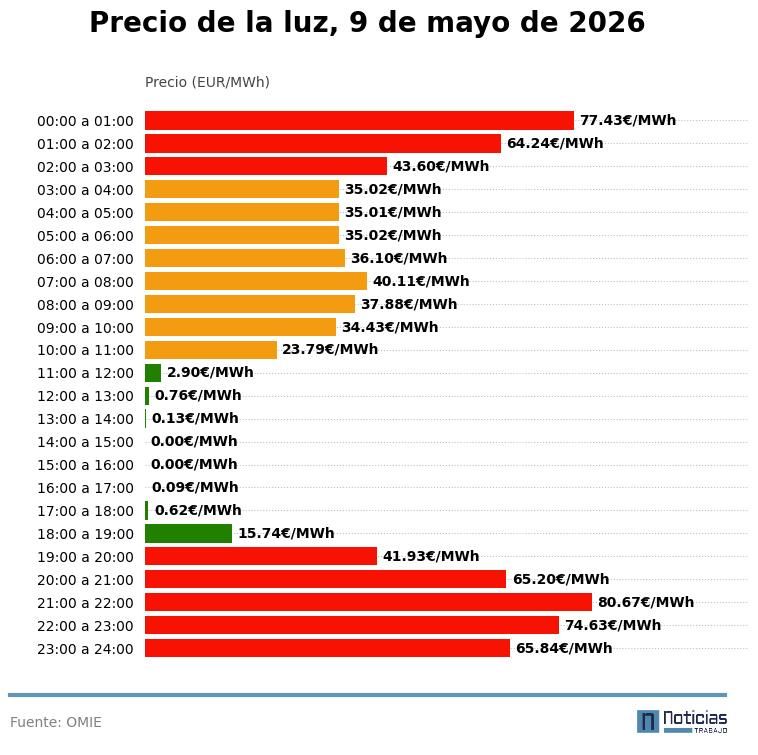
The cheapest hour of electricity will be from 2:00 p.m. to 4:00 p.m., with a price of 0 euros/MWh. As in previous days, the cheapest slots begin to occur at mid-morning and continue to occur continuously until mid-afternoon. For the benefit of consumers, there will be up to 6 below the euro.
When is electricity most expensive tomorrow, Saturday?
The maximum price of electricity will occur between 9 and 10 p.m., when 80.67 euros/MWh will be reached. The most expensive hours of electricity take place at two different times of the day: early morning and towards the end of the afternoon, starting at 7 p.m., although always below 100 euros, as had not happened all week.
Price of electricity by hour, Saturday, May 9
To take advantage of the drop in electricity, it is important to optimize consumption based on its evolution throughout the day. This will be the price of electricity hour by hour on Saturday, May 9, 2026 in the wholesale market:
| Hour | Price (euros/MWh) |
|---|---|
| 00:00 – 01:00 | 77.43 |
| 01:00 – 02:00 | 64.24 |
| 02:00 – 03:00 | 43.60 |
| 03:00 – 04:00 | 35.02 |
| 04:00 – 05:00 | 35.01 |
| 05:00 – 06:00 | 35.02 |
| 06:00 – 07:00 | 36.10 |
| 07:00 – 08:00 | 40.11 |
| 08:00 – 09:00 | 37.88 |
| 09:00 – 10:00 | 34.43 |
| 10:00 – 11:00 | 23.79 |
| 11:00 – 12:00 | 2.90 |
| 12:00 – 13:00 | 0.76 |
| 13:00 – 14:00 | 0.13 |
| 14:00 – 15:00 | 0.00 |
| 15:00 – 16:00 | 0.00 |
| 16:00 – 17:00 | 0.09 |
| 17:00 – 18:00 | 0.62 |
| 18:00 – 19:00 | 15.74 |
| 19:00 – 20:00 | 41.93 |
| 20:00 – 21:00 | 65.20 |
| 21:00 – 22:00 | 80.67 |
| 22:00 – 23:00 | 74.63 |
| 23:00 – 24:00 | 65.84 |
Evolution of the price of electricity in the first 9 days of May
The average price during these first 9 days of May has been 60.79 euros/MWh, which means that electricity is now 46.73 euros more expensive than compared to a year ago, when the average price was €14.06/MWh.
If you compare today’s day with that of just a year ago, you can see a shocking increase of 85.29%. It is so because May 9, 2025 The price of electricity stood at €18.24/MWh, while the price today stands at €33.80/MWh, which represents an increase of €15.56 compared to the same date last year.
| Date | 2025 | 2026 | Difference in euros/MWh |
|---|---|---|---|
| May 1 | 13.29 | 57.87 | 44.58 |
| May 2 | 10.94 | 43.64 | 32.70 |
| May 3 | 16,17 | 48.13 | 31.96 |
| May 4 | 11 | 69.71 | 58.71 |
| May 5 | 10.89 | 64.34 | 53.45 |
| May 6 | 10.24 | 78.02 | 67.96 |
| May 7 | 19.01 | 86.90 | 67.89 |
| May 8 | 16.76 | 64.69 | 47.92 |
| May 9 | 18.24 | 33.80 | 15.56 |
The Government reiterates the creation of a temporary tax on energy companies
At the beginning of April, the first vice president and Minister of Economy, Carlos Body, together with his counterparts from Germany, Italy, Austria and Portugal, sent a letter to the European Commission requesting the creation of a tax on the profits of energy companies after the conflict in the Middle East. In it, they asked to “explore an instrument of temporary solidarity so that energy companies contribute with the extraordinary profits obtained during the war and alleviate the burden on consumers and taxpayers.”
Now, this month of May, the PSOE has taken another step and has registered a non-law proposal in the Congress of Deputies to implement this tax at the European level, on the extraordinary benefits that energy companies are obtaining due to the rise in fuel prices.
The objective is that the increase in costs derived from the conflict “does not fall exclusively on consumers and the public treasury”, urging the implementation of this temporary contribution of solidarity, as was done a few years ago during the war in Ukraine. For the Socialist Group in Congress, if large energy companies obtain extraordinary benefits from the sharp rise in fossil fuel prices, it is “fair and reasonable” that they contribute “also in an extraordinary way to alleviate its effects.”