The public pension system has sought throughout the latest reforms to ensure that pensions do not lose purchasing power and that, in the case of the most vulnerable, they grow above the CPI, as regulated by Royal Decree 2/2023. But, if we look at the Social Security statistics, the data tells us that, despite the 2.7% increase approved in January, many retirees do not even reach the minimum wage. In fact, of the 6.7 million pensioners in the system, 2.4 million receive a retirement pension of less than 1,000 euros.
According to the latest data available on the website of the Ministry of Social Security, the monthly retirement payroll amounts to 10,499 million euros and the average retirement pension is 1,569.7 euros, 4.4% above the previous year. But behind this average, two parallel systems coexist in which there is one with 476,513 pensions receiving close to or above 3,300 euros and another with 2.42 million retirement pensions that do not reach 1,000 euros, according to the microdata by sections published by the National Social Security Institute. It is 36.2% of the country’s total retirements.
Several retirees over 80 years of age speak clearly: “It hurt me when my son told me that I should sell the house and move to a residence.”
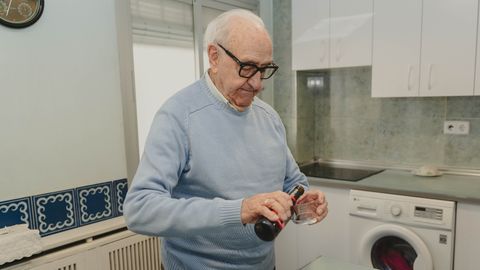
Miguel Ángel, 78-year-old retiree: “I’ve been sharing a flat for 6 years because I can’t live alone with 650 euros; the other person who lives here earned 450”
The distance between the retirement floor and the Minimum Interprofessional Wage (SMI) has also widened. Royal Decree 126/2026, of February 18, set the minimum interprofessional salary at 1,221 euros per month in 14 payments, with an increase of 3.1% that more than doubles that applied to pensions. The result, translated into retirement statistics, is that 3,108,480 pensioners, 46.5% of the total, earn less than the SMI. Almost half of the group that has already closed its working life receives a pension lower than the minimum salary of those who start working this year.
The fracture of the self-employed in pensions
The breakdown by contribution regime is where the asymmetry becomes starkest. The 5.01 million retirees of the General Regime start from a labor base with medium-high contribution bases and companies obliged to contribute for the actual working day. 29.2% of them earn less than 1,000 euros per month and 8.84% access the maximum of 3,300 euros. It is the group where the 2.7% increase reproduces, to a large extent, the salary distribution of the country.
The statistics of the Special Regime for Self-Employed Workers (RETA) say otherwise, since of the 1.36 million retired self-employed workers, 761,399 earn less than 1,000 euros per month: 56% of the group. If the bar is raised to the SMI of 2026, the figure rises to 72.4% of the total. And only 5,948 retired self-employed workers, 0.44% of the regime, reach the system’s maximum pension. The contrast with the General Regime is one in twenty: for every self-employed person with a cap, there are 75 retirees from the common regime with a capped pension.
The explanation is that the minimum contribution base of the RETA in 2026 is around 735 euros per month for the lowest sections of the new contribution system based on real income, far from the 1,260 euros of the minimum base of the General Regime. Added to this is that the majority of self-employed workers contribute the minimum and that many working lives are interrupted by economic crises or by years with income below the SMI. All of this explains why the average self-employed retiree in Spain today receives a pension of 891 euros, 43% lower than that of the General Regime.
The gender gap is concentrated in retirement
The data by sex within the retreat confirm that the floor of the system is feminine. The average retirement pension is 1,791 euros for men and 1,263 euros for women, a difference of 528 euros per month and a 29.5% gap. But photography becomes more eloquent at the extremes. Only 21.4% of retired men earn less than 1,000 euros, compared to 56.7% of women: two out of every three Spanish retirees today receive a pension less than that figure.
The asymmetry is maintained on the ceiling. 9.6% of retired men access the limit of 3,300 euros per month, compared to just 3.7% of women. Women make up 65.6% of retirees who earn less than 1,000 euros and only 21.9% of those who reach the maximum pension. The paradox of the linear revaluation of 2.7% is that, on the average male pension, it adds 48 euros per month; over women, 34. Every year, the gap in current euros grows. Without a complement linked to sections, the convergence that the system has been pursuing for a decade is not mathematically possible with this formula.
The next few months will put the model to the test. Projections from the Independent Authority for Fiscal Responsibility and the Ministry of Inclusion suggest that the mass retirement of the baby boom generation will add 6.6 million additional contributory pensions until 2050 and reduce the ratio of contributors per pensioner to below 1.7. The 2.4 million retirees who today earn less than 1,000 euros, far from being a residual anomaly, are the symptom of a system whose statistical average has risen five years in a row without the ground having moved from the site.