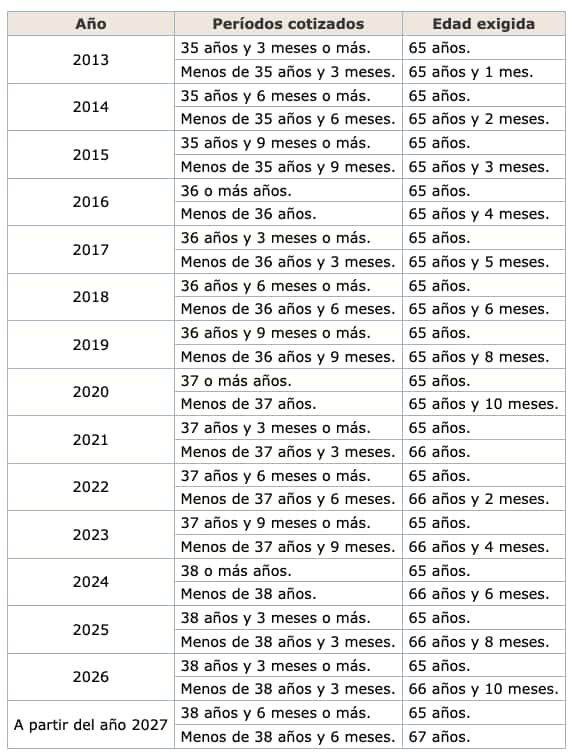
The amount of the retirement pension depends on the latest contribution bases that represent the regulatory base and the total number of years of contributions that work as a percentage to which one is entitled. That is, the more contribution bases and the more years worked, the higher the pension will be. Therefore, workers who have less than 36 years and six months of contributions throughout their working life will not reach 100% of their pension.
This is regulated by Law 27/2011 (can be consulted in this BOE), which is, so to speak, the first pension reform that began to be implemented in 2013. It established, in addition to the system to define the retirement age, the calculation method to determine the amount that a pensioner should receive (the method introduced the dual system with Royal Decree 2/2023).
Social Security denies permanent disability to an art restorer with cancer aftereffects because her injuries “do not nullify her working capacity” and the court orders that she be granted full disability.

At the age of 58, he achieved a lifetime pension of 2,252 euros after working in a metallurgy workshop suffering from lower back pain, panic attacks and anxiety, the TSJ endorses him
In this way, just as there are two ages to retire based on the years of contributions, a new calculation method was also implemented that progressively expanded the years that are taken into account to determine the regulatory base of the pension, going from 15 to the last 25 years of contributions.
A system proportional to years worked
To calculate how much each retiree should receive, the law establishes that “the amount of the retirement pension will be determined by applying to the regulatory base (…) the following percentages: a) For the first fifteen years of contributions, 50%.”
From those initial 15 years, the pension grows progressively for each additional month. As established in the legal text for the current section, “during the years 2023 to 2026. For each additional month of contribution between months 1 and 49, 0.21% and for each of the following 209 months, 0.19%.”
| During the years 2023 to 2026. | For each additional month of contribution between months 1 and 49, 0.21 percent and for each of the following 209 months, 0.19 percent. |
| Starting in 2027. | For each additional month of contributions between months 1 and 248, 0.19 percent and for each of the following 16 months, 0.18 percent. |
Thus, to receive the full or 100% pension, it is necessary to be 36 years and six months of contributions. Those who do not reach that figure receive a percentage adjusted to their actual work history. This is how the table would look for this year 2026:
| Listed Years | Regulatory Base Percentage |
|---|---|
| 15 | 50% |
| 16 | 52.52% |
| 17 | 55.04% |
| 18 | 57.56% |
| 19 | 60.08% |
| 20 | 62.50% |
| 21 | 64.82% |
| 22 | 67.14% |
| 23 | 69.46% |
| 24 | 71.78% |
| 25 | 74.10% |
| 26 | 76.38% |
| 27 | 78.66% |
| 28 | 80.94% |
| 29 | 83.22% |
| 30 | 85.50% |
| 31 | 87.78% |
| 32 | 90.06% |
| 33 | 92.34% |
| 34 | 94.62% |
| 35 | 96.90% |
| 36 years and six months or more | 100% |
From 2027 onwards, demands increase. The legislation indicates that “Starting in 2027. For each additional month of contribution between months 1 and 248, 0.19 percent and for each of the following 16 months, 0.18 percent.” This means that, from that year on, it will be necessary to prove 37 years of contributions to achieve 100%.
Practical example of how the contribution defines the pension
To understand it clearly, we will use a practical case where two people obtain different pensions. We have Ana and Carlos, who reach their ordinary retirement age. After making the calculation corresponding to its regulatory base, Social Security establishes in both cases a base of 2,000 euros per month. Ana has been contributing for 37 years. Carlos is 15 years old due to several interruptions in his career.
By requesting the benefit, Ana will reach 100% of the regulatory base and her pension will be 2,000 euros per month. Carlos, having contributed the minimum of 15 years, will be entitled to 50%. Your pension will be set at 1,000 euros.
Carlos receives a lower amount because the system adjusts the monthly payment to the actual contributory effort. It is the direct consequence of a shorter work history.
Alternatives with less than 15 years of contributions
For those who have not reached 15 years of contributions, there is the option of a non-contributory retirement pension. The Official State Gazette establishes that “people who, having reached sixty-five years of age, lack income or income in amounts greater than the established limits (…), legally reside in Spanish territory and have done so for ten years, will be entitled to a retirement pension in its non-contributory form.” This mechanism ensures economic subsistence coverage for those who are in a vulnerable situation.