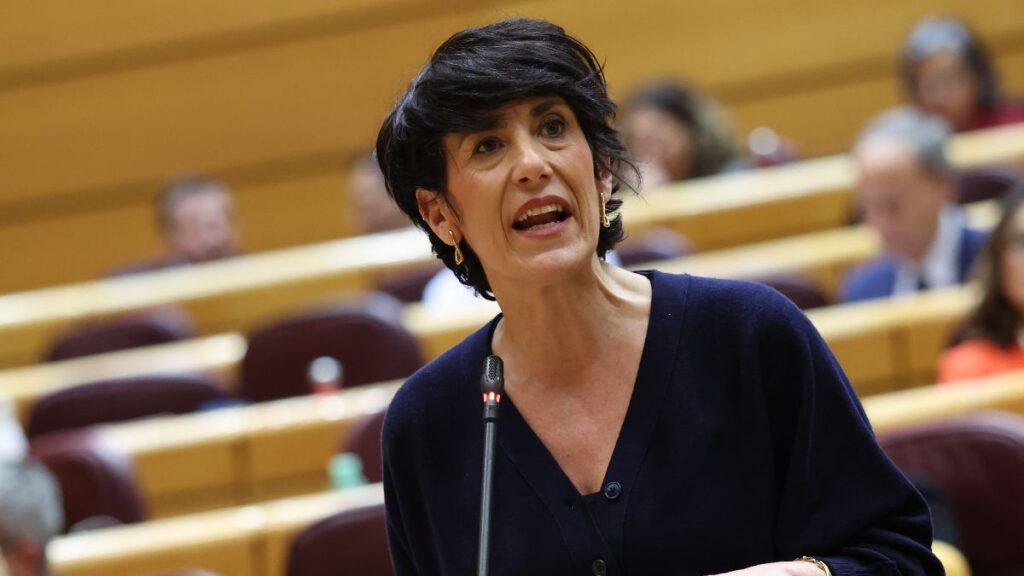
The European pension system faces the most profound debate since the harmonization of the euro, and Spain has decided not to follow the script that the Commission has written. The Minister of Inclusion, Social Security and Migration, Elma Saiz, intervened this Thursday in the plenary session of the European Economic and Social Committee to stop the package with which Brussels intends to increase the stock market exposure of employment pension funds to 70% of the portfolios and reactivate the Pan-European Individual Pension Product (PEPP), a figure created by EU Regulation 2019/1238 that has barely come to fruition in six years. “When pension systems are excessively oriented towards the private, the risks are transferred directly to people,” said Saiz in statements collected by Efe.
The demographic pressure on public accounts is real and AIReF projects that pension spending will reach 17% of Spanish GDP by mid-century, almost four points above the current level. The European Commissioner for Financial Services and the Savings and Investment Union, Maria Luís Albuquerque, defended the proposal with a message that was not liked, according to which savings products must guarantee long-term purchasing power or private pensions will lose real value over time. The idea is to channel these savings into productive investments (infrastructure, energy transition, defense, innovation) and pension funds are the natural lever to attract capital.
Now, the European Court of Auditors has already verified that the model does not work as sold. The PEPP, launched in 2019, has failed to consolidate itself as a real savings alternative in its six years of life, and the organization attributes the failure to a combination of three factors, which are the absence of national tax incentives, the cost cap set at 1% and competition from domestic products that are more attractive to European savers.
The ‘gap’ compared to the Nordic model
Spain plays in another European league, and the data says it without nuances. Its public system continues to offer a replacement rate close to 75% of the last salary, compared to the OECD average of 50% according to Pensions at a Glance records, and employment plans barely represent 2% of pension savings.
For their part, in the Netherlands and Denmark occupational funds (jointly financed by companies and workers via sectoral agreements) cover more than 90% of employees and are the second real pillar of the system. Paradoxically, this contrast is what makes the Brussels script unviable in southern Europe.
Breaking the current balance without first having a consolidated occupational network leaves the Spanish saver out in the open, exposed to stock market cycles without the safety net that does exist in the north. Automatic enrollment in supplemental plans works in the United Kingdom, where the system started in 2012 with the auto-enrolment and already exceeds 80% adhesion, and in the Netherlands by quasi-mandatory sectoral affiliation. In Spain, the productive fabric is dominated by SMEs and collective bargaining has not consolidated business plans, which invalidates copy and paste.
The memory of the ‘coup’ of 2008
Within the EESC itself, Saiz is not alone. María del Carmen Barrera Chamorro, representative of the workers’ group and vice president of the Workers’ Group since 2023, denounced that the plan lacks social evaluation and reduces the debate to financial profitability. “You cannot analyze the pension system solely from financial profitability,” Barrera said in the plenary session.
The Committee itself approved a non-binding opinion in which it recalls that, in the majority of countries where private savings have intensified, the public pillar has weakened in parallel. The memory of the 2008 financial crisis hovers over the debate, a lot.
In that cycle, many private plans chained negative returns for years and participants saw part of the savings of an entire working life evaporate, a trauma that in Spain has not yet been healed and that weighs on the confidence of the average saver.
The minister closed her intervention with the phrase that defines Madrid’s position in this European legislature, “Defending public pensions is defending the European social model”, and made it clear that Spain will vote against any reform that reduces the weight of the public pillar in the community architecture.