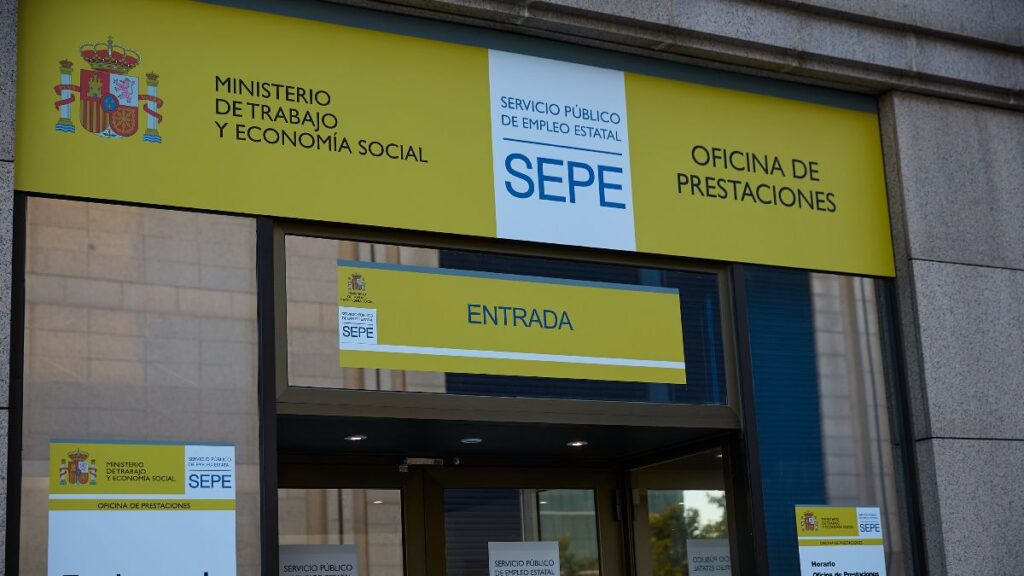
The Superior Court of Justice of Madrid has annulled a resolution of the State Public Employment Service (SEPE) in which it required a self-employed carrier to return 11,390 euros corresponding to the capitalization of unemployment. The court concludes that the Administration violated the worker’s right to defense by demanding the debt from him without detailing the reasons or calculations, offering an “abstruse” justification that generated obvious defenselessness.
Furthermore, the affected person demonstrated in the trial that he invested the entire aid in the purchase of a crane and other expenses to start his business worth 35,090 euros, a figure much higher than the 24,168 euros of the initial benefit that was granted to him.
It all starts when the self-employed person requested the contributory unemployment benefit in the single payment modality (capitalization of unemployment) on January 10, 2023. The SEPE approved it and paid him 24,168.40 euros in February 2023, giving him one month to start his work activity and present the supporting documentation for the investment.
A year later, in January 2024, the SEPE informed him that he had improperly received a part of the benefit and demanded the return of 11,390.98 euros. The only justification that the organization gave in its resolution was the phrase: “Single payment, Non-disabled Self-Employed Workers”, without providing any calculation or explaining what expenses had not been accepted.
The self-employed person challenges the claim through judicial means
Once the administrative route was exhausted, the worker filed a lawsuit through the courts, but the Social Court No. 30 of Madrid rejected it. The court argued that, although the detailed breakdown was not included in the administrative file, the worker was aware of his obligation to justify the investment.
It was during this trial that the SEPE explained its calculations for the first time: it stated that the worker had only justified expenses worth 12,777.42 euros, so the difference up to the 24,168.40 euros collected (11,390.98 euros) had to be returned.
The worker, not satisfied with the sentence, appealed and presented an appeal before the Superior Court of Justice of Madrid. In this, among other reasons, he alleged a violation of the Common Administrative Procedure Law (lack of motivation for the administrative act) and article 24 of the Spanish Constitution (right to effective judicial protection and defenselessness).
In this sense, he argued that the lack of breakdown in the SEPE claim prevented him from knowing the reasons for the debt and from defending himself adequately until the day of the trial. Furthermore, he maintained that he had invested all the money (and even more) in his business, having contributed to the trial with invoices for a crane, leasing contracts and other expenses that amounted to 35,090 euros, far exceeding the help received.
The TSJ of Madrid agrees with him and annuls the SEPE resolution
The Superior Court of Justice of Madrid ruled in favor of the self-employed worker and upheld his appeal. First, he described the justification given by the SEPE as “abstruse” and concluded that it did not minimally satisfy the legal duty of motivation required of public administrations.
By not identifying which invoices were rejected or the reason for the exclusion, an obvious defenselessness was generated in the citizen, who did not know why that money was being demanded until reaching the oral hearing. Furthermore, the TSJ did evaluate the documentation presented by the worker and concluded that the impact of the benefit on the start-up of his activity as a transporter was fully justified.
Lastly, the court criticized the attitude of the SEPE, pointing out that demanding the requirements with excessive rigor and denying the benefit goes against the spirit of the law, which seeks to promote self-employment, protect unemployed people in situations of need and help create a productive fabric.
Consequently, it upheld the self-employed person’s appeal and annulled the administrative resolution of the SEPE, meaning that it no longer had to return the 11,390.98 euros. This ruling (STSJ M 2661/2026) was not final and an appeal could be filed against it for the unification of the doctrine before the Supreme Court.