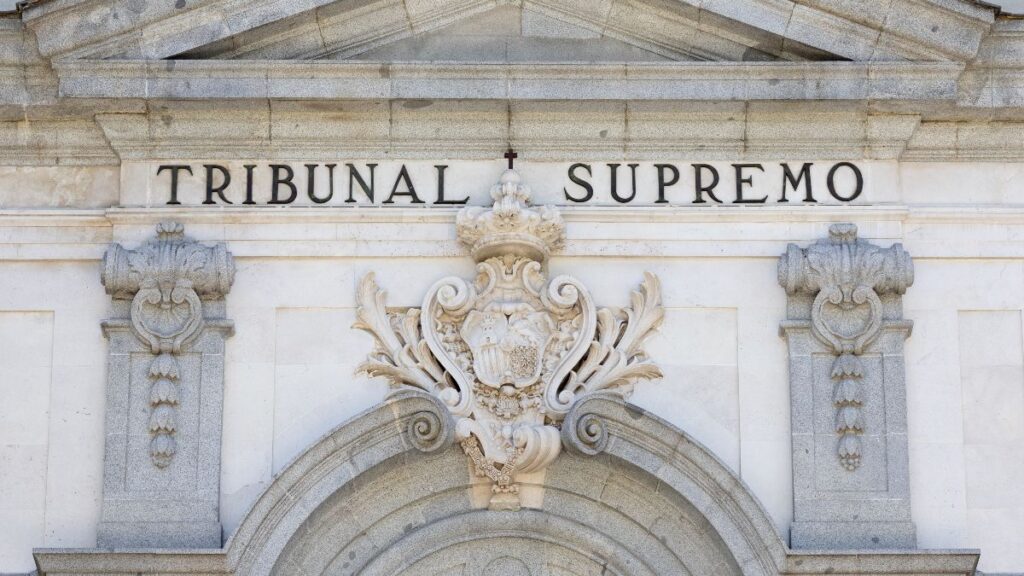


Beneficiaries of a non-contributory retirement pension who see their income increase after recognition may be forced to return the extra money collected without the Administration having to first go to court to withdraw the aid. The Supreme Court establishes that this action is not a review of an act declaring rights, but rather an act of ordinary management, that is, an administrative procedure that adapts the benefit to a new circumstance. The doctrine also applies when the citizen has not hidden information or committed any irregularity in his annual declarations.
The litigation resolved by the Social Chamber of the Supreme Court (consultable in the Judiciary) starts from the case of a recipient of the non-contributory retirement pension whose amount was set at 347.60 euros per month.

The Supreme Court denies a widow’s pension to a woman after 22 years of cohabitation and two children together: she did not register as a de facto couple

CaixaBank suffers a new setback from the Supreme Court: it will have to return more than 1,392.64 euros for the abusive clauses of a mortgage signed in 1999
Ten years later, in 2021, the beneficiary changed his address and began to live with his sister, whose annual income reached 14,397.72 euros according to his Income Tax return. The maximum limit to maintain the right to the benefit in a two-member cohabitation unit was 9,586.64 euros that year, so the sum exceeded the established limit.
In December 2022, the Madrid Ministry issued a resolution by which it terminated the pension with effect from January 2021 and demanded the reimbursement of 11,939.13 euros, the amount received during the two years in which the beneficiary no longer met the requirements.
The difference between reviewing the right and adjusting the amount
The affected person appealed and both the Social Court number 44 of Madrid and the Superior Court of Justice of Madrid agreed with him. Both instances understood that the Administration could not itself review an act declaring rights without first going to court, in application of article 146 of the Law Regulating Social Jurisdiction.
The Supreme Court, however, corrects this criterion and clarifies that this provision is not applicable. The ruling distinguishes between the review, which involves reconsidering an element that already existed when the right was recognized, and the act of ordinary management, which addresses an event after the initial recognition. In the case analyzed, the increase in income occurred ten years later and there was no irregularity attributable to the beneficiary.
“In these cases, the reimbursement of what was unduly received does not come from the review of the initial act, but from the adjustment of the temporal gap that normally occurs between the manifestation of the supervening cause and the declaration of the legal effect that derives from it in the benefit regime,” the ruling states.
Reinstatement and termination cannot be separated into two procedures
The court adds that the decision to terminate the aid and the claim for the amounts overpaid constitute a single administrative action. The ruling indicates that “the separation of the challenges to the acts of review and reinstatement lacks legal basis and is contrary to the principles of economy and procedural harmony by artificially generating two disputes on the same issue with the risk of contradictory solutions.”
The Chamber supports this interpretation in article 55 of the General Social Security Law (LGSS), which requires the return of unduly received benefits, and in articles 16 and 25 of Royal Decree 357/1991, which regulate the variation of income and the review of the amounts of non-contributory pensions.
Four years for the Administration to claim the money
The ruling unifies doctrine with the ruling of October 21, 2009 and is aligned with the pronouncements of March 11 and May 7, 2025, which had already applied this same criterion to the termination of non-contributory pensions due to sudden recognition of a total permanent disability.
Beneficiaries who receive a resolution of termination and reinstatement can challenge it by making a prior complaint to the managing body and, failing that, go to the Social Court. The obligation to return amounts unduly received expires after four years, counted from the date of collection or from when the Administration was able to take action to demand the return, as established in article 55.3 of the LGSS.