
A retiree must return 3,162.93 euros to Social Security, for having started working full-time while collecting 100% of his retirement pension as it was an improper charge. The Superior Court of Justice of Andalusia has agreed with the National Social Security Institute by considering that working full time is incompatible with the collection of the pension except in the cases included in the General Social Security Law.
As the ruling explains (available in the Judiciary), it all starts when this retiree, while collecting 100% of his retirement pension, decided to go to work with a full-time contract in a small Andalusian engineering company. Between October 11 and November 10, 2022, he worked there as an employee while continuing to collect his pension.
An 84-year-old retiree retired at 61 with a pension of almost 3,000 euros: “I would not have wanted to work more”

Ana, 87 years old, retired: “I don’t collect anything, not a cent of pension. It all depends on what my husband receives, and he does collect.”
Social Security, upon realizing that he had been discharged and that he had not communicated it (for which flexible retirement must be requested), proceeded to notify him that an incompatibility had occurred, declaring that he had improperly received the amount of 3,162.93 euros, corresponding to the monthly payment received while he was working. To recover the money, he set deductions in his pension, in four installments of 1,018.58 euros and a final one of 107.19 euros. After the agency dismissed his previous claim, the retiree decided to go to court.
Working and collecting the pension are incompatible
Although he claimed that Social Security knew perfectly well his month of activity because the contributions appeared in its records and that, therefore, there was no real incompatibility, the Superior Court of Justice of Andalusia did not agree with him, so he did have to return the money.
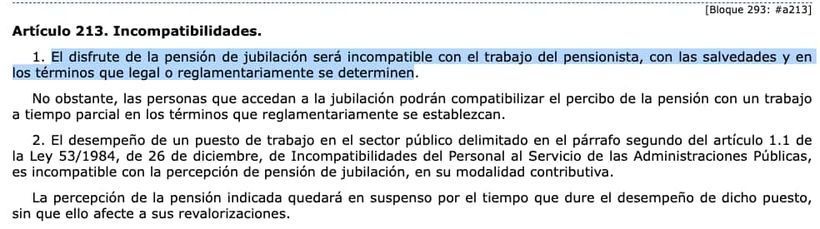
The TSJ explains that article 213 of the General Social Security Law says “the enjoyment of the retirement pension will be incompatible with the pensioner’s work.” If a retiree wants to continue working, the law itself requires him to take advantage of a specific modality, such as flexible retirement for part-time contracts or active retirement for those who continue to be active after the ordinary age.
And this is the key because, even though Social Security sees the worker’s contributions in its systems, it does not mean that it is an authorization. The flexible retirement regulation obliges the pensioner to communicate “before starting activities carried out under a part-time contract” that they are going to start working, in addition to indicating the modality they want to benefit from so that the organization can recalculate the pension during that period.
The ruling itself uses a Supreme Court doctrine from September 2023 to close the circle. If the pensioner works without making this communication, “he or she incurs the obligation to reimburse what was unduly received.” In other words, from the first day you work your pension is no longer legitimate and becomes overpaid aid.
Return more than 3,000 euros of your pension
The ruling was clear and the TSJ established that the retiree must return the monthly pension payments collected during the period of incompatibility, that is, the total owed of 3,162.93 euros, since the applicable regulation states that “the pension is considered undue from the date of start of the corresponding activities” when the required prior communication has not been made.
In this ruling we must know that working and collecting the pension are incompatible, except in the cases included in the regulations (such as flexible or active retirement), so before starting any activity you not only have to communicate it, but it is mandatory to ask clearly and expressly the specific modality that the retiree wants to benefit from so that the INSS can authorize it.