The average price of electricity for this Monday, May 4, 2026 is 69.71 euros per megawatt hour (MWh) in the wholesale market, according to data published by the Iberian Energy Market Operator (OMIE). The week begins like this with a increase of 44.84% compared to Sundaywhich translates into paying about 21.58 euros more for the ‘pool’.
To avoid confusion, it is worth remembering that this amount refers to the wholesale market, which does not include concepts such as taxes or tolls. These are included in the Voluntary Price for Small Consumers (PVPC), which is the one that affects consumers with a regulated or indexed rate in the free market and is published late in the afternoon by Red Eléctrica.
The price of electricity today, Wednesday, May 6, 2026, in the PVPC rises, and the most expensive hours already exceed 300 euros

The price of electricity on Wednesday, May 6, goes up but there are 5 very economical bands, below 2 euros
When is electricity cheaper this Monday?
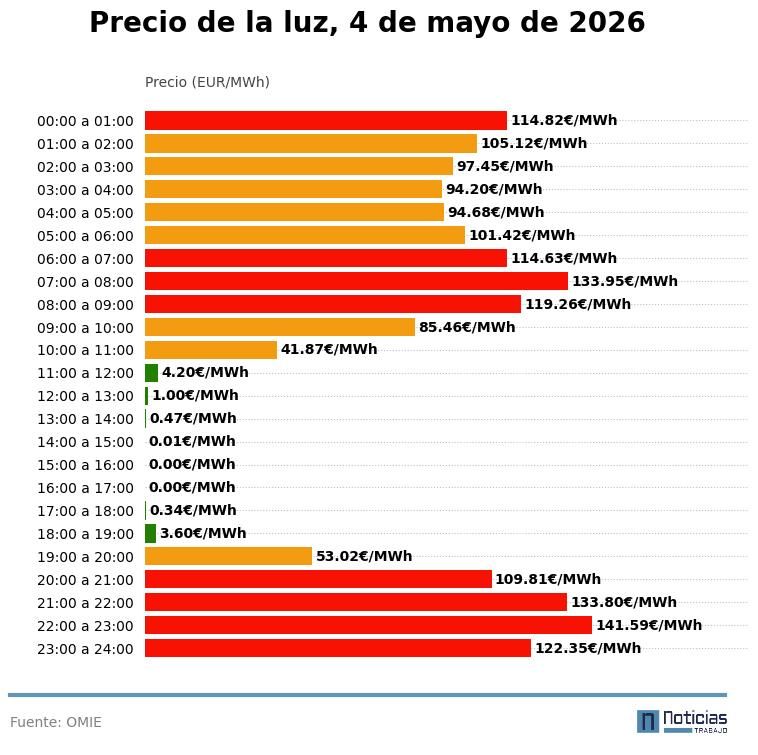
The cheapest hour of electricity will be from 3:00 p.m. to 4:00 p.m., with a price of 0 euros/MWh. Unlike the last few days, there will not be any band with a negative value, but there will be up to 5 below the euro. What is repeated is that the cheapest sections will begin at mid-morning and continue until late in the afternoon.
When is electricity most expensive tomorrow, Monday?
The maximum price of electricity will occur between 10 and 11 p.m., when 141.59 euros/MWh will be reached. The most expensive hours of electricity occur again, mainly, at two times of the day: first thing in the morning and between the end of the afternoon and at night. There will be up to 10 bands exceeding the barrier of 100 euros/MWh.
Hourly electricity price, Monday, May 4
If we do not want the increase to be reflected in the bill, it is advisable to adjust consumption according to the evolution of electricity throughout the day. This will be the price of electricity hour by hour on Monday, May 4, 2026 in the wholesale market:
| Hour | Price (euros/MWh) |
|---|---|
| 00:00 – 01:00 | 114.82 |
| 01:00 – 02:00 | 105.12 |
| 02:00 – 03:00 | 97.45 |
| 03:00 – 04:00 | 94.20 |
| 04:00 – 05:00 | 94.68 |
| 05:00 – 06:00 | 101.42 |
| 06:00 – 07:00 | 114.63 |
| 07:00 – 08:00 | 133.95 |
| 08:00 – 09:00 | 119.26 |
| 09:00 – 10:00 | 85.46 |
| 10:00 – 11:00 | 41.87 |
| 11:00 – 12:00 | 4.20 |
| 12:00 – 13:00 | 1.00 |
| 13:00 – 14:00 | 0.47 |
| 14:00 – 15:00 | 0.01 |
| 15:00 – 16:00 | 0.00 |
| 16:00 – 17:00 | 0.00 |
| 17:00 – 18:00 | 0.34 |
| 18:00 – 19:00 | 3.60 |
| 19:00 – 20:00 | 53.02 |
| 20:00 – 21:00 | 109.81 |
| 21:00 – 22:00 | 133.80 |
| 22:00 – 23:00 | 141.59 |
| 23:00 – 24:00 | 122.35 |
Evolution of the price of electricity in the first days of May
The average price during these first 5 days of May has been 54.84 euros/MWh, which means that electricity is now 41.99 euros more expensive than compared to a year ago, when the average price was €12.85/MWh.
If you compare today’s day with that of just a year ago, you can see a shocking increase of 533.73%. It is so because May 4, 2025 The price of electricity stood at €11/MWh, while the price today stands at €69.71/MWh, which represents an increase of €58.71 compared to the same date last year.
| Date | 2025 | 2026 | Difference in euros/MWh |
|---|---|---|---|
| May 1 | 13.29 | 57.87 | 44.58 |
| May 2 | 10.94 | 43.64 | 32.70 |
| May 3 | 16,17 | 48.13 | 31.96 |
| May 4 | 11 | 69.71 | 58.71 |
Why can a conflict thousands of kilometers away make your electricity bill more expensive?
The conflict in the Middle East directly affects world energy prices because this region acts as one of the large global suppliers of oil and natural gas. When tensions or armed conflicts break out, there is immediate fear that the production of these fuels will be paralyzed or that the ships transporting them will not be able to safely navigate key shipping routes.
Faced with the simple risk that there is less gas and oil available on the international market, the prices of these raw materials automatically skyrocket due to the law of supply and demand, making imports more expensive for all countries that depend on them, including Spain.
Although in our country we generate a large part of our electricity thanks to cheaper renewable sources, such as wind or the sun, we still need to burn natural gas in power plants to ensure that there is always light in times when green energy is not enough.
The electricity market works in such a way that the most expensive source of energy necessary to meet the demand of homes and companies is the one that sets the final price for all the others. Therefore, if imported gas costs much more money due to instability in the Middle East, the cost of producing that backup electricity skyrockets, which ends up causing an increase in the electricity bill that we consumers pay at the end of the month.