

Being able to buy a house increasingly seems more like a dream than a reality, and even more so seeing how housing prices continue to set records. Because of this, many families are looking for inventive ways to build or own their own home, from camper vans to prefabricated homes. Although among all the alternatives that are emerging, there is one that stands out for its versatility, and it is none other than container houses.
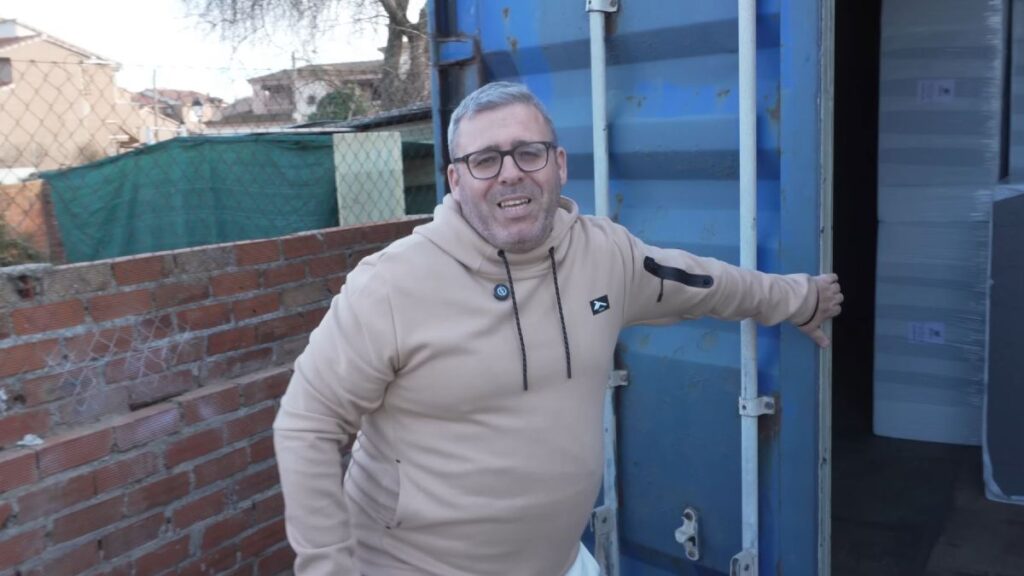
For some families like Matías’s, it is the best way to have a house to live in without having a mortgage for life. This elevator operator is the father of 2 daughters and decided to put an end to the trauma of housing by building his own house in a town in Toledo using 4 shipping containers. “You need 30,000 or 40,000 euros just to start, and a lifetime mortgage of 700 or 800 euros,” he explains about the difficulty that the current housing market presents and why he set out to create his own home through container houses, in an interview for the YouTube channel ‘Diego Revuelta’.

The Supreme Court equates tourist rentals with lodging and endorses the community statutes that veto this use

A community prohibits tourist apartments in its building after a neighbor ended up with a fractured cheekbone after confronting some tourists who were urinating in the pool: Justice supports it
The transfer of family land and the rising prices of a traditional construction project led him to discover the “wonderful shipping container community” on social media.
Matías’s project involves building a two-story, 120-square-meter home using four recycled shipping containers. He is doing the work practically on his own, relying on tutorials and YouTube videos to learn each phase of the process. At the moment, he has already purchased the first two modules for 4,500 euros, including transport, crane and VAT, and estimates that the final investment could be between 70,000 and 80,000 euros using mid-range materials.
Although many of his relatives and acquaintances doubt that he will be able to finish it, he has no intention of backing down. “I don’t change the containers for anything,” he says convinced, after discovering an alternative that he considers more affordable than taking a mortgage for decades. His idea also goes beyond financial savings: he seeks to build a home adapted to his family and designed completely to his liking.
The home will have SATE type exterior insulation, a solution that is increasingly used due to its energy efficiency and that will allow it to maintain a stable temperature both in winter and summer. In this type of construction, insulation is key to comply with regulations and avoid condensation or humidity problems.
More and more people are opting for container homes
Matías’s experience is not an isolated case. David, a computer scientist by profession, has been living for two years in a house made from two construction containers transformed into a functional home of 44 useful square meters. With no prior knowledge of masonry, he learned much of the process online and managed to turn the space into a fully equipped home.
The urban land where he built the house cost him 60,000 euros, while the interior renovation, materials and furniture cost an additional 18,000 euros. Currently, he assures that the change in life has been worth it and describes the experience as “peace.”
In addition, it highlights one of the great advantages of this type of housing: energy savings. “With very little turning on the heating, the house stays warm all day,” he explains. Thanks to thermal insulation, even in summer the interior temperature remains stable without the need for excessive consumption of air conditioning.
A model that is gaining interest among young people
The rise of container homes coincides with one of the most complicated times to access a home in Spain. The increase in the purchase price, the difficulty in saving the down payment on a mortgage and the increase in rents have led many young families to look for alternative formulas.
In municipalities close to large cities, as is the case in many towns in Toledo or Madrid, rents already easily exceed 500 or 600 euros per month, while buying a home can require initial savings that are impossible for many families with children.
Given this scenario, modular homes built with shipping containers are arousing interest for several reasons:
- They allow you to reduce structural costs.
- Construction time is usually faster.
- They can be easily customized.
- Its energy consumption is usually lower.
- They take advantage of recycled materials, which adds a sustainable component.
However, experts remember that they are not always as cheap as they seem on social networks, especially when permits, land development, connections and interior finishes are added.
The only bad thing is the permits, the project and the regulations
Despite their advantages, this type of construction continues to face important administrative obstacles. José Antonio, a builder specialized in container homes, considers that bureaucracy is the true “Achilles heel” of this model.
In Spain, a container house needs exactly the same legal requirements as a conventional home: project approved by an architect, urban planning license and compliance with the Technical Building Code. Without this documentation, the construction can be considered illegal even if it is installed on urban land.
Only the technical project and municipal taxes can raise the budget between 10,000 and 15,000 euros, a figure that reduces a large part of the initial savings sought by those who opt for this alternative.
“The municipalities do not want this type of housing at all. Under no circumstances,” laments David, who recognizes that many owners face different regulations depending on the municipality where they want to install the house.
José Antonio adds that, without permits, the administration can classify these homes as “a shanty, a substandard housing,” with the risk of sanctions or even demolition orders.
A real alternative to the housing access crisis
The phenomenon of container houses reflects the situation of a generation that is trying to find solutions in the face of an increasingly inaccessible real estate market. For many young people, saving the 30,000 or 40,000 euros that banks require to access a mortgage has become an almost impossible goal.
For this reason, more and more people are exploring alternative formulas: prefabricated homes, wooden houses, modular constructions or reuse of shipping containers. Some even incorporate self-consumption systems with solar panels or home automation to further reduce monthly expenses.
Even so, those who already live in this type of housing agree on one idea: economic savings is not the only reason. They also seek independence, energy efficiency and a different way of understanding housing, more flexible and adapted to their real possibilities.