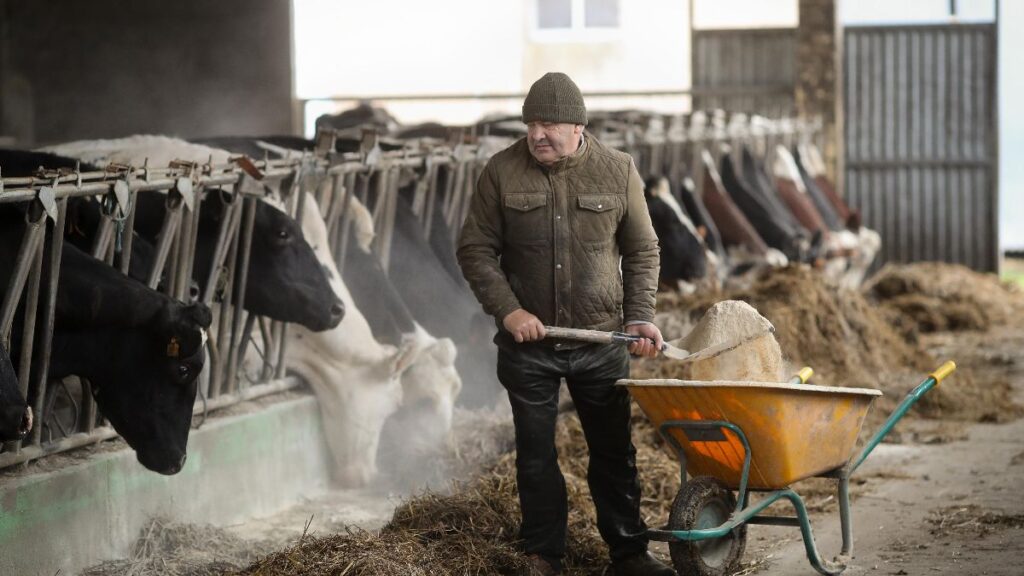


The Treasury has approved a reduction in the personal income tax modules for farmers and ranchers affected by exceptional circumstances during 2025. The measure is included in Order HAC/484/2026, of May 14, published this Monday, May 18, 2026 in the Official State Gazette (BOE)and modifies the net return indices applicable in the objective estimation method of the Personal Income Tax. One more aid that joins that promoted by the Ministry of Agriculture, Fisheries and Food to compensate for losses due to bad weather.
In practice, this means that certain farmers and ranchers who pay taxes by modules will be able to apply lower rates to calculate the net return of their economic activity for the year 2025. That is, the Treasury recognizes that certain agricultural and ranching operations have seen their activity altered by exceptional situations and reduces the fiscal parameters used to calculate what they must declare.

An 80-year-old widow sells her 380,000-euro house for only 80,000 to a couple who are friends of the family and Justice annuls the operation years later: they took advantage of her vulnerability
Brussels promotes tobacco review despite doubts about the scientific basis
The order itself explains that this reduction is based on article 37.4.1 of the Personal Income Tax Regulations, which allows the Ministry of Finance to authorize, on an exceptional basis, the reduction of signs, indices or modules when economic activities in objective estimation are affected by “fires, floods or other exceptional circumstances” in a specific sector or area.

The BOE confirms the reduction of the modules
The key point of the rule is in the single article of Order HAC/484/2026, which is the one that confirms the lowering of the IRPF modules for the affected agricultural and livestock activities. The BOE states it literally like this:
“The net performance indices applicable in 2025 to agricultural and livestock activities carried out in the territorial areas defined in the annex to this order will be those contained therein.”
This article is the one that approves the reduction of net performance indices for 2025. This is not direct aid or a subsidy, but rather a tax reduction within the personal income tax module system, applicable only to the activities and areas that appear detailed in the annex to the order.
When does it come into force
The order has already come into force the day after its publication in the BOE. This is stated in the sole final provision, which literally establishes: “This order will come into force the day following its publication in the Official State Gazette.”
Having been published on Monday, May 18, 2026, the entry into force occurs on Tuesday, May 19, 2026. From that moment, farmers and ranchers included in the annex can take into account the new reduced rates for the 2025 tax period.
Who benefits from this tax reduction?
The reduction affects specific agricultural and livestock activities and does not apply generally to the entire countryside. The annex to the order includes a detailed list by autonomous communities, provinces, municipalities, activities and applicable net performance indices.
Among the activities included, for all autonomous communities and provinces, beekeeping, with an index of 0.13; dairy sheep and goats, with an index of 0.18; and sheep and goat meat, with an index of 0.09, except in those territories where the annex itself sets a lower index.
Reductions are also included for crops such as wine grapes, almonds, cereals, olive products, citrus fruits, rice, vegetables, potatoes, forage, flowers and ornamental plants, non-citrus fruits and other products, depending on the affected area and the activity carried out.
For example, in Andalusia, reductions are included for wine grapes with designation of origin and without designation of origin in all provinces, in addition to specific discounts by municipalities for activities such as almonds, olive products, cereals, peppers, tomatoes, potatoes or asparagus. In the Valencian Community there are also numerous municipalities and affected crops, such as citrus fruits, rice, avocado, persimmon, almonds, grapes or horticultural products.
Why does the Treasury approve this measure?
The order indicates that the Ministry of Agriculture, Fisheries and Food has issued a report which shows that during 2025 exceptional circumstances occurred in the development of agricultural and livestock activities. This situation is what justifies the Treasury to use the authorization provided for in the Personal Income Tax Regulations to reduce the net return rates.
In other words, the Administration recognizes that certain farms did not have a normal campaign and, therefore, they should not be taxed with the same modules that would be applied in an ordinary year. The reduction attempts to adjust the tax burden to the reality of those who suffered losses, damages or lower production due to exceptional causes.
The order groups all the reductions in an annex to facilitate their application. This annex details the autonomous community, province, territorial scope, activity and new net performance index. Therefore, affected taxpayers must check if their municipality and its activity are expressly included.
How it affects the income tax return
This reduction affects the Income campaign for the 2025 tax period, so it has an impact on the calculation of the net income of agricultural and livestock activities that are taxed by objective estimation. In simple terms, the lower the applicable index, the lower the net return calculated by modules and, therefore, the lower the personal income tax tax may be.
Of course, the reduction does not automatically apply to any agricultural or livestock operation. To benefit from it, three elements must coincide: that the taxpayer pays taxes using the objective estimation method, that he develops one of the activities included in the annex and that said activity is located in the territorial scope indicated by Order HAC/484/2026.
Therefore, before applying the reduction, it is advisable to review the complete annex of the order or consult with a tax advisor, especially in cases in which the same province or municipality has different rates depending on the crop, the type of livestock or the specific area affected.