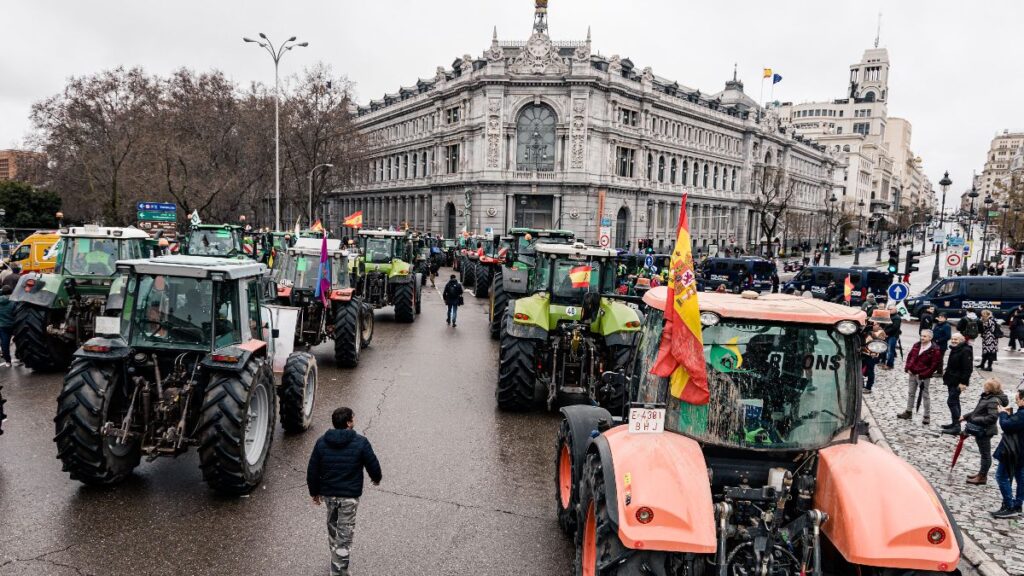
Spanish farmers can’t take it anymore, they feel suffocated by the high cost of diesel and other essentials to carry out their work days and achieve production that brings them benefits. But the thing is that, in addition, the farms are gradually becoming less profitable. Despite the efforts made by the Ministry of Agriculture, Fisheries and Food of Luis Planas, which has anticipated a extension in field aid either 37,235 million euros for the CAP (Common Agricultural Policy), field professionals will once again plant their tractors at the door of this organization.
The call has been launched for this Wednesday, October 28, 2026 and is organized by Asaja, COAG and the Union of Farmers and Ranchers. These will once again take their tractors to the streets to end in Madrid with an intense day of protest. In the end, Agri-Food Cooperatives of Spain have also announced that they are joining the mobilizations and have presented the motto ‘We produce your food, we deserve to live from our work’. The intention is to raise awareness of the problems that the field is going through today, which are varied and can be found both in the Middle East crisis as in the losses caused by thrips.
What farmers are asking for with the ‘tractor’
The organizations that have called for this mobilization have made the manifesto available to anyone who wants to consult it and highlight five fundamental points in which they believe it is essential to be heard by the Government.
Shock plan for the increase in production and diesel costs
The rise in the price of diesel, fertilizers, energy, feed and other means of production “eats up margins that were already insufficient” and the moment an international crisis is detected, “it ends up having an impact on our farms without us being able to transfer the extra costs to the prices we receive.”
The demand is “a shock plan with immediate measures to alleviate the situation and the implementation of a professional agricultural diesel, with reduced and stable taxation and a bonus that is applied directly when refueling field professionals.” And, during the time it takes to start up, aid is demanded for diesel that covers 70% of the real extra cost, without limits in addition to reduced VAT for fuels, fertilizers and plastics, a reduction in personal income tax and an adapted electricity rate.
A resounding ‘no’ to the dismantling of the CAP
Farmers refuse to let the CAP be weakened, with “fewer resources and more obligations” asking that the next Common Agricultural Policy not be “residual” with funds that are diluted among “other” budgetary priorities. In the case of Spain, they point out that Brussels has made a cut of nearly 10 billion euros, 28% less in real terms.
In this way, for the period 2028-2034, the CAP must be “truly common” with a “own and sufficient” budget, without “cuts in real terms” and maintaining the two pillars of direct payments and rural development, “protecting agricultural income and avoiding inequalities between European producers.”
Fair prices and an “effective” food chain law
“We cannot build the future of the countryside on farms that sell products without covering, on too many occasions, what it costs to obtain them.” They point out that both farmers and ranchers “can no longer be the link that supports the rise in costs, commercial pressures or a good part of the risks of the chain and when the consumer “pays on average four or five times what the farmer charges, the problem is not in the field.”
Avoid unfair competition
“It is not acceptable that increasingly stricter standards are required of our farmers and ranchers while the door to the market in Europe is opened to products obtained under less demanding conditions. We cannot compete with our hands tied against those who are not obliged to comply with these same rules.” The agreements with Morocco or Mercosur stand out, which are “examples of the hypocrisy of European trade policies that reserve the narrowest part of the funnel for our products and the widest part for imported ones.”
They will ask for effective mirror clauses, rigorous border controls, clear labeling of origin, automatic activation safeguards and protection measures for certain affected sectors since “you cannot allow yourself to sell here what you cannot produce here.”
The ‘Lula effect’ collapses Banco Santander and Telefónica on the stock market, affecting Ibex 35 companies

The price of electricity this Tuesday, October 27, rises again and 18 strips will exceed 200 euros
Less bureaucracy
“Administrative obligations grow while we spend more and more time filling out forms, completing paperwork, maintaining records and responding to overlapping issues. Administrative obligations grow while there is little time left for the important things it is to tend to crops, care for livestock or manage our farms.”