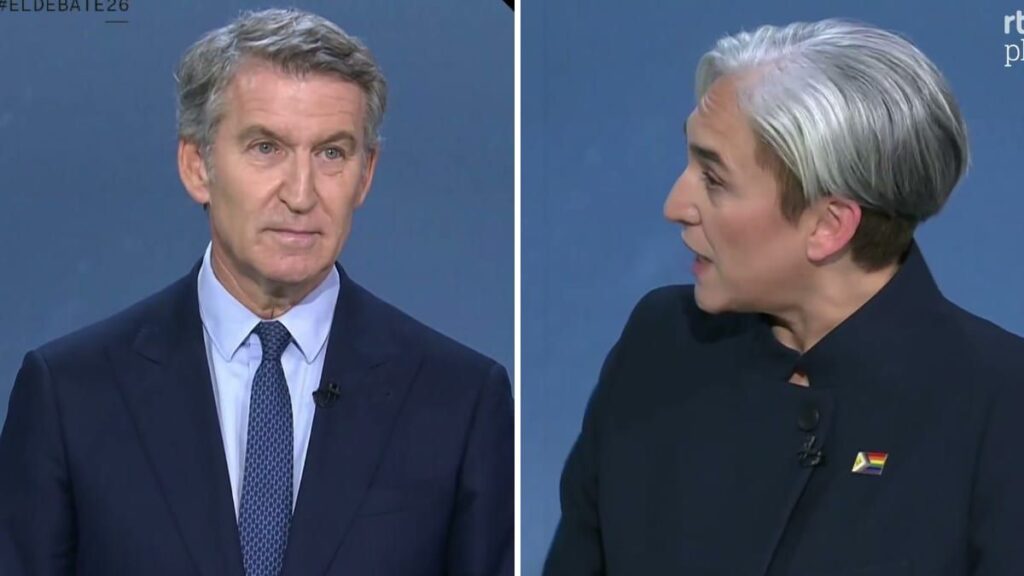
During the four-party debate held last night, three days before the general elections of 29N, one of the topics raised by the Frente Amplio candidate, Ada Colau, was the interprofessional minimum wage, and she accused the leader of the PP, Alberto Núñez Feijóo, of always being against increases, the last one to 1,286 euros per month in 14 payments, which will come into force on January 1, 2027.
Feijóo had said shortly before that people, when they open the refrigerator, “what they see is that they cannot make ends meet,” and Colau returned the phrase with a question: “But if you are so concerned about the refrigerator of the Spanish people, why have they always voted, up to four times, against the increase in the interprofessional minimum wage?”
“It is not approved by law, it is approved by royal decree,” Feijóo corrected him. Colau insisted (“But you have always taken a position against it, haven’t you?”) and the popular one cut it short with a “Mrs. Colau, let’s not waste our time.” When she asked him if he was in favor of increases, he replied: “Of course I am in favor of raising the minimum wage.”
Even so, the Frente Amplio candidate reproached him again: “He has always positioned himself in favor of the employers and against increases in the minimum wage,” and added that, if he had changed his mind, he celebrated it.
Feijóo’s response was the following: “Listen, just because you manage the unions does not mean that I manage the employers,” and he concluded: “What a joke.”
What the PP really voted on the minimum wage
Legally, Feijóo was right, because article 27.1 of the Workers’ Statute says: “The Government will set, after consultation with the most representative trade union organizations and business associations, annually, the minimum interprofessional wage.” That is, it is approved by the Council of Ministers by royal decree, like the one this month, which increases it from 1,221 euros in 2026 to 1,286 in 2027.
In fact, El Folio’s verification found Colau’s “four times” false, because the increases are approved “without the need for an ordinary vote in Congress”, although he admits that his second accusation, that the PP has taken a position against it, “does have precedents.”
Note that on Thursday and hours before the debate, the PP voted in favor of Royal Decree-Law 38/2026 (available in this BOE), regulations that prevent the 2027 minimum wage from having to pay personal income tax. The Permanent Deputation validated it with the support of all the groups present, without Vox, which did not attend.
Even so, the PP has opposed raising it without an agreement, as in January, when it rejected the proposal of the Minister of Labor, Yolanda Díaz, for 2026 because it did not have the support of the employers or the unions. The 2027 increase came out with the rejection of the CEOE and without the 7% that CCOO and UGT requested.
Congress gives the green light to a 4.5% salary increase for civil servants and for the 2027 SMI to be exempt from personal income tax

Pepa Millán, spokesperson for Vox, on work in Spain: “Before in Spain people worked to have a life project and today to survive”
In the face to face with Pedro Sánchez on November 19, Feijóo had already established his position, stating that “of course the minimum wage must be raised, but the important thing is to raise the average wage.”