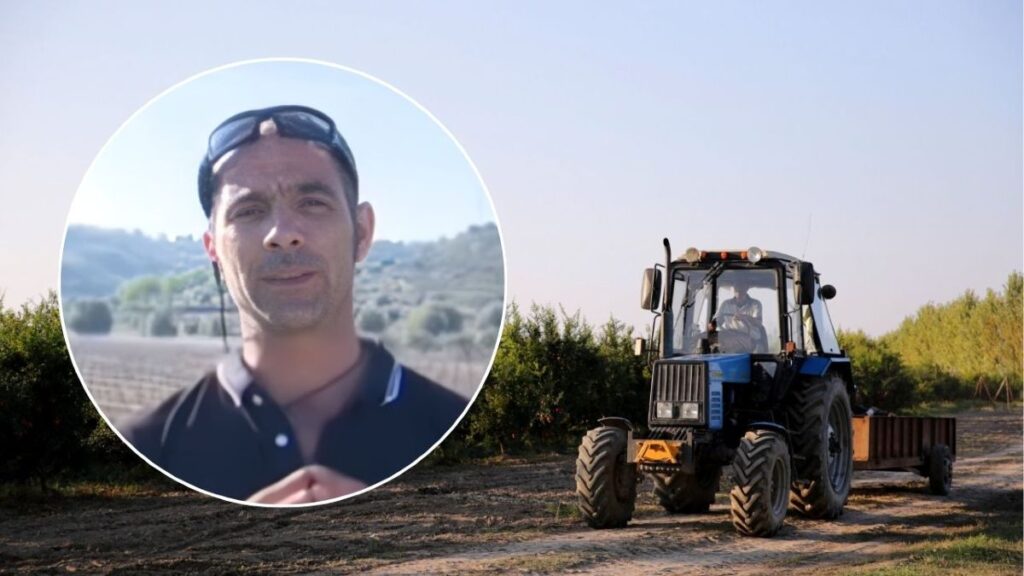
Cipri, a farmer from Arganda del Rey, confesses his feelings: “More than drowned, what we are is suffocated by the sudden rise in diesel,” he tells Public Mirror.
To feed families and keep farms running, he needs to fill tanks of thousands of liters, but the help that will come from the Government seems symbolic to him. “For 14,000 liters, which in the market today we would be talking about about 20,000 euros, they are going to provide us with a single payment of just 700 euros,” he denounces. In his opinion, “it cannot be that those of us who work the most depending on diesel (…) are the ones who are paying the price.”
A millionaire plan that does not reach them
The general context is this: the Government has approved an anti-crisis plan of 80 measures with an allocation of 5,000 million euros to cushion the economic impact of the war in the Middle East.
The package includes tax reductions on electricity, gas and fuel, with a reduction in VAT from 21% to 10% on fuel. On paper, the objective is to alleviate the energy bill of homes and companies, especially in the sectors most dependent on diesel, such as agriculture and transportation.
But on the ground, farmers like Cipri feel that relief falls short and comes too late. “No one is in favor of war, but we are not in favor of ruining ourselves and filling the State coffers,” he criticizes.
As he explains, agricultural diesel “has risen more than automotive diesel.” While the citizen’s car diesel rose by about 40 cents, he has seen an increase of 65 cents in a fuel “that had already been refined for more than 60 days.”
From the refinery to the field: the rise that is not understood
Cipri gives a very concrete example: “If tomorrow I buy a 2,000 liter diesel tank, which today is at 1.55… I remember that I bought it at 0.98 on February 20.” This sharp rise, he assures, is not justified only by the war, but by what he considers pure “speculation.” He points directly to the oil companies: he says that “they are swelling at the expense of consumers and workers.”
He also looks at the Government, which he criticizes for slow and unambitious responses. He remembers that, in the previous crisis due to the war in Ukraine, the multi-million dollar sanctions came “four years later”, with a fine of 5 million euros compared to benefits of 25 million: a proportion that, in his opinion, does not correct the abuses. Meanwhile, each agricultural campaign becomes a Russian roulette of costs.
The “discount” that does not add up to the account
One of the points that generates the most indignation is the design of diesel aid. The linear reduction of 20 cents per liter, which was announced so much, seems to him directly “a scam.”
He explains that the system does not work as many believe: it is not that the liter of agricultural diesel automatically drops at the pump, but rather that it is calculated a posteriori. “The reduction is that they are going to take 365 days of the year 2025, they are going to see the total diesel consumption that we have had… for us for 14,000 liters (…) they are going to provide us with a single payment of just 700 euros,” he details.
The feeling is that the more you work, the more you lose: “The more you work, the more taxes and the more money you are paying.” His complaint connects with that of a good part of the primary sector, which sees production costs skyrocket while margins narrow. For small and medium-sized farms, that difference can mark the line between continuing or closing.
“Let them get on a tractor”
For this reason, Cipri sends a direct message to La Moncloa: it asks “Sánchez and the ministers” to “get off, to move to a livestock farm, to get on a tractor and see how the needle drops on the diesel that has been in the cabin for 12 hours.”
He calls for “immediate solutions” and a clear measure: “We finally need professional diesel” and “a cap on diesel to make farms productive in the long term.”
“It cannot be that those of us who work the most depending on diesel, feeding people, taking food to places, are the ones who are paying the price for ‘no to war’, ‘yes to war’ and one another,” he finally says before the Antena 3 cameras.