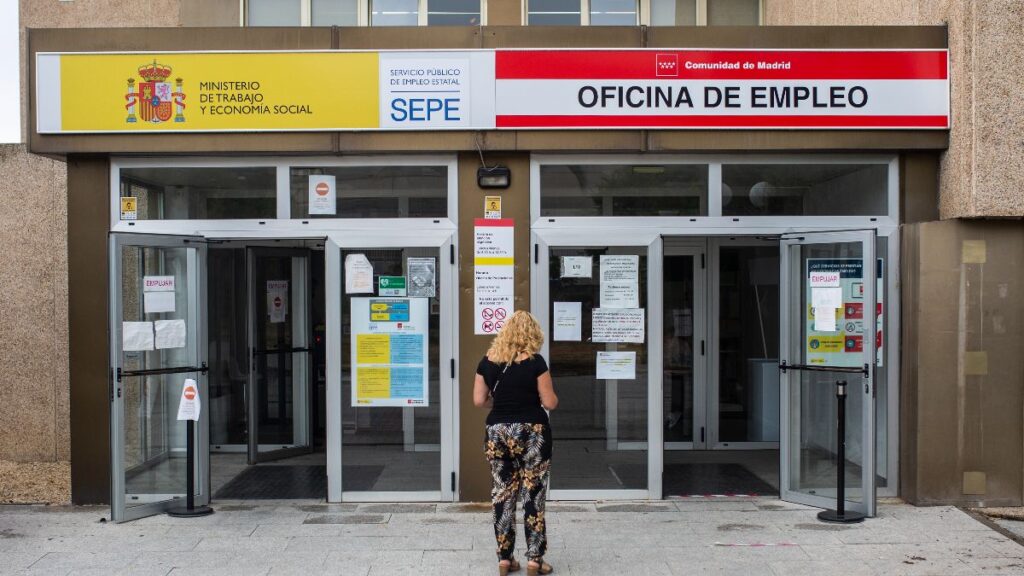
The Superior Court of Justice of Catalonia has ruled in favor of a woman from whom the State Public Employment Service (SEPE) claimed 4,525.06 euros in unemployment benefits. The agency mistakenly recognized the aid without discounting the 248 days that he had already spent due to being on medical leave. When she realized this, she demanded that she return the money, but the court considers that the woman acted in good faith and that she should not bear the consequences of an error made by the Administration itself.
On August 30, 2021, the SEPE allowed the woman to once again collect an unemployment benefit that she had already recognized. The problem is that he made a mistake when calculating the days he had left to collect, since he did not deduct 248 days that he had already consumed due to being on medical leave between January 8, 2019 and July 9, 2021.
After realizing the withdrawal, the SEPE requested the return of 4,525.06 euros, corresponding to the 248 days of benefits that had been consumed and that had not been discounted in the resolution, due to an error by the public body itself.
Despite this, the SEPE decided to go to court to demand the money back. However, the Social Court No. 9 of Barcelona dismissed his claim by applying the Cakarevic doctrine of the European Court of Human Rights (ECtHR). Not satisfied with this decision, the SEPE decided to appeal the sentence before the TSJ of Catalonia.
The arguments of the SEPE to appeal the sentence
Although the SEPE had initially demanded the return of the 4,525.06 euros, in its appeal it only requested that the recognition of the unemployment benefit be revoked, without forcing the woman to return the money.
The organization defended that the Cakarevic doctrine, which allows avoiding the return of benefits unduly collected when the error is on the part of the Administration, should be applied exceptionally. According to him, before exempting the beneficiary from returning the money, her economic and property situation should be analyzed, something that, in his opinion, should be done during the execution phase of the sentence and not before.
Furthermore, he questioned whether the woman had not had any responsibility for the error, since, when requesting unemployment, she did not expressly inform that she had been receiving temporary disability benefits for the previous two and a half years. Although it recognized that there was no bad faith, it considered that the worker should have provided this information without forcing the Administration to carry out additional verifications.
Finally, the agency maintained that the woman’s situation was not comparable to that of the Cakarevic case, in which the beneficiary was in a situation of extreme economic vulnerability and suffered from mental health problems. In this case, the SEPE alleged that a similar economic situation had not been proven and that the worker had demonstrated that she could return to work.
The TSJ of Catalonia confirms that you should not return anything
The TSJ of Catalonia rejected the SEPE’s arguments and recalled the doctrine established by the ECtHR in the Cakarevic case. According to this doctrine, citizens have the right to trust the decisions of the Administration when they act in good faith and have not contributed to the error. Therefore, if a public body mistakenly recognizes a benefit, it cannot automatically transfer the consequences of that failure to the beneficiary.
In this sense, the magistrates explained that public administrations must act with diligence, correctness and consistency, following the principle of good governance, and that it would not be fair to force a person to return money that they collected in good faith and that they used to cover their basic needs, since it would involve an excessive economic effort.
The ruling also recalled that the Supreme Court has applied this doctrine in several resolutions, including those of October 15, 2024, May 27, 2025 and April 16, 2026. With them there has been a change in criteria regarding the return of benefits improperly collected, so that when the error is the exclusive responsibility of the SEPE and the beneficiary has acted in good faith, it must be the Administration that assumes the consequences of its mistake.
Applying these criteria to the case, the TSJ of Catalonia highlighted that the SEPE itself recognized both the administrative error and the good faith of the worker. In fact, the agency no longer demanded the return of the money in its appeal. Likewise, he recalled that the unemployment benefit is intended to cover basic subsistence needs, so demanding the return of the 4,525.06 euros would represent a disproportionate burden.
The SEPE pays 21 months of subsidy to those who have contributed six months and have a dependent family, but with one month less contributions the aid remains at five
How to check the status of your SEPE benefit: online, with a PIN on your mobile phone or by phone
For all these reasons, the court dismissed the SEPE’s appeal and fully confirmed the first instance ruling, which had rejected the organization’s initial demand and its claim for 4,525.06 euros. The sentence was not final and could be appealed to the Supreme Court.