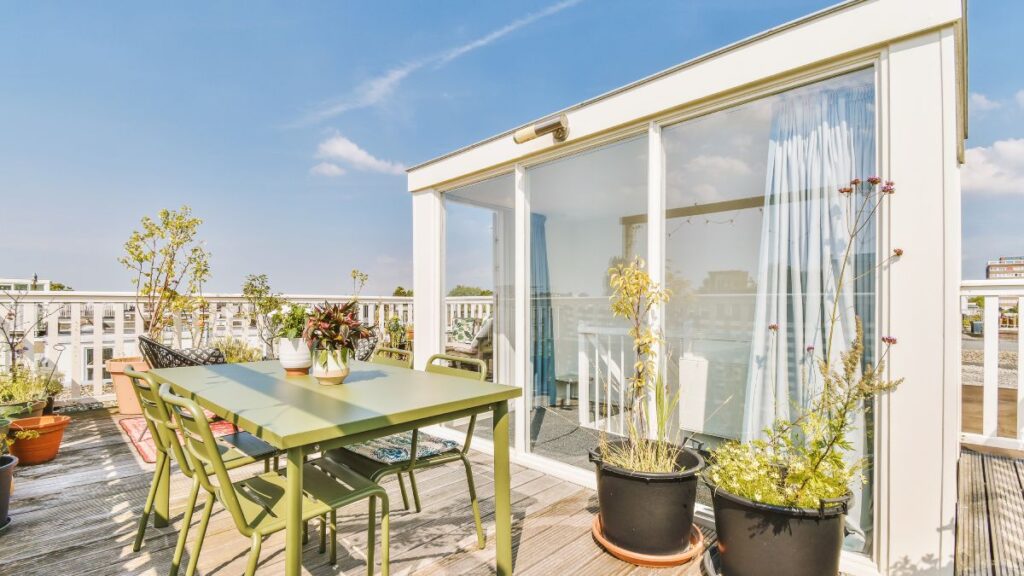
The Provincial Court of Barcelona has ruled in favor of a community of neighbors and has confirmed that an owner must remove two enclosures installed on his terrace so that the humidity that affected the floor below can be repaired. Although both he and his tenants argued that the works could be carried out without dismantling the structures, the court finally considered that the best way to guarantee correct waterproofing was to remove the enclosures to make repairs.
The leaks had appeared in the homes that were located under two community terraces for private use and, one of them, according to the ruling of February 23, 2026, had two enclosures that were used as an office and laundry room. The community had approved some works to replace the asphalt fabric on the terrace, but to carry them out they considered it necessary to remove both structures.
The Court of First Instance and Instruction number 1 of Gavà ruled in favor of the community and forced the owner to remove the enclosures, and that both he and his tenants let the workers enter to make the repairs.
As they were not satisfied with this decision, they appealed the ruling asking that they be allowed to keep the enclosures, understanding that the works could be done without having to dismantle them, as a judicially appointed expert had indicated.
The community had approved the removal of the enclosures to repair the humidity
As it is a building located in Catalonia, article 553-44 of its Civil Code establishes that when a terrace is communal, even if its use is reserved for a home, the community has the obligation to preserve the common elements of the building in adequate conditions, including its waterproofing.
In this case, the replacement of the asphalt fabric had been unanimously approved and it had been agreed that the owner would remove the two enclosures, assuming the additional costs caused by these structures.
The Court highlighted that, according to articles 553-29 and 553-30 of the Civil Code of Catalonia, agreements validly adopted by a community are executive and obligatory for all owners, even for those who do not agree with them.
Therefore, since the owner had not challenged the agreement, he was obliged to remove the enclosures to allow for repairs, without being able to subsequently question the need to do so.
The owner must remove the enclosures even if a judicial expert considered that they could be maintained
On the other hand, the owner and his tenants also discussed whether it was really necessary to dismantle the structures to waterproof the terrace. According to them, repairs could be carried out without removing them, as a judicially appointed architect had concluded.
However, the Provincial Court rejected this argument because, according to article 348 of the Civil Procedure Law, judges can evaluate expert reports in accordance with the rules of sound criticism, without the opinion of a judicially appointed expert necessarily having greater value than that presented by one of the parties.
In this case, the Court considered the report of the technical architect hired by the community to be more convincing, which defended that the enclosures should be removed to guarantee the waterproofing of the entire surface. Furthermore, he pointed out that the judicial expert had not sufficiently explained how the structures were installed and that one of the enclosures housed a sink located in an area especially exposed to leaks.
The residents of a building have been living among scaffolding for six years that prevent them from opening the windows and leave their homes without natural light.
He buys a home without a parking space and sues his community of neighbors for prohibiting him from parking in the parking circulation areas: Justice agrees with the neighbors
Therefore, the Court understood that removing the enclosures was the solution that offered the greatest guarantees to avoid new humidity. However, against this ruling (SAP B 1753/2026) an appeal could be filed.