


The Provincial Court of Pontevedra has recognized the right of a 57-year-old woman to collect a lifetime compensatory pension of 600 euros per month, after demonstrating that
As explained in the ruling SAP PO 454/2026, the conflict arose from the dissolution of the marriage bond in which the woman claimed that her dedication to the house and family had prevented her from developing professionally. Although the Court of First Instance agreed, the ex-husband appealed the decision trying to annul the compensatory pension (or reduce it to six months) alleging that he only received a pension from Switzerland and that they had domestic help. For her part, the plaintiff appealed asking that her pension not have an expiration date.
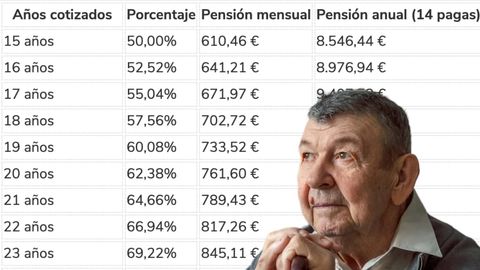
The retirement pension that you will receive with a salary of 1,400 euros depending on the years of contributions

A 37-year-old assistant achieves a lifetime pension of 2,773.76 euros by achieving permanent disability due to myalgic encephalomyelitis and chronic fatigue
The High Court rejected that the compensatory pension was temporary. They explain that, for this to be temporary, a “prospective judgment must be made in order to explore or predict the possibilities that, in a specific period of time, the existing imbalance will disappear.” Far from being based on optimistic assumptions, the magistrates confirm that one must act with prudence and avoid what jurisprudence has called “mere futurism or divination.”
In that ruling, after more than 30 years without being able to work (she stopped working as a salaried employee shortly before getting married) and without having specific training, the Court determined that it cannot be assumed that in nine years she will overcome her precarious economic situation. In fact, the ruling emphatically emphasizes that “at 57 years of age he only appears to be likely to have low-paying jobs in the hospitality field.” For this reason, the temporary limit is eliminated, guaranteeing the pension for life to protect the most vulnerable party from the breakup.
A dedication to the home marked by the imposition and care of grandchildren
The ruling also addresses the compensation of article 1438 of the Civil Code, designed to compensate for work for the house in marriages with a regime of separation of property. The ex-husband tried to avoid this payment (initially set at 192,000 euros) by claiming that they did not have common children and reiterating the existence of assistants. However, the Court dismantles this argument, stating that the continued hiring of domestic help was not proven and revealing a marital dynamic of profound imbalance in decision-making.
The magistrates report the existence of “a situation of prevalence of the appellant’s will over that of his wife in decision-making that has its expression (…) in the imposition that she had to renounce maintaining a work activity outside the home.”
The court document even cites previous proceedings where the man acknowledged that she did not work because “being with him she does not need anything.” Furthermore, although they did not have children of their own, it was documented that the woman cared exclusively for about ten years for two grandchildren who belonged solely to her husband.
An adjustment of compensation to avoid “duplications”
Despite agreeing with the woman regarding the right to receive the money, the court made an essential qualification regarding the final amount of compensation, reducing it from 192,000 to 80,000 euros.
The Court justifies this reduction based on three key factors: the dedication for many years was only for the couple as there were no children in common, the fact that the husband alone borne all the financial burdens of the marriage and, especially, to avoid compensation for the same events twice.
By now granting him a compensatory pension for life based precisely on his exclusive dedication to the family, the Court warns of the risk of “doubling the compensation criterion” if the high initial sum was maintained in full.