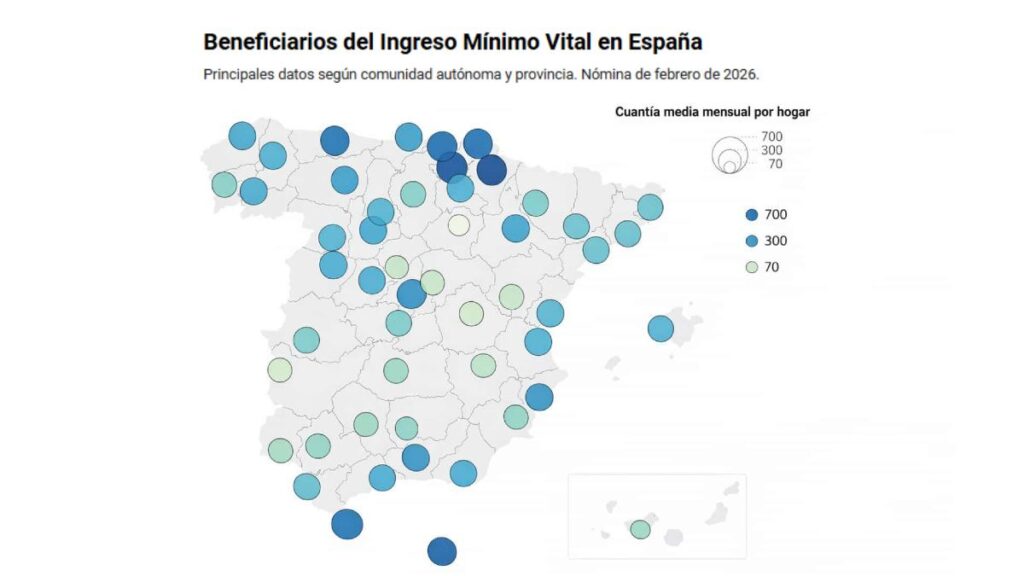
He Minimum Vital Income (IMV) This February it reached 810,928 homes in which 2,477,021 people live, according to statistics published by the National Institute of Social Security (INSS). The average amount of the benefit was 545.1 euros per month per household and the gross payroll for the month amounted to 472.2 million euros.
Compared to February 2025, there are 122,921 more active benefits, which represents an increase of close to 18% in protected households. The increase is similar in the number of beneficiaries, which has grown by 18.1%, with 379,731 more people than a year ago.
Protection focuses primarily on children. 40.9% of the beneficiaries are minors, reaching the figure of 1,013,102 girls, boys and adolescents. Currently, more than two-thirds of covered families live with minors, representing 559,083 households. These coexistence units include 136,680 single-parent households. The Childhood Aid Complement (CAPI) has reached 560,800 cohabitation units this month, with an average aid of 66.1 euros per minor.
The profile of the help maintains a marked feminine character. 68% of the owners are women, totaling 551,113 people, while among the beneficiaries 53.4% are also women, with 1,323,208. Since its launch in 2020, the program has provided coverage to 3,482,781 people, of which more than 1.5 million are minors.
The Minister of Inclusion, Social Security and Migration, Elma Saiz, has highlighted that “the rate of risk of poverty and social exclusion continues to decline in Spain, to the lowest figure in the historical series, and also among women. The Minimum Living Income, where two out of every three beneficiaries are women, is a decisive tool to reduce this vulnerability and advance equality. Since its launch, the IMV has protected 1.9 million women.”
Where are there more beneficiaries of the IMV and which provinces receive greater amounts
As indicated, the Minimum Living Income reaches 2,477,021 beneficiaries in 810,928 homes, so its average ratio is 3.05 people per benefit. The largest number of beneficiaries is concentrated in Andalusia with 788,181 people, and by province Madrid stands out with 203,306 people. At the opposite extreme, the lowest figure corresponds to Soria with 3,176 beneficiaries. The ratio of beneficiaries per benefit is especially high in Melilla with 4.07 and Ceuta with 4.05, while it is below the average in Bizkaia with 2.37 and Asturias with 2.38.
Average age of beneficiaries and applications managed
The average age of IMV beneficiaries is 28.5 years, which represents an important support for young people in situations of exclusion. If the people receiving aid are excluded, the average age drops to 20.1 years.
The improvements incorporated into the IMV have facilitated access for young people in vulnerable situations. Currently, people over 18 years of age or emancipated minors with dependent children can apply for help, and the period of independent living required for those under 30 years of age has also been reduced, which has gone from three to two years.
53.4% of IMV holders are women
The profile of the help maintains a marked feminine character. 53.4% of Minimum Living Income holders are women, which confirms the weight that this benefit has in the economic protection of households headed by women. This percentage reflects the role of the IMV as a key tool to reduce female economic vulnerability, especially in units living with minors or in single-parent households, where in the vast majority of cases the responsible adult is a woman.
The places with the greatest female presence among holders of the Minimum Living Income are Madrid, which tops the list in absolute terms with 44,594 women, followed by Barcelona (33,655), Seville (29,824), Valencia (23,361) and Cádiz (20,317). However, if we analyze the percentage proportion within each territory, the highest concentrations of women are found in Melilla, where they represent 74.12% of the total, followed by Ceuta (70.64%), Cádiz (70.16%), Granada (69.96%) and Seville (69.76%), highlighting a clear female majority in the autonomous cities and Andalusian provinces.
The Minimum Living Income is a Social Security benefit that guarantees a minimum level of income to households in situations of economic vulnerability. It is configured as a subjective right adapted to the reality of each coexistence unit and is compatible with income from work, incorporating incentives to promote labor insertion.
To apply for the IMV it is necessary to have resided in Spain legally and continuously for at least one year, prove the cohabitation unit through the corresponding records and demonstrate a situation of economic vulnerability due to lack of income or sufficient assets.
The majority of beneficiary households meet the requirements to access this benefit, including proving legal and effective residence in Spain for at least the previous year and being in a situation of economic vulnerability. The Minimum Living Income is configured as a subjective right that adapts to the situation of each coexistence unit, guaranteeing a minimum level of income.