The average price of fuel in Spain registers a new rise after the escalation of the conflict in the Middle East, which has caused an increase in energy costs due to the closure of the Strait of Hormuz. For its part, the average price of a liter of diesel has risen to 1,441 euros, so diesel it is paid 1.27% more expensive than last weekwhile gasoline has reached 1.486 euros per liter, with an increase of 1.06% compared to the last week.
The data on the average price of fuel, collected by the Petroleum Bulletin of the European Union (EU), shows the consolidation of the turn in the price trend that is taking place in 2026 with the seventh week of increases, after the previous downward path that led the price of gasoline to reach minimums that had not been seen since before the war in Ukraine began. The following table shows this change in trend that has occurred since mid-January of this year:
This new upward trend and its previous downward trend respond to the moderation of the latest CPI datawhich closed the year at 2.3%, mainly due to the drop in electricity. It remains to be seen what will happen in the coming weeks after the attacks by the United States and Israel on Iran, which have already caused the first lines at gas stations.
Filling a tank of gasoline costs 81.73 euros
The average price of gasoline (super 95) stood at 1.486 euros per liter, which represents an increase of 1.06% compared to last week, when it stood at 1.471 euros. With this new increase, filling an average 55-liter tank of gasoline costs approximately 81.73 euros, which is 4 euros less than a year ago, when it cost 85.74 euros.
This is the average price and it may vary depending on the province or service station where the refueling is carried out. In the electronic headquarters of the Ministry of Industry and Tourism, in the section “fuel prices at Spanish gas stations”, you can check every day at what price fuel is sold at each gas station in Spain.
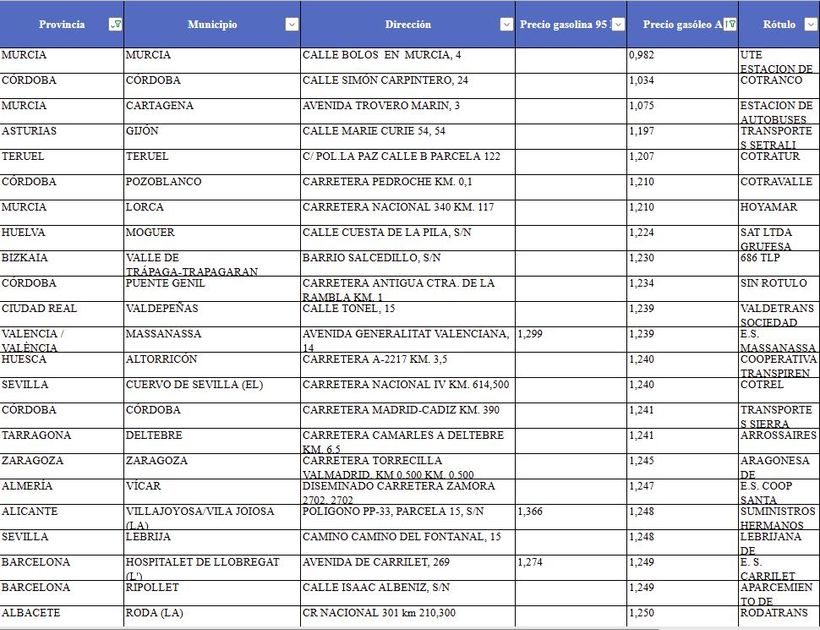
The cheapest station to refuel with gasoline in Spain is ES Carrilet, with a price of 1,274 euros, which is located at Avenida de Carrilet, 269, in L’Hospitalet de Llobregat (Barcelona). In the next place is the Autacor gas station, with a price of 1,276, which is located on Avenida del Zafiro, 2, in Córdoba.
Filling the diesel tank costs 79.25 euros
The average price of diesel (diesel A) has reached 1.441 euros per liter this week, which represents an increase of 1.27% compared to the 1.423 euros registered the previous week. With these prices, filling an average 55-liter tank of diesel costs approximately 79.25 euros, which represents a saving of 2.69 euros compared to the same dates last year, when the cost reached 81.95 euros.
The cheapest gas station to refuel with diesel this week is the UTE Estación de Murcia (0.982 euros), located on Bolos street number 4, in Murcia capital. The next option to refuel that has a lower cost is the Cotranco, with a price of 1,034, which is located on Simón Carpintero street number 24, in the province of Córdoba.
Difference between fuels from Spain and Europe
Although prices have risen in recent weeks, Spain continues to have fuel at lower prices compared to the European average. At current levels, a liter of gasoline costs on average 1,664 euros in the European Union and 1,722 euros in the eurozone, while here it is below those figures. In the case of diesel, the price in Spain is also still below the European average, established at 1,629 euros per liter in the EU as a whole, and the 1,662 euros reflected in the euro zone.
The differences are mainly motivated because in Spain taxes on fuel and logistics costs are lower compared to other EU countries.
How the conflict in the Middle East affects the price of gasoline and diesel
The escalation of the conflict in the Middle East is generating tension in energy markets, especially after the closure of the Strait of Hormuz, one of the key routes for global oil transportation. This situation causes an increase in the price of crude oil in international markets and ends up being passed on to the cost of fuel in importing countries such as Spain.
When oil becomes more expensive, gas stations progressively adjust their prices, which translates into greater expenses for drivers. For this reason, conflicts in energy-producing areas usually cause increases in gasoline and diesel prices, directly affecting consumers’ pockets.