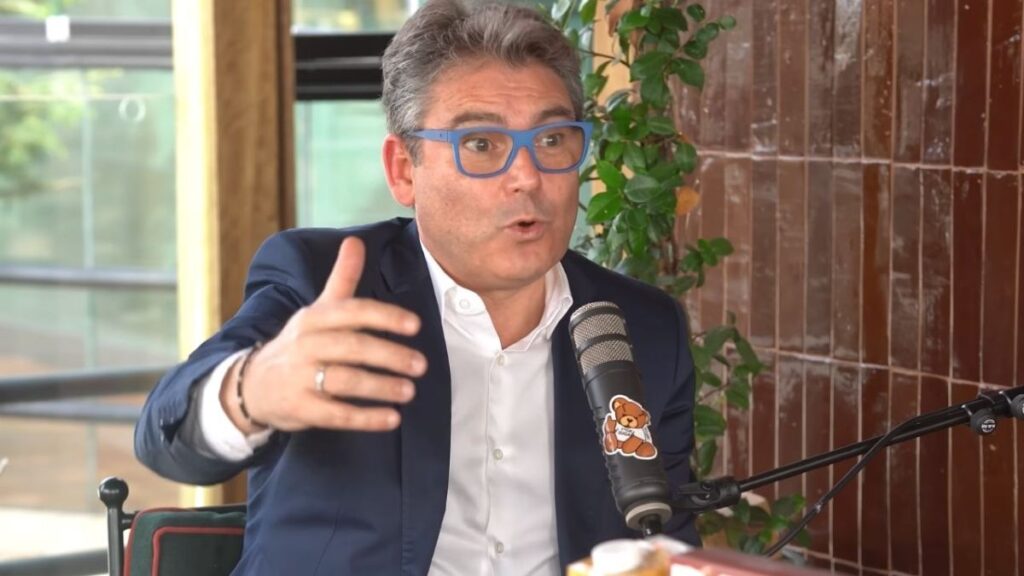
The conflict in the Middle East has unleashed various consequences not only in the United States, but has also reached our borders. According to economist Marc Vidal, he warned that the impact of the conflict “is already noticeable” with immediate increases in the markets, so he did not hesitate to send a message to citizens: “Any war in the Gulf is going to reach our gas stations, and from there, to the shopping basket,” he stated during his section. Emergency exit, in ‘Herrera Cope’.
And, after the massive attacks by the United States against Iran, Brent crude rose by around 10%, going from around 73 to 80 dollars in a few hours in over-the-counter operations, a movement that is not traded on the open market, but that marks a global trend.
Vidal recalls that various analysts are already pointing to a possible scenario of “100 dollars a barrel” if the tension continues, which would translate into “more expensive gasoline and distribution chains” and a “rebound in inflation” that Spain cannot afford. This rise in oil not only makes refueling more expensive, it also increases the costs of transporting food and goods, putting pressure on the increase in the shopping basket and complicating the work of the European Central Bank to control prices.
China, the most affected
The geopolitical map also works against us. One of the most delicate points is the Strait of Hormuz, a corridor of just 39 kilometers through which approximately a fifth of the world’s oil circulates. The tension has led some shipping companies to suspend routes as a precaution, making insurance and, potentially, freight costs more expensive.
Vidal, however, doubts that a prolonged blockade will be reached. As he details, the biggest loser would be China, “the largest buyer of Iranian oil and Qatari gas.” For the analyst, a lasting closure “Would be equivalent to Iran shooting itself in the foot and leaving its great ally and client without supplies,” a scenario that he considers “unlikely at the moment,” although not impossible if the escalation gets out of control.
“Oil and gas are our Achilles heel”
In parallel, Spain arrives at this crisis somewhat better positioned than in 2022, but still with significant vulnerabilities. Since the Russian invasion of Ukraine, Europe has reduced dependence on Russian gas, from around 45% to around 12% of the supply, and Spain has been a key player thanks to its six regasification plants and its ability to receive liquefied natural gas from multiple sources.
Vidal also highlights a historical milestone: in 2024, “we will generate 57% of electricity with renewables”, the best figure to date, the result of the push for wind and photovoltaics. But, despite these advances, diagnosis remains critical. “Oil and gas continue to be our Achilles heel,” remembering that Spain does not produce crude oil and depends, to a large extent, on fossil fuels and liquefied gas to drive its economy.
That dependency converts any shock in the Middle East in a direct bill for homes and businesses: first in the form of more expensive diesel and gasoline, then as food and basic products with rising prices.