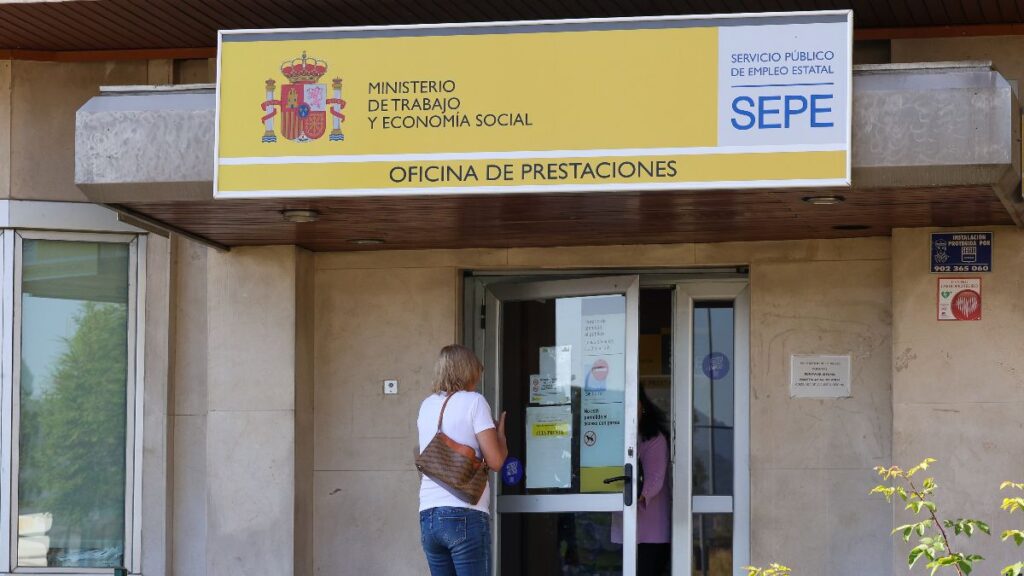


The Superior Court of Justice of Catalonia has recognized the right of a worker to maintain her unemployment benefit, rejecting the accusation of the State Public Employment Service (SEPE) that she fraudulently forced her own dismissal through unjustified absences on her afternoon shift. The court concludes that there is insufficient evidence of a premeditated “fraud of law” to collect and capitalize unemployment to open one’s own business, also recalling that the subjective assessments of the Labor Inspection regarding the hidden intentions of an employee lack the presumption of certainty before the courts.
The employee had been working for the same company since December 1, 2014, with a full-time indefinite contract, although she had a reduction in hours recognized for caring for a minor. As of November 5, 2021, he stopped recording his work in the afternoon shift. As a consequence of this, on the 26th of that same month, the company handed her a disciplinary dismissal letter alleging a repeated decrease in her performance, a dismissal that the worker recognized as appropriate and did not challenge judicially.

What is the point of signing up as a job seeker even if you have a job and why managers recommend it
Spain has almost 60% of unemployed people over 45 years of age and six out of every ten senior unemployed are already women
After the dismissal, the woman requested and obtained contributory unemployment benefits (what is known as unemployment). Subsequently, in January 2022, he requested the capitalization of the benefit (single payment) to start her own business as a self-employed person, being granted an amount of 19,060.47 euros. With this capital, he acquired a financial and accounting services business and rented a commercial space.
However, in February 2023, the Labor and Social Security Inspection (ITSS) issued an infraction report concluding that the worker had committed a “fraud of law.” This body considered that he had forced his dismissal by being absent from work in order to request and collect unemployment benefits, equating it to voluntary leave. Based on this report, the SEPE revoked the unemployment benefit for a very serious violation and demanded the return of 9,814.50 euros.
The conflict ends in court
Not satisfied with the SEPE resolution, the woman filed a claim through the courts, with her claim being upheld by the Social Court No. 2 of Lleida, which restored her right to the benefit. The State Public Employment Service appealed this ruling and presented an appeal before the Superior Court of Justice of Catalonia.
In this, the SEPE asked to modify the proven facts so that it could be stated that the worker stopped appearing at work during her afternoon shift from November 5, 2021 until the dismissal. The court rejected this modification, understanding that this information was already included in the lower court ruling, although with different wording.
On the other hand, the public body argued that the worker was not in a true legal situation of unemployment, since the loss of her job was not involuntary. He argued that, by being unjustified absent, he forced the dismissal by committing a very serious infraction to obtain undue benefits. Furthermore, he appealed to the “presumption of certainty” of the Labor Inspection minutes, stating that the inspector’s assessments demonstrated fraudulent conduct.
The TSJ of Catalonia maintains unemployment collection
The Superior Court of Justice of Catalonia clarified, citing repeated jurisprudence of the Supreme Court, that the presumption of certainty of the ITSS minutes only applies to the “objective facts” that the inspector perceives directly, but not to subjective assessments, value judgments or legal qualifications. The inspector’s conclusion that the worker deliberately “forced her dismissal” is a simple legal assessment that lacks the presumption of certainty and does not prevent the judge from evaluating the rest of the evidence.
The court also recalled that fraud of law is not presumed, but must be rigorously proven by the person who invokes it. Although indirect evidence (presumptions) is admitted, there must be a direct and logical link between the proven facts and the alleged fraudulent intent.
Applying all this to the case, the TSJ concluded that there was not sufficient evidence to deduce fraudulent intention on the part of the worker. First, his absences were partial (he was only absent in the afternoons, but continued working in the mornings), which does not amount to an unequivocal abandonment of the job. Furthermore, there is no evidence that the company had warned her, required her to stop this conduct, or previously sanctioned her before notifying her of the dismissal.
In this sense, the court noted that it is logical that the company claimed a “decrease in performance” given that the worker worked fewer hours, but that does not prove that she was pre-ordering a dismissal to collect unemployment benefits.
Furthermore, the worker effectively used the money from the benefit to open a real and autonomous business, investing in furniture, a client portfolio and a commercial premises in a phased manner, which fully complies with the teleological purpose of the rule (promoting self-employment).
For all these reasons, the TSJ of Catalonia dismissed the SEPE’s appeal and confirmed the woman’s right to receive and maintain her unemployment benefit without having to return any amount. The sentence (STSJ CAT 3238/2026) was not final and an appeal could be filed against it before the Supreme Court.