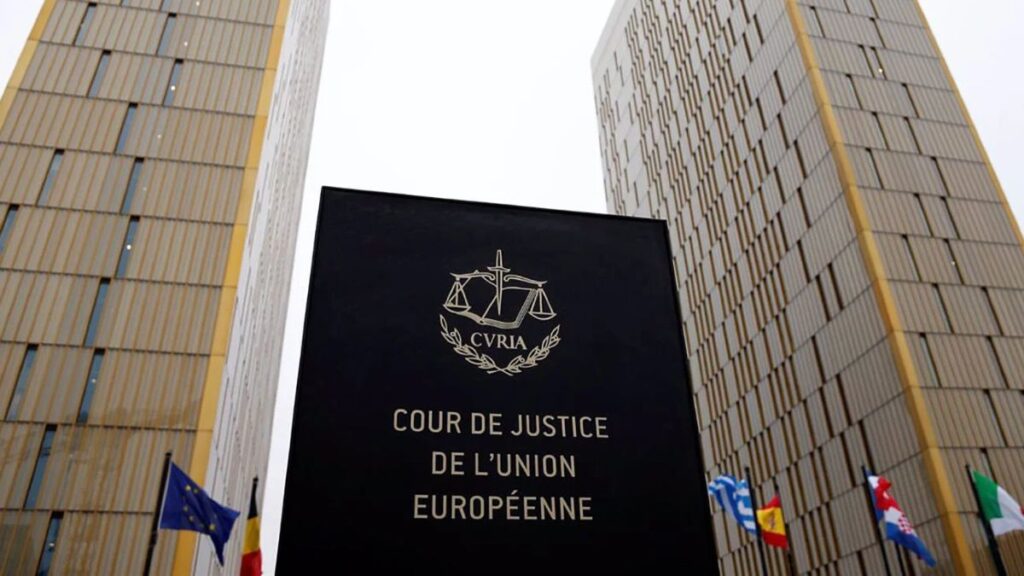


The Court of Justice of the European Union (CJEU) has ruled that Member States must take into account when calculating retirement pensions difficult work carried out in other EU countries when these give rise to specific benefits, such as access to early retirement. The decision refers to the interpretation of Regulation 883/2004, which coordinates Social Security systems within the European Union and requires the totalization of certain periods of activity carried out in different Member States.
The ruling, which Europa Press has accessed, analyzes the case of a Slovak citizen who worked as a miner in an underground mine located in the territory of the current Czech Republic between 1976 and 1995. When applying for an early retirement pension in Slovakia, the authorities did not count the period worked in Czech territory between 1993 and 1995 to reach the required minimum of 15 years in underground mines.
Social Security officials agree: “If your spouse does not work or receive a pension, you may be denied voluntary early retirement”

Social Security establishes that starting in 2027 the age of involuntary early retirement will be 63 years with a penalty of up to 30%, unless you are 38 years and 6 months of contributions.
Slovak regulations provided for specific conditions for miners, allowing access to the pension from the age of 55 as long as 25 years of work were proven, of which at least 15 must have been developed underground in a deep mine.
You cannot lose benefits for having worked in another EU country
The CJEU interprets Regulation 883/2004 and, in particular, the rule that requires totaling the periods of activity completed in different Member States for the calculation of the pension. This provision seeks to prevent workers from losing specific advantages, such as access to early retirement, for having exercised their right to free movement and transferring their activity to another EU country.
On this basis, the court determines that when a Member State grants a specific advantage for a specific activity, such as early retirement for arduous work, it must also take into account the equivalent periods carried out in another Community country. In this sense, it understands that not recognizing these periods would mean harming workers who have exercised their right to free movement within the European Union.
Furthermore, the CJEU emphasizes that this rule must be applied whenever there are specific pension settlement rules for certain occupations or activities in the State that grants the benefit, even if there is no special regime separate from the general Social Security system.
In this case, Slovakia did have specific rules for miners of underground structures during the period analyzed, so the periods worked in the Czech Republic in that activity had to be taken into account to calculate the pension in Slovakia, without prejudice to the Supreme Court’s verifications.
Another important point that the CJEU makes clear is that the periods prior to accession to the European Union also count. The court recalls that Regulation 883/2004 obliges to consider all periods of insurance or activity covered before its entry into force and before the accession of the affected States to the EU, so that the fact that the contributions are previous does not prevent its application to the Slovak-Czech case.
This ruling does not directly resolve the national dispute, since it is up to the Slovak court to do so by applying the interpretation established by the CJEU. The criterion set by the European court is also binding for other judicial bodies, including the Spanish ones, that face similar cases.