
The average price of electricity for this Monday, May 18, 2026, rises for the third consecutive day, reaching 60.72 euros per megawatt hour (euros/MWh). Compared to the rate set on Sunday, May 17, electricity increases its price by 32.51%, that is, it is paid at 14.90 euros more, since That day the price was 45.82 euros/MWh according to data published by the Iberian Energy Market Operator (OMIE).
What time is electricity cheaper this Monday?
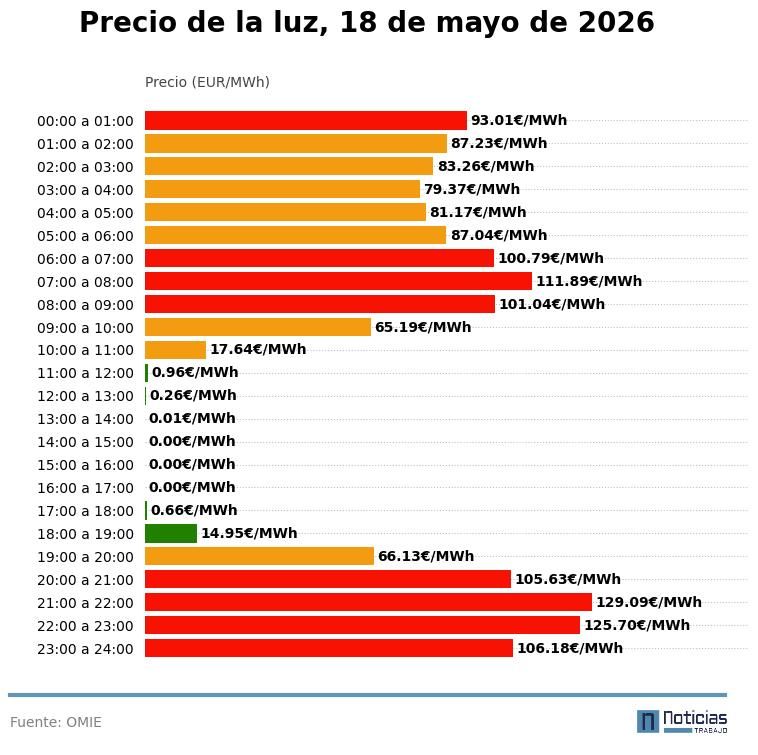
The cheapest price to consume electricity will be concentrated in the section from 2:00 p.m. to 5:00 p.m., with a price of 0.00 euros/MWh. After this section, the next cheapest hour, in which electricity will cost 0.01 euros, will be from 1:00 p.m. to 2:00 p.m. Although the price is close to 0 euros or is negative, it does not mean that the electricity is free.

The price of electricity today, Monday, May 18, in the PVPC soars with 2 sections above 200 euros

The price of electricity on Sunday, May 17 in the PVPC rises with 12 sections above 100 euros
When is electricity most expensive this Monday?
If we talk about the highest price of the day, this will be from 9:00 p.m. to 10:00 p.m. with a price of 129.09 euros/MWh. Another time when it is not recommended to turn on appliances is between 10:00 p.m. and 11:00 p.m., when it will have a price of 125.70 euros. Here it is important to avoid excessive use of electricity at home.
Hourly electricity price, Monday, May 18
To save on your bill, it is important to know the price of electricity hour by hour during the 24 time slots of the day. It must be taken into account that the highest cost of electricity will occur at night and in the early morning, as well as that the best time to save is during midday, as can be seen in the following list and graph prepared with official OMIE data.
| Hour | Price |
|---|---|
| 00:00 to 01:00 | 93.01 euros/MWh |
| 01:00 to 02:00 | 87.23 euros/MWh |
| 02:00 to 03:00 | 83.26 euros/MWh |
| 03:00 to 04:00 | 79.37 euros/MWh |
| 04:00 to 05:00 | 81.17 euros/MWh |
| 05:00 to 06:00 | 87.04 euros/MWh |
| 06:00 to 07:00 | 100.79 euros/MWh |
| 07:00 to 08:00 | 111.89 euros/MWh |
| 08:00 to 09:00 | 101.04 euros/MWh |
| 09:00 to 10:00 | 65.19 euros/MWh |
| 10:00 to 11:00 | 17.64 euros/MWh |
| 11:00 to 12:00 | 0.96 euros/MWh |
| 12:00 to 13:00 | 0.26 euros/MWh |
| 1:00 p.m. to 2:00 p.m. | 0.01 euros/MWh |
| 2:00 p.m. to 3:00 p.m. | 0.00 euros/MWh |
| 15:00 to 16:00 | 0.00 euros/MWh |
| 16:00 to 17:00 | 0.00 euros/MWh |
| 17:00 to 18:00 | 0.66 euros/MWh |
| 18:00 to 19:00 | 14.95 euros/MWh |
| 19:00 to 20:00 | 66.13 euros/MWh |
| 20:00 to 21:00 | 105.63 euros/MWh |
| 9:00 p.m. to 10:00 p.m. | 129.09 euros/MWh |
| 22:00 to 23:00 | 125.70 euros/MWh |
| 23:00 to 24:00 | 106.18 euros/MWh |
Evolution of the price of electricity during the first 18 days of May
During the first 18 days of May, the average price of electricity has been 54.19 euros, so it can be said that we now pay 34.20 euros more on average, since exactly a year ago the average price was 20.00 euros.
Compared to a year ago, today electricity is 798.18% more expensive (53.96 euros more), since on May 18, 2025 The price of the ‘pool’ was set at 6.76 euros.
| Date | 2025 | 2026 | Difference in euros/MWh |
|---|---|---|---|
| May 1 | 13.29 | 57.87 | 44.58 |
| May 2 | 10.94 | 43.64 | 32.70 |
| May 3 | 16,17 | 48.13 | 31.96 |
| May 4 | 11 | 69.71 | 58.71 |
| May 5 | 10.89 | 64.34 | 53.45 |
| May 6 | 10.24 | 78.02 | 67.78 |
| May 7 | 19.01 | 86.90 | 67.89 |
| May 8 | 16.76 | 64.69 | 47.92 |
| May 9 | 18.24 | 33.80 | 15.56 |
| May 10 | 9.08 | 20.84 | 11.76 |
| May 11 | 96.94 | 50.66 | -46.28 |
| May 12 | 21.69 | 69.23 | 47.54 |
| May 13 | 41.42 | 48.26 | 6.84 |
| May 14 | 30.55 | 53.34 | -22.79 |
| May 15 | 11.62 | 37.73 | 26.11 |
| May 16 | 4.68 | 41.78 | 37.10 |
| May 17 | 10.64 | 45.82 | 35.18 |
| May 18 | 6.76 | 60.72 | 53.96 |
Brussels asks Spain to end the regulated electricity rate
The European Union is reforming the energy market and wants Spain to prepare a plan to progressively eliminate the regulated price of electricity, according to a report from the European Commission. The European body believes that this system should be only for specific cases.
The regulated rate is the one that directly affects thousands of people and homes throughout the national territory. Well now, the Commission insists that regulated tariffs should only be maintained to protect vulnerable consumers or in exceptional situations.