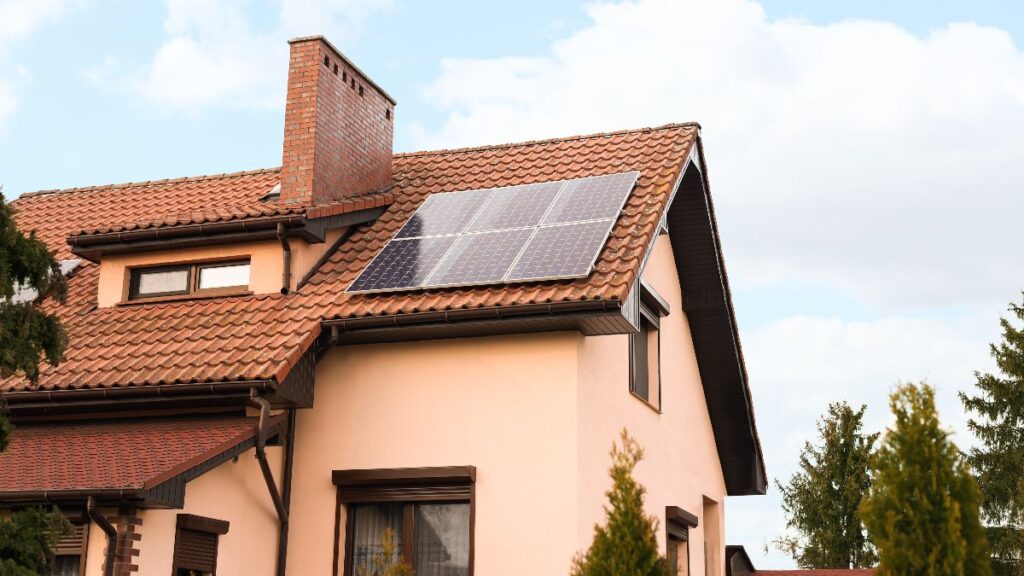
More and more people are turning to solar panels to take advantage of the sun’s energy to produce energy and thus save on the electricity bill. However, although these systems allow electricity savings, they cannot always be placed in any building, especially when it comes to buildings protected for their historical value. It is something that some owners in the United Kingdom did not take into account who installed 28 solar panels on the roof of an old barn and now they will have to remove them because the City Council considers that they damage the appearance of the building.
According to the information known about the case and collected by Monmouthshire Beacon, The property is a former farmhouse formerly used as holiday accommodation and features several historic buildings including a 15th-century farmhouse, a 17th-century barn and an 18th-century former stable.
The owners had placed the solar panels on the south-facing part of the barn roof, but had not requested the necessary authorization to do so. For this reason, the City Council has ordered them to remove the 28 solar panels, along with the cables and the rest of the installation, within a period of three months.
They will have to remove the solar panels because they affect the appearance of the old barn
It was the municipal authorities who detected that solar panels had been installed on the property, specifically in the barn that was classified as historical heritage and that it had also been done without having the corresponding permits.
As explained by those responsible for urban planning in the town, although the panels were not very visible from a distance, they could be seen from different points in the area.
In fact, they could be distinguished from a nearby public path and from a nearby bridge, in addition to being visible within the farm’s own complex of buildings.
The City Council considered that the installation damaged the appearance of the barn and also the surroundings of the other historical buildings. Among them are an old cider mill from the 19th century and other buildings that are part of a property surrounded by about 80 acres of land, equivalent to about 32 hectares.
Although the authorities recognized that solar panels could have environmental benefits, they considered that these were not sufficient to allow them to remain on the roof.
In particular, they noted that the “small public benefit to the environment” provided by the panels did not outweigh the damage they caused to the character and appearance of the listed building.
The owners have three months to remove the entire installation
One of the main issues that the authorities took into account is that the barn is part of a group of old buildings that are protected for their historical value.
For this reason, the City Council considered that the owners could not modify the appearance of the roof without having the necessary authorization, even if it was an installation intended to harness solar energy.
Finally, municipal officials ordered the removal of the 28 solar panels and all elements related to their operation, including the cables and the inverter used to transform the energy.
To do so, the owners had a period of three months.
A couple sets fire to their own house to collect the insurance and pay their debts: Justice says it was provoked and they have to pay the costs of the investigation

A city council closes access to the garden of an 81-year-old retiree and the Justice grants her the right of way because she had been using it for 59 years
The City Council explained that they had no evidence that those affected had filed any appeal against the removal order, and indicated that they did not plan to inspect the property again until said period had expired, when they would go to verify that they had been removed.