


It is not the first time that, thanks to some works, a great historical discovery has been found. And this is precisely what has happened in the Czech Republic, where this year a Celtic settlement from the 2nd century BC was discovered. C. that hides all kinds of treasures, from hundreds of gold and silver coins to precious amber and luxury ceramics. A production facility that probably manufactured these ceramic pieces more than 2,000 years ago has even been found there.
The discovery occurred when archaeologists were carrying out studies prior to the construction of a highway, turning a routine procedure into “one of the largest collections of artifacts ever found in Bohemia,” in the words of the East Bohemian Museum in Hradec Kralove, as reported by the media.Popular Mechanics‘.
You may be interested

A woman achieves a permanent disability pension of 1,213.59 euros for post-covid syndrome after Social Security denied it

A woman appeals her eviction alleging that her landlord did not offer her a social rent: the court says that this does not prevent her from recovering her house and orders the eviction
A curiosity about this discovery is that the coins and valuable materials found were not simply scattered on the ground, but the excavation team discovered different ancient buildings that made up a complete settlement from the La Tène period (refers to the second phase of the Iron Age in Europe, which lasted approximately from 450 BC to 50 BC), probably from a Celtic community.

A unique site due to its “size and characteristics”
As stated in the aforementioned media, “the entire site is unique in Bohemia due to its size and characteristics.” “The settlement was a supra-regional commercial and productive center connected to long-distance trade routes, as demonstrated by the finds of amber, gold and silver coins, and indications of the production of luxury ceramics,” they detail about it.
As anticipated, through the excavations Celtic gold and silver coins, coin dies, fragments of ceramic vessels, foundations of homes, production facilities and at least one religious sanctuary have been found. So much so, that they have removed up to 22,000 bags with artifacts from the area, becoming one of the largest collections ever discovered in Bohemia, one of the three historical regions that make up the Czech Republic, which includes both everyday objects and an “extraordinarily rich collection of jewelry.”
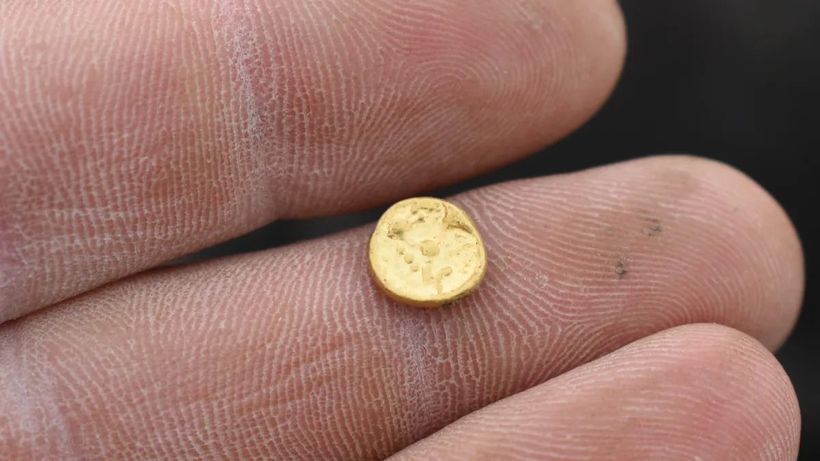
Professor at the University of Hradec Kralove and co-director of the excavation, Tomas Mangel, delved into the items found, stating ‘Live Science’ that there could be several hundred coins and that among the jewelry are “bronze and iron brooches, fragments of bracelets, metal components of belts, glass beads and bracelets.”
Despite this, they have not been able to find any inscription that allows them to identify the Celtic group to which they belong and which, therefore, settled in the area. One possibility is the Boios, an Iron Age tribe that lived mainly in what is now central Europe (particularly in Bohemia, where the find is located).
The treasures will be displayed in an exhibition at the end of 2025
Another peculiarity of this discovery, according to archaeologists, is the unusually high density of finds in the upper layer of soil. “The informative potential of the original surface of the settlement in the horizons of the superficial and subsurface soil far exceeds what is usual,” they explained, being pleasantly surprised that the site had not been looted.
On the other hand, the lack of fortifications at the site shows that the settlement was probably a key trade route and was active in the 2nd century BC. C., before the appearance of larger fortified settlements with central functions.
The volume of fine pottery, coin production and amber only reinforce this theory as well as the belief that Celtic settlements played a key role along the Amber Route trade route, an ancient trade route that connected the North Sea and Baltic Sea with Italy, Greece and the Mediterranean Sea, as well as the Black Sea and Egypt.
Given the magnitude of the discovery, the East Bohemian Museum plans to organize an exhibition at the end of 2025 to honor and showcase everything related to gold, silver and amber.