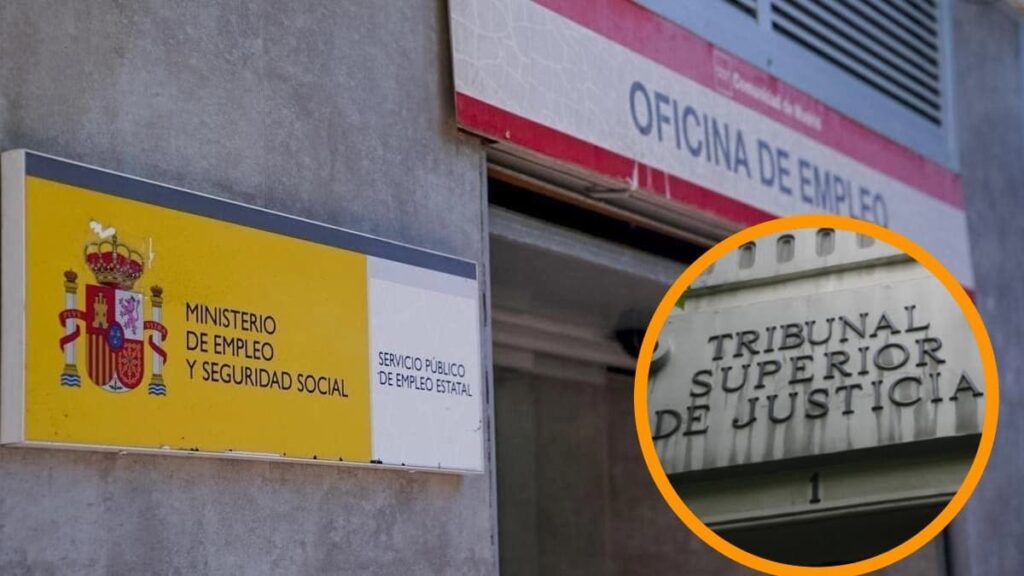
The Superior Court of Justice of Asturias has issued a sentence that puts limits to the State Public Employment Service (SEPE) when charging debts to the unemployed. The court has proved the reason to an unemployed to which the SEPE was discounting an old debt of 10,514.45 euros directly from its new subsidy for over 52 years. The Chamber establishes that, although the compensation is legal, this “must respect the limit of non -contributory pensions”, confirming that there is a minimum amount of subsistence that cannot be touched.
According to the sentence, the plaintiff had unduly received more than 10,000 euros in benefits between 2017 and 2019. After the voluntary route is exhausted to return the money, the SEPE communicated the debt to the General Treasury of Social Security to initiate its collection by executive route (a forced procedure for the collection of the debt). Therefore, when the subsidy began to collect for over 52 years in 2023, the SEPE began to stay with part of the benefit to be able to settle the outstanding debt.
You may be interested
Workers who win less than 2,250 euros can already collect unemployment and their salary at the same time: work confirms it

When unemployment is charged in October 2025: Banks and Sepe dates
The beneficiary was not satisfied with this decision, so he decided to go to the courts and the Social Court proved him right, condemning the Sepe to return the deduced amounts. Now, the public body was not satisfied, so the decision appealed before the Superior Court of Justice of Asturias.
Justice establishes a limit to embargoes
In the TSJ, the SEPE defended that debt compensation was a necessary measure to “guarantee the sustainability of the public aid system” and that it had no quantitative limits. In spite of this, the Social Chamber of the TSJ of Asturias completely dismissed its arguments, relying on prior jurisprudence of the Supreme Court. This doctrine explains that, although the benefit can be reduced below the minimum interprofessional salary, the deduction “must respect the limit of non -contributory pensions”, for constituting the “vital minimum of vital subsistence.”
The court clarifies that, although compensation is a different figure from the embargo and can leave the benefit below the minimum interprofessional salary is not unlimited. The sentence is blunt when pointing out that this practice must respect a minimum threshold, which is that of non -contributory pensions. The foundation, according to the ruling, is that this amount “constitutes the minimum vital economic subsistence in the social security system.”
The TSJ reason that “if any citizen who meets the legal requirements is entitled, even without having quoted social security, to obtain that minimum income level, with greater reason he must keep him who is beneficiary of the contributory system of social security, although he has perceived part of his benefits unduly and must fulfill his obligation to reintegrate what he charged without having the right.”
The SEPE must return the money unduly seized
Thus and for everything explained in the sentence, the SEPE must not only cease its practice of seizing all of the benefit, but is condemned to “reintegrate the actor the unduly deduced amounts of its unemployment provision”. The sentence thus confirms the resolution of the Court of First Instance and dismisses the appeal of the SEPE.
In this way, a clear criterion is established, which is, that the SEPE can recover the amounts paid more, but without depriving the citizen of minimum income considered essential for their subsistence, set in the amount of a non -contributory pension.