


As the President of the Government, Pedro Sánchez, says, the Spanish economy is going “like a rocket”, surpassing its European partners, but we must be careful, as it is moving towards a demographic and fiscal wall that can threaten stability. This is explained by the latest report from the OECD (Organization for Economic Cooperation and Development) where it issues a warning to Spain and that is, that reforms adopted to date are insufficient to contain pension spending.
The Paris-based organization envisions a scenario with an uncertain future for Spain if action is not taken now. As they point out, today’s workers (the youngest) will have to work longer to retire later and pay more taxes and then end up receiving a lower pension.
You may be interested

Josefina, a 70-year-old widow with a pension of almost 3,000 euros: “giving 1,000 euros a month to my children is the best decision I have ever made”

A retiree cannot cancel his registration in the RETA and must return 63,053.06 euros of his pension for continuing to practice as an architect after retiring
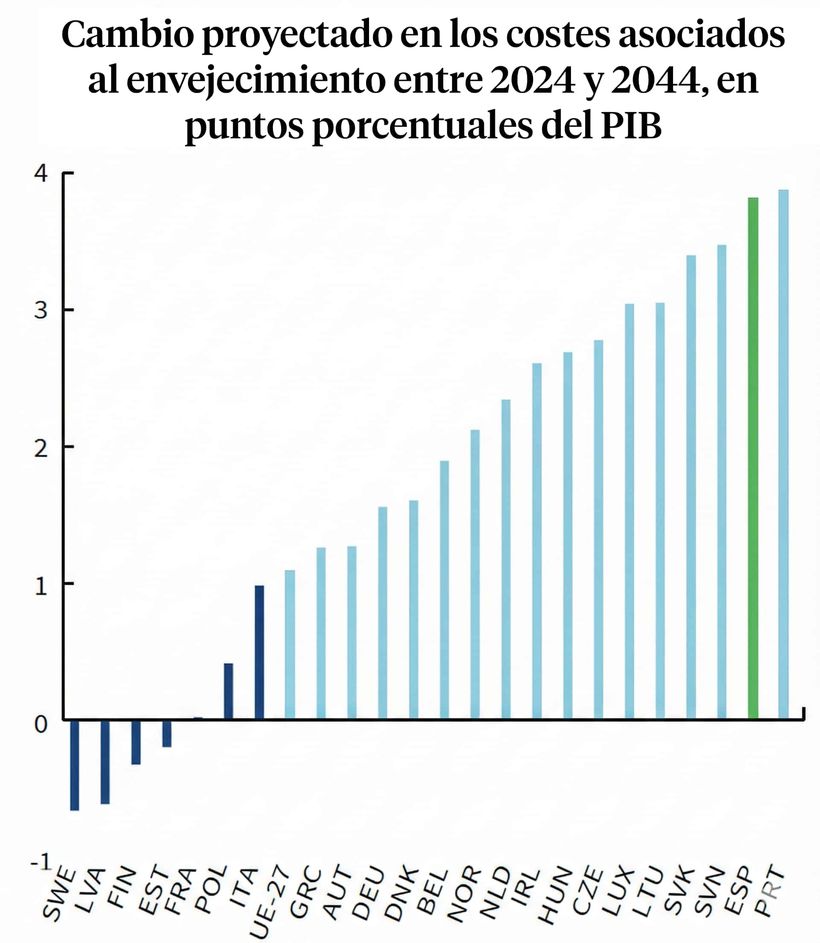
This study (which can be downloaded at this link) admits of the good conjunctural health of the economy, where the GDP is expected to end above 2.9% in 2025, driven largely by private consumption and tourism with structural imbalances.
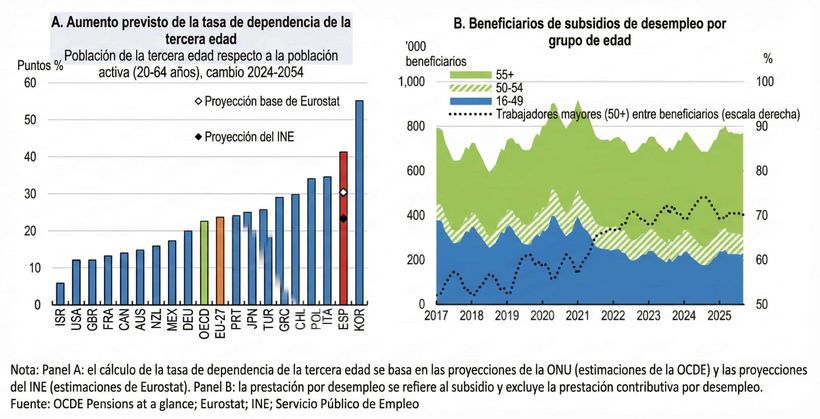
On this point the OECD is clear and says that the aging of the Spanish populationwhich will be the second most pronounced in the world until mid-century only behind South Korea, which will greatly strain public accounts, pushing them to limits that are difficult to manage if new adjustments are not made now.
The “mortgage” of pensions
The thorniest point of the report focuses on the sustainability of the Social Security system. Despite the reforms carried out approved in the past legislatures, which reintroduced linking the CPI and increased contributions through the Intergenerational Equity Mechanism (MEI), the OECD considers that “the accounts do not work out.” According to the projections included in the study, pension spending will increase by 3.2 percentage points of GDP between 2023 and 2050.
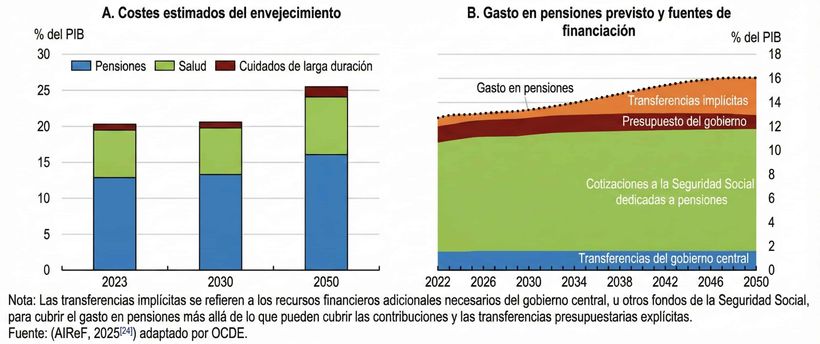
To redirect this expense, the organization proposes recovering recipes that are politically sensitive (that is, that not everyone likes). Specifically, it proposes extending the reference period for calculating the pension to 35 years, compared to the current model that progressively moves towards 29 years (discarding the worst two and which comes into force from 2026).
This measure lowers the average pension for pensions without long contributions periods, since even if the periods known as “contribution gaps” are included when also including the calculations for the first years, it will therefore affect lower salaries. To understand it, a worker in the same position does not earn the same money now as he did 30 years ago, in the same way that 1,000 euros now does not have the same value as when the current currency entered.
Likewise, the report insists on the need to link the legal retirement age to life expectancy, an automatic adjustment mechanism that already existed in the 2013 reform (the Sustainability Factor) and which was repealed. For the OECD, extending working life is not an option, but rather an imperative necessity to prevent public debt, which is currently around 102% of GDP, from escalating again in the 2030s and 2040s.
This is so, since we live longer and as we live longer, those years in which pensions are collected are longer, which puts pressure on pension spending.
Fiscal pressure and productivity
The international organization not only asks to cut spending or tighten access to retirement; It also puts the focus on income. The OECD anticipates that Spain will be one of the European countries where fiscal pressure will have to grow the most to sustain the welfare state. However, he warns against the temptation to continue raising social contributions, as this could penalize job creation.
Instead, OECD economists suggest comprehensive tax reform that shifts the tax burden. They recommend gradually eliminating VAT exemptions, harmonizing rates, and increasing environmental taxation (equating, for example, taxes on diesel and gasoline). The objective is to raise more to finance social spending without suffocating the labor market.
The report also points out the “usual suspect” of the Spanish economy, which is low productivity. The business fabric, dominated by very small SMEs, hinders the capacity for long-term growth. The OECD calls for eliminating regulatory barriers that prevent companies from gaining size and improving the training of workers, especially those over 50 years of age, whose premature expulsion from the labor market is a luxury that the system cannot afford.
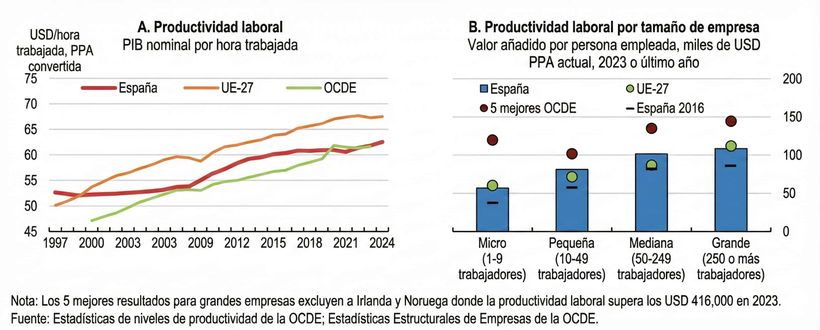
To summarize it all and with data to take into account, the Economic Study 2025 works as a reminder that current inertia does not guarantee future sustainability. Although Spain has avoided recession and is creating jobs at a good pace, the “cards of the future”, as the demographic analysis suggests, have already been dealt. The room for maneuver is narrowing and the options proposed by the OECD (work more, pay more taxes or collect adjusted pensions) configure the difficult trilemma that Spanish society will face in the next decade.