
In Spain, the second vice president and Minister of Labor, Yolanda Díaz, seeks to reduce the working day to 37.5 hours, but a political and business wall is making it difficult for her. Now, if we look at our neighbors in the European Union, we see that reducing working hours may not be such a bad idea if we are more productive. This is the example of the Netherlands, which has not needed to impose a four-day work week, but which leads Europe with an average working day that barely reaches 32.2 hours per week.
The country does so by demolishing the great Spanish macroeconomic myth, that is, that reducing working time does not imply making wages precarious or sinking competitiveness. Their hourly productivity is overwhelmingly higher than the community average and their remuneration reaches levels that the Iberian market, burdened by chronic immobility, can only dream of. In other words, we reduce working hours, we improve salaries, but we must be more competitive.
When talking about the Holy Grail of work efficiency, the collective imagination usually points towards traditional industrial engines like Germany, but the Dutch labor market has mutated almost without realizing it towards the true paradise of flexicurity. According to the most recent official data from Eurostat corresponding to 2024, the real and effective working day in the Netherlands is consolidated as the lowest on the entire continent, standing at an unusual 32.1 hours per week.
On the other side of the coin we find Spain, where real full-time employment continues to involve days that easily exceed 40 hours (although according to Eurostat it is 36.4 hours), and where self-employed workers suffer a burden that exceeds 43 hours a week.
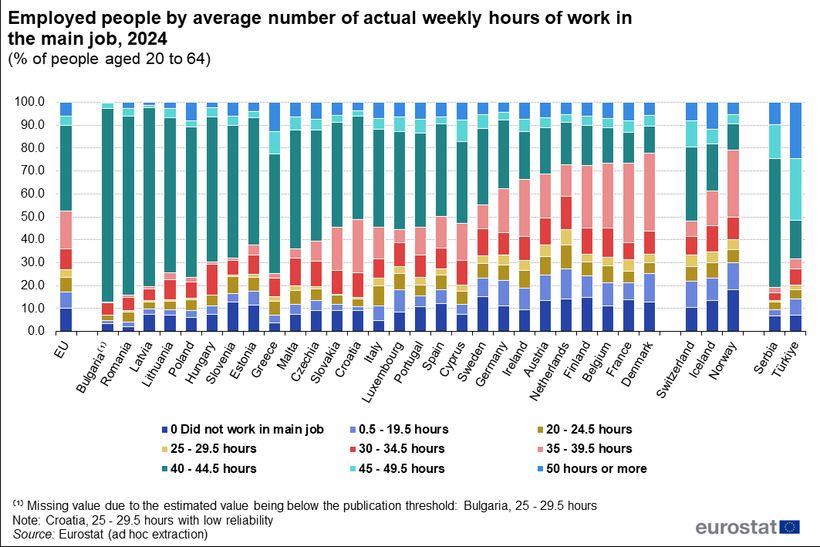
The difference is that the Dutch have stripped part-time work of all the stigma of precariousness. While in southern Europe a reduced working day is often a punishment in the form of unwanted underemployment, in the Netherlands it is the standard to which everyone aspires. An immense part of the employed population (more than 50% of women and around 15% of men) freely chooses to work within the 32-hour threshold. This culture is protected by an institutional framework where employees, after only six months in their position, can legally demand to adapt their calendar; falling on the employer the titanic burden of justifying, for extremely severe business reasons, why he should not grant that reduction.
Fewer office hours, much larger salaries
The average gross monthly salary in the Netherlands is 3,875.00 euros compared to that in Spain, which is set at 2,531 euros per month, although the modal salary (the one most frequently received by the vast majority of citizens) is stagnant at just 15,575 euros gross per year, bordering on the minimum subsistence wage (although it must be said that the standard of living is also higher). Now, how do you do it to work fewer hours, be more competitive and have a higher salary?
According to OECD metrics adjusted for purchasing power parity, labor efficiency in the Netherlands generates $94.38 of wealth for every hour worked. On the contrary, Spain is far behind, yielding only 73.42 dollars in that same period of time.
This Dutch profitability is what finances the cost of the reduction in hours. Organizations in the Netherlands operate under horizontal corporate hierarchies. Managers act as counselors, pernicious “in-personism” is completely eradicated and the challenge to inefficiencies from the bottom up is constant. By having more compact days, workers experience drastic drops in stress levels, which catalyzes their concentration and triggers real performance during work time.
In short, fewer hours, being more efficient, more productive, but doing it with less stress, to be more focused on what we are doing.
Conciliation is not decreed, it is cultivated.
Now, the Netherlands has not implemented a “four day work week“forced by the State, in fact, they have not needed it at all. Their business ecosystem has organically assimilated that prioritizing the staff’s personal time is the only valid strategy for retaining talent in the 21st century. The psychological boundary between the office and home is unbreakable; in fact, responding to a simple corporate email during the weekend or after hours is perceived as a serious management failure.