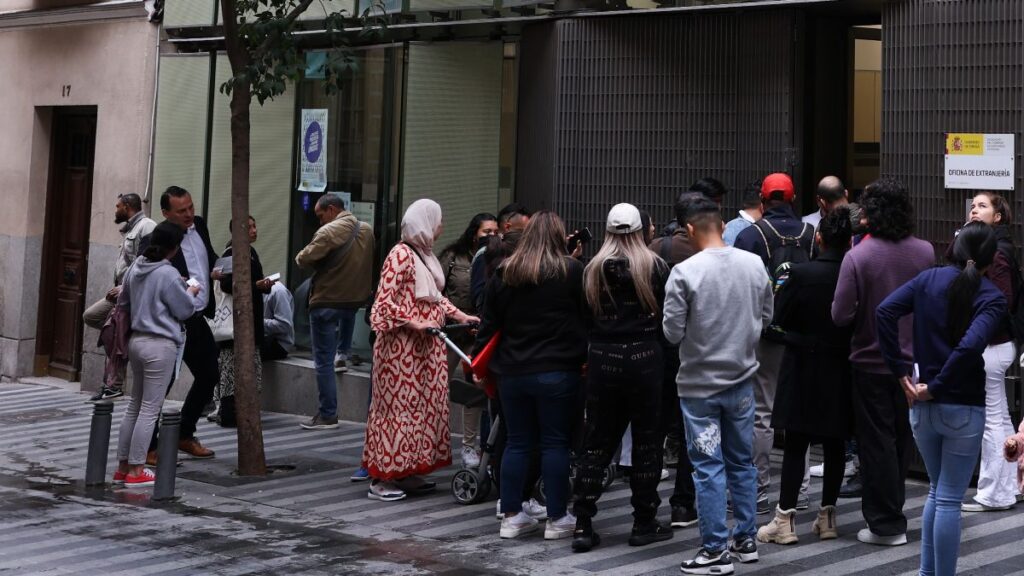
The Government approved this Tuesday in the Council of Ministers the royal decree for the extraordinary regularization of migrants in Spain. After the meeting, the Minister of Inclusion, Social Security and Migration, Elma Saiz, detailed in a press conference how the process will work and defended the measure as “one of the great milestones of this legislature.”
As the minister explained, this initiative will allow regularize thousands of people who already reside in Spain and who are part of the society. “They are people who live among us, who give life to our people and who from today on will be able to enjoy full rights with guarantees,” he noted.
Saiz has also stressed that the measure has “triple legitimacy: social, political and economic”, highlighting the support of more than 700,000 signatures, the majority parliamentary support and the endorsement of social agents.
During the press conference, Saiz also defended the positive impact of the measure on the economy and the labor market. He recalled that “43% of the employment created in Spain… corresponds to foreign workers”, and pointed out that regularization will contribute to strengthening the welfare system and promoting social integration.
When does regularization begin and how can you request it?
The minister has confirmed that the process will start immediately after the publication of the royal decree in the BOE. Specifically, applications can be submitted from Thursday, April 16, electronically.
“The telematic channel will be available 24 hours a day, 7 days a week,” explained Saiz, who has insisted that this will be the most agile channel to process requests.
As for in-person care, it will begin on Monday, April 20 and an appointment will be mandatory. This can be requested from April 16 itself, both through the Ministry’s website and by phone.
The process will be open until June 30 and is aimed at migrants in an irregular situation who were in Spain before January 1, 2026 and who can prove at least five months of continuous stay in the country.
In addition, those who have requested international protection before December 31, 2025 may also qualify.
What rights will regularized people have?
During her speech, the minister explained that people who meet the requirements will be able to access a residence and work authorization in Spain.
This permit will have an initial duration of one year and will allow beneficiaries to obtain a Social Security affiliation number and access to the health card.
After this period, they will be able to integrate into the ordinary channels of the immigration system, which will facilitate a “full and progressive integration,” according to Saiz.
How the process will be organized and what means have been enabled
The Government has designed a specific plan to manage the volume of applications. “We want to ensure that all people who have the right to it can access it,” said the minister.
To this end, more than 550 professionals have been hired and some 450 offices will be set up throughout the territory, including Social Security centers, Post Offices and immigration offices.
In addition, applications will be processed through the Mercurio digital platform, from which the Immigration Processing Unit will resolve the files.
Saiz has insisted that the system is prepared to respond to demand: “we have gone to great lengths in the process” and a “very elaborate” operation has been designed so that it works correctly.
The Government eliminates the responsible declaration to prove the absence of a criminal record
One of the relevant changes to the royal decree is the elimination of the possibility of submitting a responsible declaration to prove the absence of a criminal record.
As negotiation sources have confirmed to Europa Press, this option did appear in previous drafts, but it has finally been discarded after the objections of the Council of State.
In its opinion, this body considered that it was an “inappropriate” technique for a massive process, as it could “open the door to less rigorous practices.”
In this way, applicants must prove this requirement through official certificates from their countries of origin or residence. However, if they do not receive a response within one month, the Spanish Administration may directly request the information from the corresponding authorities.
Exclusion of stateless persons and other conditions of the process
The process will not include stateless people, such as the Sahrawis. On this point, the minister has clarified that “they are not in an irregular situation” and that their exclusion avoids “overlapping” with other procedures.
Likewise, it will be allowed to start the procedures with an expired passport, which will facilitate access to regularization for many people.
To participate in the process it will also be necessary to have no criminal record and not pose a threat to public order.