
In recent years, the Ministry of Labor has defended increases in the Minimum Interprofessional Wage (SMI) with the argument of reaching 60% of the average salary, in line with the recommendations of the European Social Charter. Now, the advisory committee itself that guides these revaluations recognizes that Spain is the only European country that directly uses 60% of the average salary as a reference to set the SMI, and also does so based on the net salary, a choice with mechanical effects on the final threshold.
The finding appears in the latest report from the group of experts that advises the department headed by Yolanda Díaz, where it is admitted that “so far there is no evidence of the use of 60% of the average salary as a reference in any country except the case of Spain.” The phrase is not minor because it reorders the debate, since it is not only discussed how much the SMI should rise, but also what indicator is used to measure whether the objective has been achieved and with what consequences.
Mean vs. median
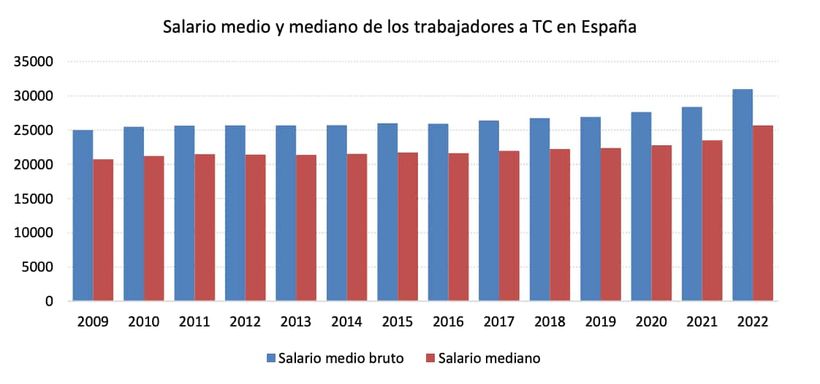
Most European countries, according to the document, rely on alternative metrics, mainly the gross median salary. The difference is not excessively technical, but it is decisive. The average is pushed up by higher salaries; The median better describes the center point of the wage distribution and is usually less volatile. In a labor market with wage inequality, choosing one or another variable changes the result.
In the case of Spain, the report places the median salary between 16.8% and 17.3% below the average salary. That is, if the objective is calculated on the mean, the “desirable” threshold is placed higher than if it were measured on the median. And this simple statistical shift ends up translating into a conclusion, where the chosen criterion pushes towards higher SMI increases than those that would result from applying the predominant references in the environment.
The text also recalls that the community framework for adequate minimum wages does not require a single formula and proposes indicative indicators different from those used by Spain. Among the most cited in the European discussion are 60% of the gross median salary and 50% of the gross median salary. The difference with Labor’s approach is not only the type of average, but also the change from gross to net, a change that alters comparability between countries and makes it difficult, in strict terms, to speak of the same “60%” in different tax and contribution contexts.
To understand it, a good part of the Member States have opted for references considered more conservative. The report mentions that Ireland, France, Germany and Greece move in the orbit of 60% of the median salary; Bulgaria takes 50% of the average salary as a guide; and the United Kingdom has set the goal of reaching two-thirds of the median salary in 2026. With these parameters on the table, Spain stands out not for pursuing an ambitious goal, but for doing so with a less common rule, that is, 60% of the average net salary.
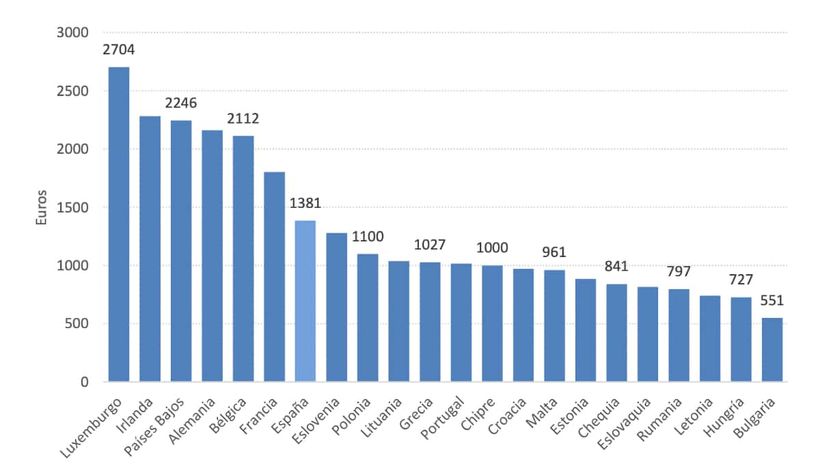
The net salary effect
The document dedicates a specific section to justify why Labor prefers the net salary. The argument is political and social, since the SMI must guarantee sufficient income to cover basic needs, and the real spending capacity depends on what reaches the pocket. The choice, however, has an automatic effect on the calculation.
If the objective is defined in net terms, the gross salary must grow at a greater rate to absorb personal income tax withholdings and social contributions. For this reason, experts warn that anchoring in the net can generate deviations in certain simulations, the application of 60% of the average net salary ends up placing the SMI at 65.9% of the average net effective salary, well above the theoretical threshold invoked as a reference.
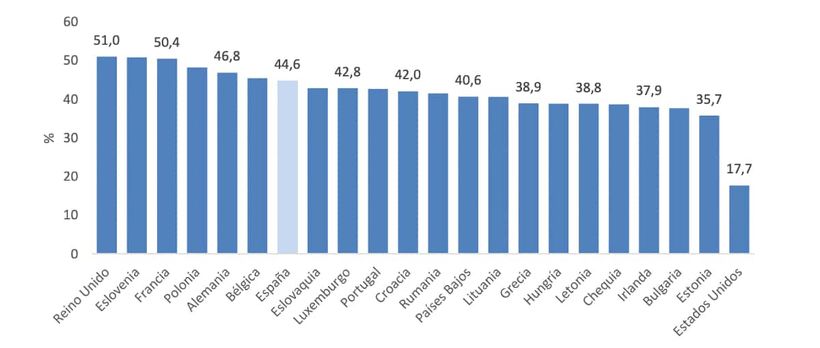
EU countries, United Kingdom and United States, 2024 | Ministry of Labor
In other words, the indicator not only sets the destination, it also moves the arrival point. An objective formulated in net terms can accelerate the increase in the gross amount and, thereby, increase the relative weight of the minimum wage over all salaries, even if the initial intention was to stick to a specific percentage.