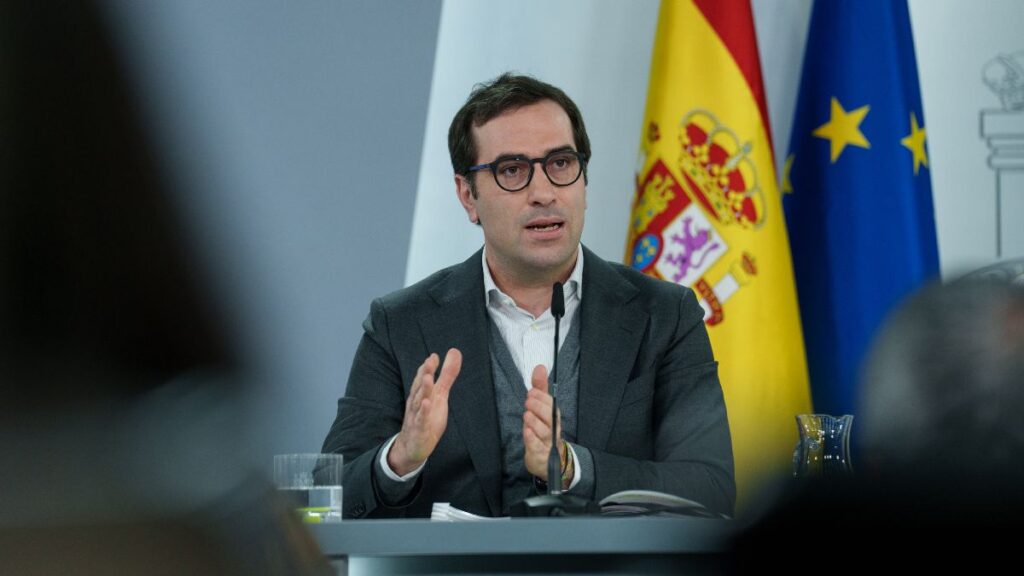
The First Vice President and Minister of Economy, Carlos Body, together with his counterparts from Germany, Italy, Austria and Portugal, has sent a letter to the European Commission requesting the creation of a new tax on the profits of energy companies after the conflict in the Middle East.
“Ministers Markus Marterbauer, Joaquim Miranda Sarmento, Lars Klingbeil, Giancarlo Giorgetti and I ask the European Commission to explore a temporary solidarity instrument for energy companies to contribute with the extraordinary profits obtained during the war and alleviate the burden on consumers and taxpayers,” the Corps itself published on its ‘X’ profile this Saturday.
The objective of this tax is to mitigate the economic impact of rising oil prices. Furthermore, those responsible for the economy of these countries insist that the cost of the energy crisis should not fall exclusively on “consumers”, allowing this measure to also “stop inflation without overloading public budgets.”
“At the Eurogroup meeting on March 27, 2026, we defended and supported measures to tax the extraordinary profits of energy companies. A similar instrument was already introduced in 2022 through a temporary solidarity contribution established by Regulation (EU) 2022/1854, of October 6, 2022, relating to an emergency intervention to address high energy prices,” is stated in the letter signed by the leaders of the Economy.
The European Commission promises to review the issue “quickly”
In the letter, the aforementioned leaders state that, given the current market distortions and fiscal limitations, the European Commission “should quickly develop a similar EU-wide contribution instrument, based on a solid legal basis (and without prejudice to all other efforts and measures of individual Member States) to address high energy prices.”
In the text, they also defend that a joint European solution of this type would function as “a signal” for the citizens of the Member States and for the economy in general, “demonstrating that we remain united and are capable of acting.” At the same time, they state that this is “a clear message that those who benefit from the consequences of war must do their part to alleviate the burden on the general public.”
Lastly, they state that the European Commission has promised to review this proposal “quickly.”