Pensioners who charge a widow’s pension that have 65 years or more and who lack sufficient economic income can be improved by their amount to 60% of their regulatory base. Thus, as explained by Law 27/2011 in its thirtieth additional provision, although the widowhood pension has an amount equivalent to 52% of the regulatory base, it can increase its amount, but knowing that a series of economic requirements must be met.
This is so since social security understands that when they turn 65 and have no other source of income, the amount of it can be insufficient, so and hence the improvement up to 60% of the regulatory base. In addition, as is a plus that meets economic needs, everyone will not be able to access, since it would not make sense to raise a pensioner who has monthly economic returns greater than 3,000 euros per month.
You may be interested
A woman loses the widow’s pension and must return 2,355.62 euros because she did not communicate to justice that she had reconciled with her husband after divorce

A man loses the widow’s pension after living almost 30 years with his partner and having three children because social security does not recognize the “gypsy rite” as a legal link
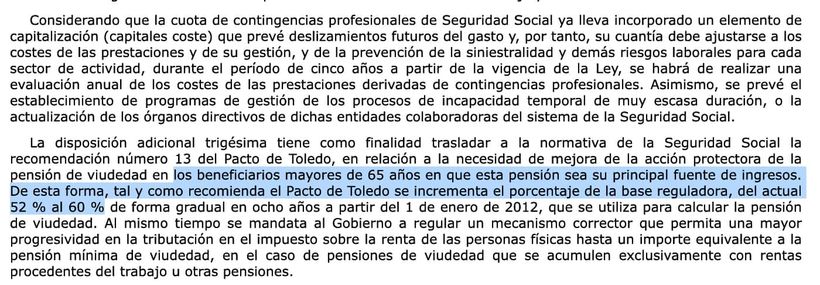
Now, you have to know that this is a right that only widow’s pensioners can access that the conditions meet and that we should not confuse with a generalized increase. The key difference is that it does not apply to everyone when they turn 65, but that this pension is required to be the only or main source of support of the beneficiary.
Requirements that I must meet so that my widow’s pension rises to 60%
Widow’s pensioners who want to access this improvement must meet each and every one of the following requirements. This is established by the thirtieth additional provision of Law 27/2011 (it can be consulted in this Official State Gazette), which indicates that the amount will rise to 60% when these circumstances concur in the beneficiary:
- Have an age equal to or greater than 65 years.
- Not be entitled to another public pension, whether Spanish or foreign.
- Do not receive income from carrying out work on their own or on your own.
- Not having other yields or income (capital, patrimonial gains …) that exceed, in annual computing, the income limit set to be a beneficiary of the minimum widowhood pension.
This means that the improvement is designed to protect those who, arrival an advanced age, depend almost exclusively on the widow’s pension to live. The law introduced this measure progressively, and is now fully in force.
Practical example of the ascent
To understand it better, let’s see it with a practical example. A 70 -year -old pensioner charges a widow’s pension and has no other income, nor works, nor charges any other pension, starting from her husband, already deceased, had a regulatory base of 1,500 euros per month.
Under normal conditions, 52% of the regulatory base of its spouse would correspond to this pensioner, that is, a pension of 780 euros per month. However, as it meets all the special conditions required by law (being greater than 65 and lacking other income), Social Security will apply the improved percentage of 60% on the same regulatory base, recalculating its pension at 900 euros per month.
In this way, this pensioner will not charge 780 euros, but social security will pay 120 euros more every month for life, leaving a final pension of 900 euros. Although the improvement is a recognized right for this group, we must know that the regulations are inflexible in terms of economic requirements, without the possibility of accessing it if established income limits are exceeded.