


To access the contributory retirement pension, Social Security asks the worker to comply with a series of conditions or requirements. These conditions are regulated both in the General Social Security Law and in Law 27/2011 (which can be consulted in this BOE), which is what establishes the current calculation method. Failure to comply with any of them, such as the specific deficiency, may result in Social Security denying us the contributory retirement pension even if we have more than 40 years of contributions.
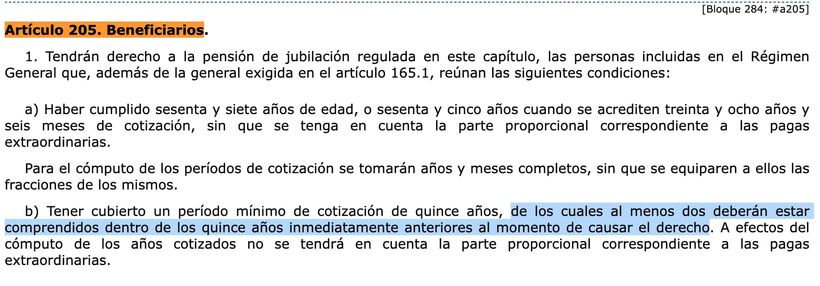
This is recognized by article 205 of the General Social Security Law. This establishes that three requirements must be met to access the contributory pension. The first is to comply with the generic deficiency, that is, having a minimum of 15 years of contributions throughout one’s working life.
You may be interested

Judith (78 years old), a retiree who collects several pensions of 20,500 euros: “We learned to stretch every euro”

Table with the increase in retirement, widowhood and permanent disability pensions based on the payroll for 2026: this is how it looks according to your salary

The fulfillment of the “causing event” follows. To understand this, it is the situation in which a worker finds himself to access any benefit and where Social Security includes three situations. One, which is, the day on which the worker ceases his work activity, as long as he is registered with Social Security. The second is the day on which the application is submitted (in this case the retirement pension). The third and last is the one that is presented without being discharged, that is, in a situation assimilated to discharge.
As a third requirement and unknown to many, this is the specific deficiency. This requirement indicates that to access the benefit it is necessary that of the total years of contributions, at least two years are within the last fifteen years. This is essential to comply with because if not, Social Security will deny the pension even if we have more than 40 years of contributions.
What happens if I don’t meet the specific requirement?
In the case of not meeting the specific deficiency, Social Security offers two options. On the one hand, continue contributing, either by working and therefore generating contributions to the system or through the special agreements with Social Security. This is a mechanism where the worker pays the contributions out of his pocket to generate them and thus have the right to the pension. Now, it is necessary to have a minimum of 1,080 days (almost 3 years) in the last 12 years.
The other option is to give up and opt for the non-contributory retirement pension. This has a smaller amount, since it is assistance aid that seeks to cover a minimum income for the retiree or pensioner. To access this pension, as it is “welfare”, it is necessary for the beneficiary to meet a minimum income, which if they exceed the threshold, it is understood that there is no economic need and therefore, it is not necessary to collect this pension.
A practical example
To understand it better, let’s imagine the case of Juan, a worker who has been “at the foot of the canyon” contributing a total of 40 years in a factory. However, at the age of 49, the factory closes and Juan stops working and contributing, living off his savings until today, when he has just turned 65. Juan goes convinced to Social Security to ask for his retirement because he thinks that, with 40 years of contributions, he has more than enough right to his contributory pension.
Well, the surprise is that Social Security is going to deny him the pension and this will happen because, although Juan more than meets the generic deficiency (more than 15 years in total), he fails in that third requirement: the specific deficiency. When reviewing his last 15 years (from age 50 to 65), Juan does not have at least 2 years of contributions, so the system understands that he has lost the link with Social Security, and is left without the contributory pension despite his entire previous working life.