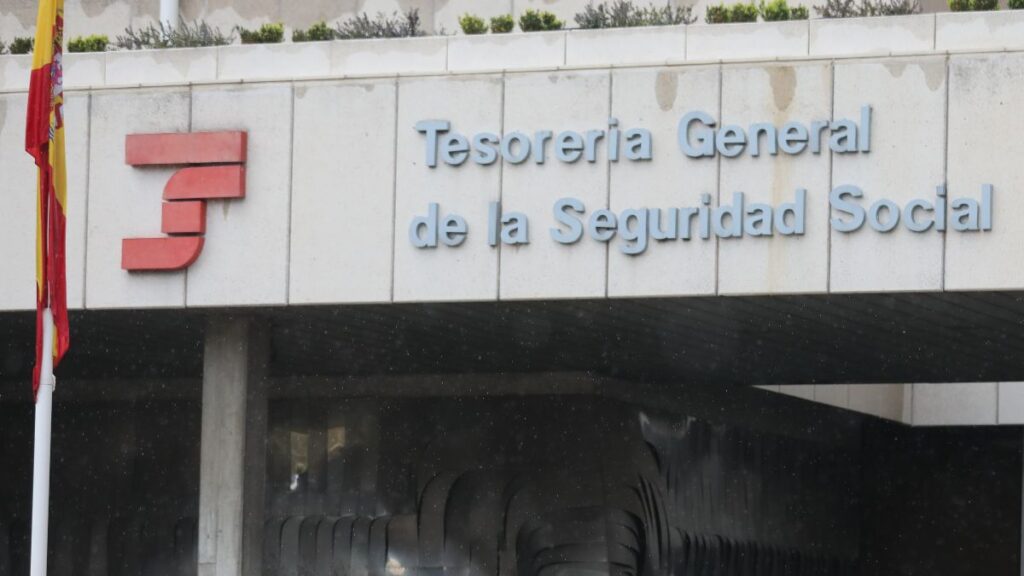
In Spain, Social Security allows workers to advance their ordinary retirement age voluntarily up to a maximum of 2 years in exchange for a cut on the pension in the form of a percentage, which, with 40 years of contributions, is 19%. Now, the regulations also explain that if the resulting pension before applying this reducing coefficient is above the maximum, it is limited to this limit and a new coefficient will be applied, which will go from 8.5% to 10% as of January 1, 2027.
This is stated in article 210.3 of the General Social Security Law (available at this BOE link), which explains that when the regulatory base exceeds the maximum pension, the coefficients “will be applied on the indicated limit”, that is, on the maximum pension, which in the case of 2026 would be 3,359.60 euros per month. These percentages are included in the thirty-fourth transitional provision of that same law, where a total of 10 tables are shown (each one for each year between 2024 and 2033) with the coefficients to apply based on the years of contributions and the months advanced with respect to the ordinary age.
These percentages are not the same as those in the early retirement penalty table. This only applies when the regulatory base, before applying reducing coefficients, is above the maximum pension. These percentages were quarterly, but with the entry of Law 21/2021, they became monthly and would grow each year, since one of the objectives of the rule was to discourage early retirements in order to make the system more sustainable.
With 40 years of contributions, 100% of the regulatory base is charged (the average of the contribution bases of the last years of work), but what this measure affects is those who have a base greater than 3,359.60 euros. This is the case of salaries that contribute close to the maximum base, of 5,101.20 euros per month in 2026 according to Order PJC/297/2026.
How much will be cut in 2027 according to the years quoted
According to the standard, the reduction coefficients will increase in 2027 as follows:
- With less than 38 years and 6 months of contributions, it will go from 9.10% to 10.80%.
- From 38 years and 6 months to 41 years and 6 months it will go from 8.50% to 10%.
- From 41 years and 6 months to less than 44 years and 6 months it will rise from 7.90% to 9.20%.
- With 44 years and 6 months or more, the cut will go from 6.70% to 7.60%.
In the case of advancing the ordinary age by fewer months, the coefficient to be applied will be lower. For example, with those same 40 years, advancing the age one year (12 months) the coefficient goes from 2.98% to 3.30% and a single month, from 1.28% to 1.54%.
The ordinary retirement age with 40 years of contributions will continue to be 65 years in 2027, since the General Social Security Law will require a minimum of 38 years and 6 months of contributions (three months more than in 2026), so that you could retire at age 63 as a maximum advance.
As an estimate, whoever retires this 2026 at the age of 63 and with 40 years of contributions would receive a gross pension of 3,074.03 euros per month (3,359.60 less 8.5%), which with the January revaluation would rise to about 3,182. In the case of doing so from January 1, 2027 and taking into account that experts such as Funcas predict a revaluation of around 3.5% (if the November CPI does not deviate), the maximum pension will be 3,481 euros per month, so if we subtract 10%, the resulting pension would be approximately 3,133 euros. That is to say, it would be about 49 euros less per month, about 680 per year in 14 payments, but taking into account that these data are indicative.
Who is left out of the step and what does the law guarantee?
Keep in mind that the transitional rule also indicates that this step will only affect whether the increase in the maximum pension absorbs the increase in the coefficients, so that the recognized pension “is in no case lower than what would have corresponded with the application of the rules in force in 2021.” That is, the cut grows because so does the maximum pension (the CPI plus 0.115 points).
This only affects voluntary early retirements, so involuntary early retirements (those that are beyond the control of the worker, such as collective or objective dismissal, a competition or a closure due to force majeure) continue to maintain their own rule, which is 0.50% for each quarter or fraction of a quarter of advance (can be read in article 210.4 of the LGSS).
In addition, the conditions are maintained for those who lost their job before January 1, 2022 without being registered again for more than 12 months, or for those who lose their job later due to an ERE, a collective agreement or a competition approved before that date.
Can you work with a 65% disability?

CaixaBank claims 25,810.89 euros from a retiree for retiring before the age of 63 and continuing to collect the pre-retirement agreement, but the court rejects it because he claimed it late
The percentage to be cut is applied at the time of the causative event (usually the date on which the right to the pension arises) and can no longer be increased or reduced, as is the case with the general 21% cut explained by Alfonso Muñoz, a Social Security official, for pensions that do not reach the maximum.