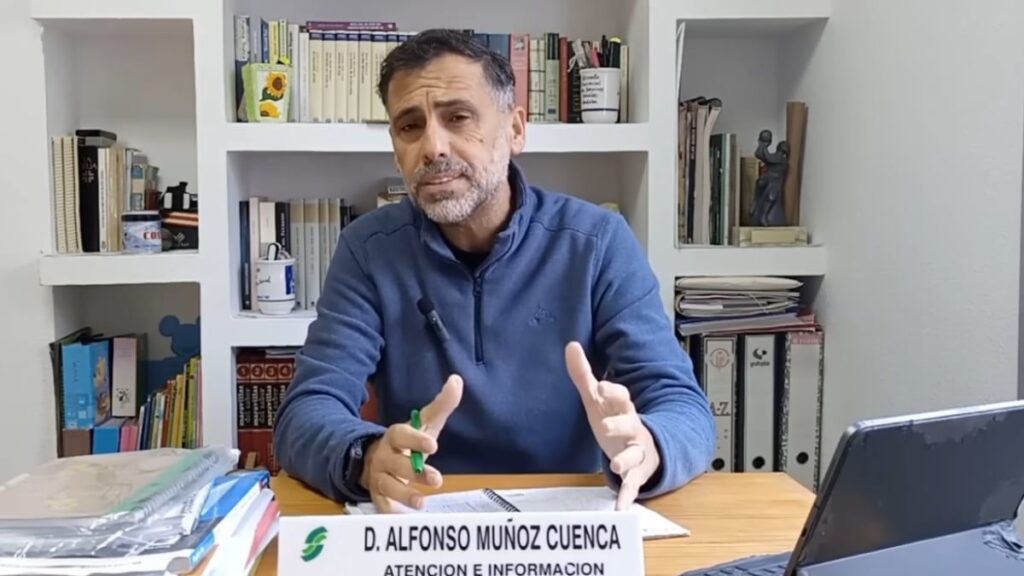
He subsidy for those over 52 years of age It allows you to collect indefinite aid of 480 euros per month, but knowing that you contribute to the retirement pension for 125% of the current minimum base. On the other hand, the early retirement allows you to enjoy your pension before, but knowing that Social Security will apply cuts that can reach up to 21%. Faced with this situation, many workers wonder what is better. Alfonso Muñoz Cuenca, a Social Security official specialized in pensions and benefits, analyzes and explains this dilemma with real figures and a calculation formula that anyone affected can apply to their own situation.
“One of the most frequent questions I am usually asked is whether I am interested in continuing to receive the subsidy for those over 52 years of age or requesting early retirement,” acknowledges the official, who however prefers not to give generic prescriptions. “I usually don’t give advice, because the important thing is that people know all the details, all the options, all the numbers and make the right decision taking into account their own financial interests.”
The official analyzes the subsidy for unemployed people over 52 years of age and says that “the contribution is 125% of the minimum contribution base.” In 2026 this is equivalent to a base of 1,780.50 euros per month (125% of the 1,424.40 euros of the minimum base of the General Regime), an amount that keeps the contribution alive for the future retirement pension. “The amount of the subsidy is only 480 euros per month and it also has no extraordinary payments. A very low amount,” warns the official. Those 480 euros are equivalent to 80% of the IPREM and they are very far from what you would receive by already receiving an early pension.
Muñoz explains it with a case of a worker who is two years away from his ordinary retirement age. In the first scenario, you request the early retirement and his pension is set at 1,300 euros per month. In the second, he decides to wait and collect the subsidy and his ordinary pension would amount to 1,550 euros per month. At first glance it seems better to wait. But the official invites us to “do the numbers.”
Almost 25,000 euros difference in two years
If the worker remains with the subsidy for two years, he will receive 480 euros for 24 monthly payments (subsidies do not have extra payments), a total of 11,520 euros. If, however, you choose early retirement, you will receive 1,300 euros for 28 monthly payments (the pension does include extraordinary payments), a total of 36,400 euros.
The difference is striking. “With early retirement you would earn 24,880 euros more during those two years,” says Muñoz, who immediately poses the question that closes the circle of the dilemma: if the early pension is 250 euros less than the ordinary pension each month, how long does it take to compensate for that advantage of almost 25,000 euros collected at once? “The calculation is simple,” he explains. “We divide those 24,800 euros by 250 euros per month and it gives us approximately 99 months, that is, just over 8 years.”
This means that the decision to remain with the subsidy would only begin to be profitable after those 8 years from ordinary retirement. If the ordinary age is 65 years, it would be compensated from 73. If it is 67 years, from 75.
Three scenarios depending on the time remaining
But this is just an example, because so that each worker can apply the formula to their personal situation, Muñoz recommends a specific step. “The correct way is to request two retirement simulations from Social Security, one calculated at the ordinary age and another two years before,” he details. With these two figures the citizen can replicate the operation and make an informed decision.
The key, according to the official, is to compare three variables that determine whether the operation pays off. The first, what is earned more by collecting retirement in advance compared to the subsidy. The second, the permanent reduction suffered by the pension due to early retirement. And the third, how long it would take to recover that difference once reaching the ordinary age.
And based on his professional experience in the offices of the National Social Security Institutethe official offers some general guidelines. “As a general rule, taking into account the average retirement pension in Spain, the midpoint of compensation is around 9 years. That is, from the age of 75 onwards is when it makes financial sense not to have requested early retirement.”
But the important nuance is in the time left for the worker to reach his legal retirement age, and Muñoz summarizes it in three clear scenarios that serve as general guidance. “If there are two years left, it is generally interesting to request early retirement. If one year is left, the situation is more complex and requires making numbers for each specific case. And if there are only six months left, it is normally interesting to continue collecting the subsidy and retire at the ordinary retirement age.”