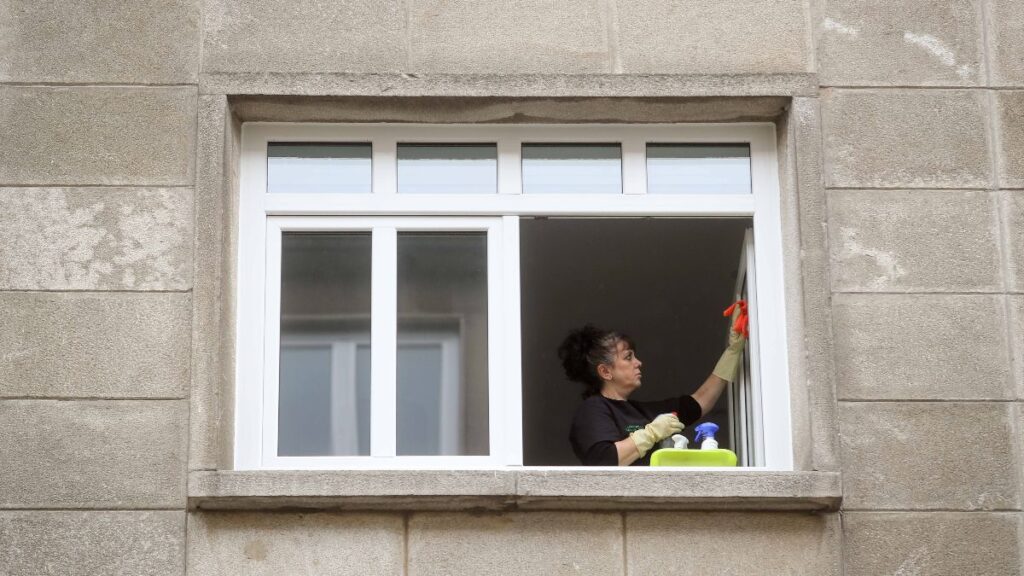
The Superior Court of Justice of the Basque Country has recognized total permanent disability for a domestic worker who had been denied a pension by Social Security despite suffering from osteoarthritis in both knees, obesity and the consequences of carpal tunnel syndrome. Although the National Social Security Institute (INSS) considered that his ailments did not prevent him from continuing to work, the court has determined that his limitations in standing, walking and using his hands prevent him from carrying out his profession normally, for which he will be entitled to a lifetime pension of 75% of his regulatory base.
It was in 2023 when Social Security rejected his request to receive permanent disability, understanding that the osteoarthritis he suffered in both knees and obesity were not sufficient reasons to prevent him from continuing to work. Not satisfied with this decision, the worker filed a claim in November, which was also rejected.
For this reason, he went to court and the Social Court No. 5 of Donostia/San Sebastián upheld his claim, recognizing his total permanent disability. This gave him the right to collect a pension equivalent to 75% of his monthly regulatory base of 393.56 euros (about 295.17 euros per month), with economic effects from October 17, 2023.
Social Security decided to appeal the sentence, arguing that her ailments were not serious enough to prevent her from continuing to work as a domestic worker. Specifically, he argued that domestic tasks require moderate physical effort and do not require special preparation or manual dexterity. Furthermore, it maintained that the woman retained adequate mobility in the knee and sufficient capacity in her hands to continue carrying out her profession.
The TSJ of the Basque Country confirms total permanent disability
The court recalled that, according to the jurisprudence of the Supreme Court, to recognize a total permanent disability, not only must the illnesses suffered by a person be taken into account, but also how they affect their ability to work. In this sense, he pointed out that a worker must be able to perform his or her usual tasks and maintain adequate performance without having to make a greater effort than normal to be able to continue working.
In this case, the magistrates indicated that the woman’s ailments prevented her from normally carrying out the tasks of a domestic worker. And this profession requires standing and walking constantly, something that the worker was limited by osteoarthritis in both knees, aggravated by obesity. Added to this were problems with numbness in her hands, which persisted despite having undergone carpal tunnel surgery and made it even more difficult to perform household tasks.
For all these reasons, the TSJ of the Basque Country concluded that he could not develop his profession with the required continuity, efficiency and performance, rejecting the Social Security appeal and confirming his right to receive a pension for total permanent disability.
Unemployment of domestic workers: how much is paid and when does the two-year benefit period reach?

Víctor Arpa, labor lawyer, to domestic workers: “Your salary pays for your work, it does not buy your silence or your dignity”
The sentence was not final and could be appealed in cassation before the Supreme Court.