

A woman has lost her widow’s pension after Social Security denied it for being legally separated and not having officially communicated her reconciliation, despite having resumed living together with her husband and having had a second child after the separation. In this sense, the Supreme Court explains that the fact of living together again and having children after the breakup is not enough, since the reconciliation must be communicated to the Court so that it has legal effects against third parties.
It all begins when Aurora requests a widow’s pension after the death of her husband on February 4, 2019, which was denied by Social Security. The reason is that, although they lived together, they continued to be legally separated since 1992 and had not been formally established as a de facto couple.
You may be interested

When pensions and extra Christmas pay are collected in November 2025: the date in Caixabank, Santander, ING, BBVA and other banks

Social Security will lower the retirement pension for workers whose regulatory base, after applying coefficients, is higher than the maximum amount
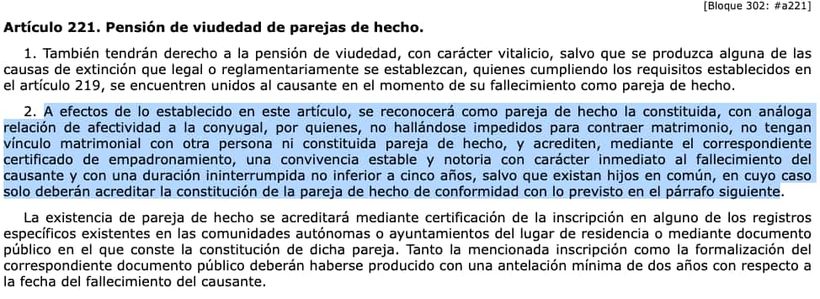
The couple, who had married in 1987 and separated judicially in 1992 due to mistreatment, had resumed living together shortly after. In fact, they had a second child after the separation ruling and in 1994 they even signed public deeds where they appeared as spouses with the same address. But, for Social Security, this coexistence was not enough, since there was no evidence that the widow and the deceased communicated the reconciliation before the Court that declared the separation, as required by article 221.2 General Law of Social Security (consultable in this BOE).
Given this situation and thinking that Aurora was right, she decided to go to court to have her right to a pension recognized, trying to access it through common-law marriage.
I do not communicate the reconciliation to the Court
Both the Social Court and the Superior Court of Justice of Murcia rejected his appeal, that is, he was not entitled to a widow’s pension. For this reason, she decided to try it one last time, before the Supreme Court, where she was also not given the right to a pension.
The High Court gave a reason, which was the existence of an incompatibility. The Supreme Court explains that the pension cannot be claimed as a de facto couple if there is still a marital bond, even if it is separated. To be a de facto couple, it is an unavoidable requirement not to have a marital relationship with any person, not even between the cohabitants themselves. Therefore, since the marriage had not been dissolved by divorce, they could not be considered a de facto couple.
Private coexistence is not enough if there is no official communication
The problem, therefore, is how this return to coexistence is validated, and the conclusion is that without communication to the Court, there are no legal effects. The Supreme Court is categorical in explaining that private reconciliation only obligates the couple, but not third parties such as Social Security.
For reconciliation to be valid for pension purposes, it must be linked to official recognition, that is, through a judicial resolution that is registered in the Civil Registry. In the words of the court, the “voluntary and commonly accepted continuation of marital cohabitation” between legally separated persons does not have the same legal effects as marriage itself if it is not formalized.
It is true that Aurora tried to use an old ruling from 2014 that seemed to allow this, but the Supreme Court clarifies that this doctrine was expressly abandoned and that the current criterion is much stricter.
In the case of Aurora, not even the subsequent cohabitation, the birth of the second child and the notarial deeds where they appeared as spouses have been enough. In other words, the social reality of the couple does not serve to skip the formal requirement of notifying the judge that they have returned. By not having done so, Aurora is definitively left without the right to a widow’s pension.