

The Superior Court of Justice of Asturias (TSJA) has ruled in favor of a woman for not returning the 5,784.91 euros improperly collected from the Minimum Vital Income, thus dismissing the appeal from the National Social Security Institute (INSS). The ruling explains that it was an error by Social Security and, therefore, it is its exclusive responsibility.
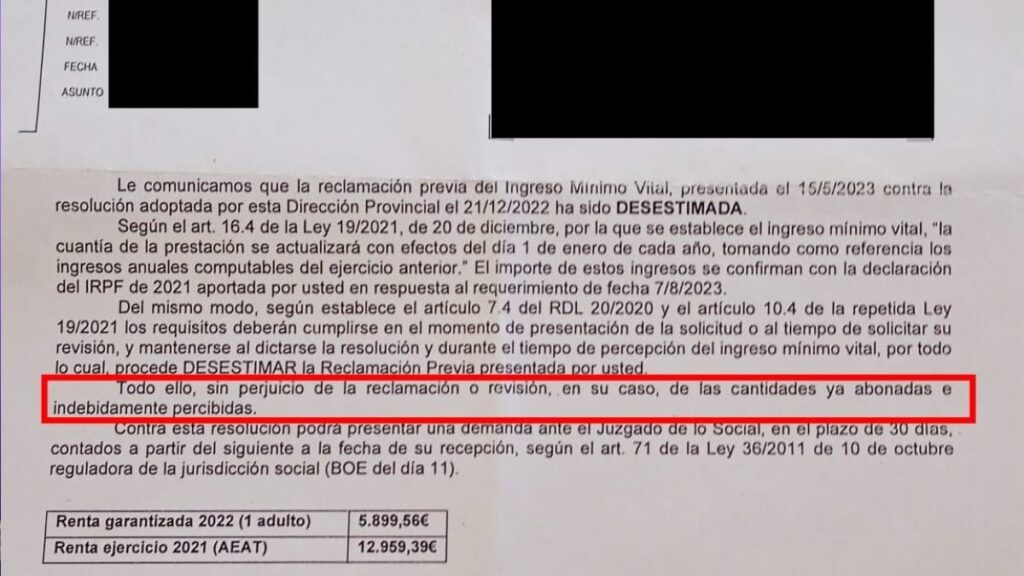
In November 2021, Social Security recognized this woman’s Minimum Living Income, since she was already a beneficiary of a regional basic income (it is the simile of the IMV at the regional level). But, almost two years later, in September 2023, Social Security cross-checked data with the Tax Agency and observed that during 2020, it had exceeded the income level, which is why it demanded the return of what was “unduly” collected between January and November 2021. In addition, in parallel, the Principality also claimed 10,336.32 in respect of the Minimum Insertion Income.
You may be interested

A separated mother who received the Minimum Living Income must return 6,048.93 euros despite the fact that her family unit changed after a conviction for gender violence

Social Security aid for those born between 1960 and 2002: up to 1,595 euros per month
The woman, not being satisfied, decided to go to court, where the Social Security Court agreed with her, that is, she did not have to return the money. Not being satisfied, Social Security decided to go to the Superior Court of Justice, alleging that articles 26.3 and 19.8 of the Royal Decree-Law 20/2020 (which is the law that regulates the Minimum Living Income) allows the subsequent “regularization” of the amounts, so there was no error by the Administration.
Social Security had the data and did not use it
The Superior Court of Justice of Asturias once again ruled in favor of the woman and reproached the Social Security for its lack of diligence, explaining that when the Minimum Vital Income was approved in November 2021, the 2020 Income campaign had already ended months before (in June), so the INSS had full capacity to know the economic reality of the applicant before paying erroneously.
Thus, as stated in the ruling, it explains that “at that time the managing entity could have verified all the financial data of the plaintiff with the Tax Agency…; however, it did nothing and a month later it rectified the amount.” Since it was not verified, the court considers that a situation of “legitimate trust” was created in the citizen, who acted in good faith and did not contribute in any way to the administrative error.
Another thing that we must take into account is that the Principality of Asturias was already demanding more than 10,336.32 euros in parallel due to the incompatibility of the Basic Social Salary with the IMV. In this sense, the court applied a principle of equity and proportionality, explaining that forcing the woman to return the two amounts was an irreparable harm.
The ruling states that “if the situation of economic vulnerability exists, it seems clear that the reimbursement of benefits should not be doubled.” In this sense, the Chamber relied on the jurisprudence of the European Court of Human Rights (Cakarevic case v. Croatia), which considers that demanding the return of subsistence benefits for errors attributable to the State constitutes a disproportionate burden for the citizen.