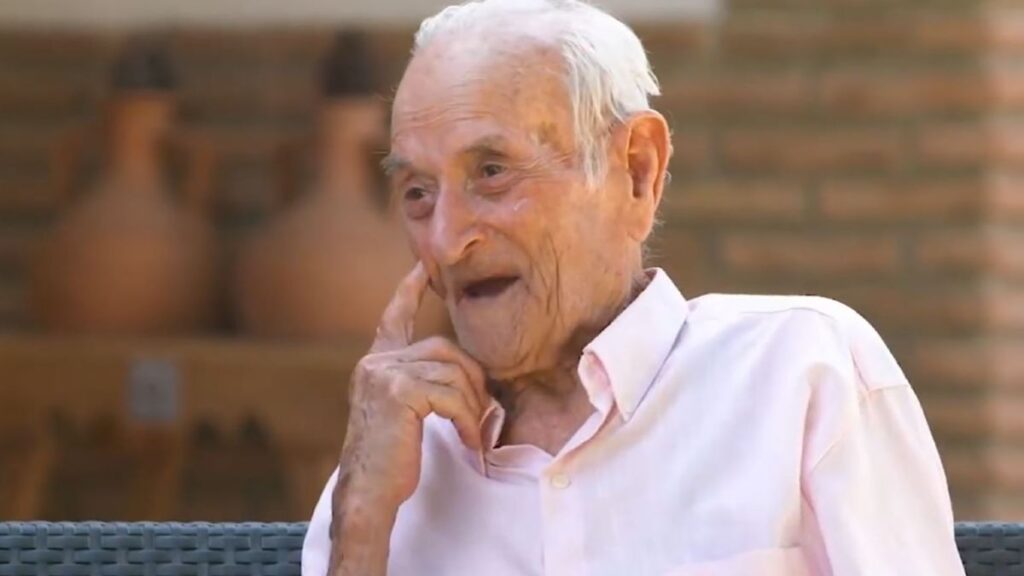
There is no better account of what life was like before than the one told to us by our grandparents and retirees, who know what it was like to live in the post-war period, a time marked by hard work from a very young age and going hungry in the majority of Spanish homes. in the program Centenarians from Canal Sur, some retirees over 100 years old explain what their life was like at that time and the hardships they had to go through. Three Andalusians share their memories, marked by scarcity, constant effort and a way of life that has little to do with the current one.
Soledad, Pedro or María Inés are some of the few centenarians who remain in Andalusia and who still have the strength to tell what it was like to live in the post-war period. They grew up in a Spain where working was not an option, but a necessity. Getting up early, enduring endless days and making do with what little there was were part of everyday life. For them, making a living literally meant surviving.
Their testimonies reflect how things have changed over time. What is understood today as quality of life, for them was an unthinkable luxury. Through this documentary, they compare their youth with now, making it clear that they were much harder times.
“The people were hungrier than the sea…”
Soledad Domínguez, known as “Sole,” remembers her years running a butcher shop during the rationing era. “My mother had another one next door… we were both butchers,” she says with a laugh at her home in Seville.
In those days nothing was wasted. Necessity sharpened ingenuity and hunger marked people’s behavior. “At my wedding they jumped over the tables… there was a lot of hunger,” she recalls, reflecting the harshness of the time.
Working from a very young age was common, especially complicated in the case of women. “By then, having a business as a woman was ahead of your time,” explains her family. Even so, Sole broke the mold: at the age of 60 he got his driving license and bought a car.
When they ask her how she sees herself today, she is clear: “I don’t look old.”
“Two arrobas on the head and miles walking”
From Los Barrios (Cádiz), María Inés, 105 years old, remembers a life marked by physical effort. “That was all misery,” he summarizes simply.
Long walks carrying weight were common. “Five or six kilometers… with two arrobas on the head,” his relatives remember. Working in the fields, collecting plants or any task that provided something to eat was part of the routine.
Solidarity was also present even in scarcity. “My mother fed whoever she could… she shared what little there was,” explains her son.
During the war she suffered an irreparable loss: her husband was called up and died shortly after. Still, he kept going without giving up. His message is clear and direct: “You have to look forward.”
“In 1935 I was already looking for work”
In Córdoba, Pedro, born in 1920, remembers how he started working when he was just a teenager. “At the age of fifteen I was already in the countryside,” he explains.
Without machinery or comforts, agricultural work required great physical effort. “With a pair of mules and good hands… that’s how everything was done,” he says. The day had no end: he watered at night and rested when he could, even in the middle of the furrow.
His lifestyle has always been simple. “Garlic, onion… that is the best medicine,” he says. Even today he maintains rural customs, convinced that they have influenced his longevity.
In the postwar period, women worked without rest and without a contract.
Hunger and restrictions marked an era. Ration cards were essential and getting food meant long lines. Added to this was the constant fear during the war.
The sirens forced people to take shelter without knowing what would happen when they came out. Many families lived with daily uncertainty, with no guarantee of keeping their home.
Women also took on jobs without recognition: caring, cleaning or helping with whatever was needed, always without rest or contract.
A generation in which effort was not negotiated
The stories of Sole, María Inés and Pedro reflect the reality of an entire generation. They started working when they were very young, at a time when there were hardly any opportunities or labor rights.
Clothes were reused, food was shared and work was constant. Rest barely existed and studying was, in many cases, impossible.
“Now young people live differently,” reflects Pedro, aware of the generational change.
For them, retirement was not just about stopping working, but about having endured enough to get there. Your life is not measured in years contributed, but in accumulated effort.
Between hard memories and proud moments, they leave a clear lesson: work, resist and move forward, no matter what happens.