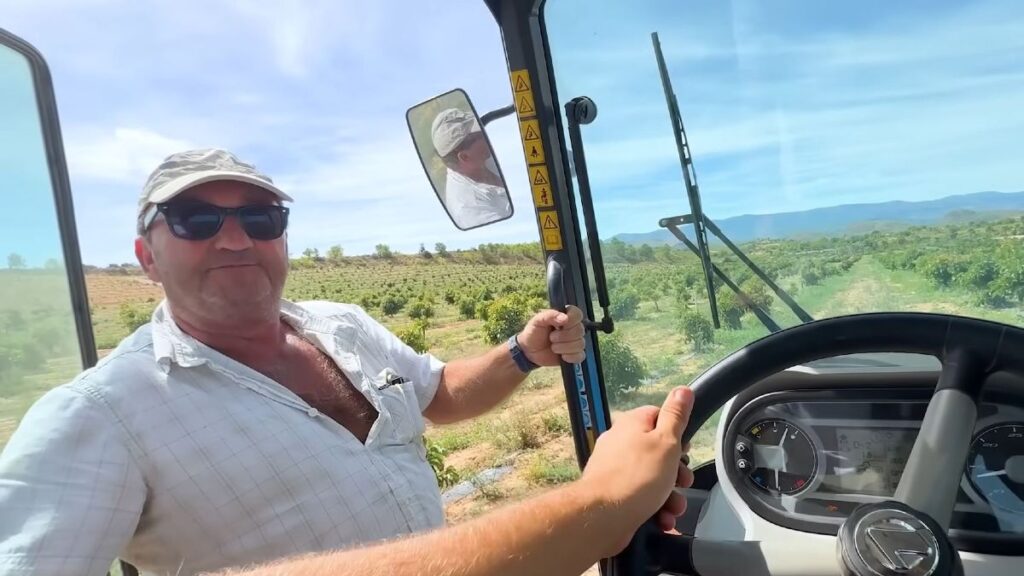
The countryside continues to be one of the fundamental pillars of the Spanish economy, but it is increasingly difficult to find generational replacement, which is why it is increasingly common to see migrants working in agriculture. The hardness of the work, the uncertainty of the harvests and, above all, the low salaries are behind this problem. This is reflected by Paco, a farmer and tractor driver with a lifetime dedicated to the land, in an interview on the ‘@Archieted0’ YouTube channel, where he shows from the inside what a real day in the field is like.
With decades of experience behind him, Paco tells us what a tractor driver dedicated to agriculture earns: “about 7 euros an hour or so he would charge around there… that’s it.” A figure that, according to the worker himself, is far from compensating for the physical effort required by the job.
A life by and for the countryside
Paco is not new to this. “All my life,” he answers when asked about his experience in agriculture. He has been working since he was young and knows every detail of a trade that has changed over the years, especially with the incorporation of machinery.
Today, one of the key tools is the tractor, an essential machine to optimize work. Its function, he explains directly, is to “cultivate the land.” However, behind that simplicity there is a technical and demanding work. The tractor he uses, for example, reaches “16,000 revolutions per minute” in its work system, capable of removing the earth and eliminating weeds.
Furthermore, it is not exactly a cheap tool. “50,000 bucks” he says the cost of a tractor like his is, an investment that not everyone can afford and that shows the level of mechanization that current agriculture requires.
Hard work that no longer pays like before
Beyond technology, the economic reality of the sector is clear. Paco makes it clear when comparing the past with the present: “In the past you earned much more than now. When I started I earned more than now.”
This loss of purchasing power is one of the main concerns of the sector. The work is still hard, with long hours, exposure to heat and constant physical tasks, but income has not evolved at the same pace.
During the day shown in the video, the content creator experiences this hardship first-hand: hours plucking herbs by hand, collecting products or selecting tomatoes under high temperatures. An effort that helps to better understand why salaries are insufficient for many workers.
Agriculture, between vocation and lack of relief
Paco’s testimony is framed in a broader context that is also explained by the owner of the farm, Pascual, who warns of the economic risks of the sector. Losses due to weather phenomena or price pressure can be enormous, reaching “300, 400…” thousand euros in some cases.
Added to this is the lack of attractiveness for young people. Although the field remains essential, current conditions make it difficult for new generations to become interested in this type of work.
Paco represents precisely that generation that has experienced the countryside from within, adapting to changes but seeing how conditions worsen. Its message is clear: work is still necessary, but it is increasingly difficult to make it profitable.
At a time when there is talk of sustainability, local products and support for farmers, his testimony brings figures and reality to a sector that, despite its importance, continues to fight to be recognized and valued as it deserves.