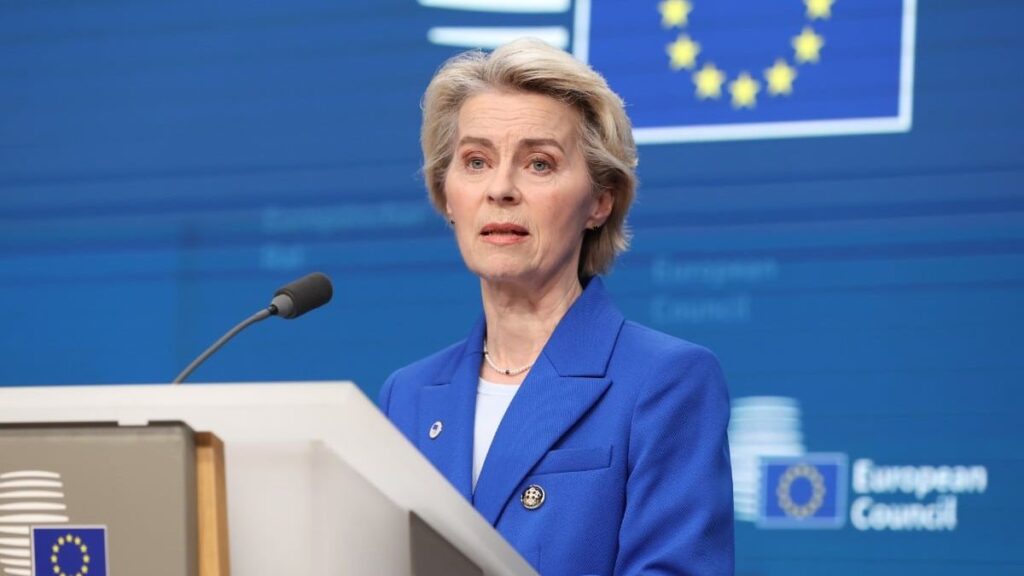
A total of 26 European scientists and public health experts have sent a letter to the President of the European Commission, Ursula von der Leyen, in which they demand a change in the regulatory approach to tobacco and nicotine products. The group calls for future community standards to be based “on available scientific evidence” and not on the premise that all nicotine products present the same health risks.
The initiative comes accompanied by 131 scientific studies that, according to the complaint, were not included in the recent impact assessment report of the Tobacco Directive prepared by the European Commission. With this, they seek to ensure that the Community Executive takes into account a broader scientific base before legislating.
In the letter, the experts show their concern about the possibility that future regulations equate products such as electronic cigarettes, heated tobacco or nicotine bags with conventional cigarettes, as announced by the Platform for the reduction of harm from smoking. “It is not supported by evidence to treat fundamentally different products as equal in terms of risk to public health,” they warn.
Although they recognize that these alternative products are not risk-free and must remain subject to strict regulation (especially to prevent their use among minors), they emphasize that they cannot be considered as harmful as combustible tobacco. “It is equally incorrect to suggest that these products are as dangerous as smoking, or to regulate them as if they were,” they say.
Combustion, at the center of the problem
One of the main arguments of the signatories is that the greatest health risk does not lie in nicotine itself, but in the combustion of tobacco. This process is responsible for the release of toxic substances linked to cancer, cardiovascular and lung diseases, as well as premature mortality.
For this reason, they defend that non-combustion products should be evaluated in comparison with the consumption of traditional cigarettes, and not only against total abstinence. “The key question is not whether these products are risk-free, but whether they are more or less harmful than continuing to smoke,” they point out.
In this sense, they warn that comparing these alternatives only with “non-consumption” can distort the reality of millions of adult smokers, whose immediate alternative is not to give up nicotine, but to continue smoking.
Risk of misinformation and bad policies
Scientists also warn of the confusion that exists in the public debate between nicotine and smoke, which, in their opinion, can mislead both citizens and policy makers. “Confusing nicotine with smoke is not a minor technical error: misinforms the public and can lead to bad legislation“, they point out.
Regarding the protection of minors, they agree that it should be a priority, but they insist that it should not justify decisions that are far from scientific rigor. Furthermore, they recall that in several countries where non-combustion alternatives exist under strict regulation, youth smoking has continued to decline.
The European objective, at risk
The letter concludes with a warning: the European Union’s goal of achieving a “tobacco-free generation” by 2040, with a prevalence of less than 5%, could be compromised if different products are not adequately differentiated.
“Legislating on the basis that all nicotine products are equal runs the risk of protecting the cigarette market rather than reducing it,” argue the experts, who urge Brussels to adopt a regulatory approach based on the “risk continuum” between products and aligned with science.
“Europe cannot claim to ‘follow the science’ in the fight against cancer while ignoring one of the most basic scientific distinctions: the difference between smoke and non-combustible products,” they add. With this petition, the debate on how to regulate new nicotine products in Europe is once again at the center of the community agenda, at a key moment for the public health policy of the European Union.