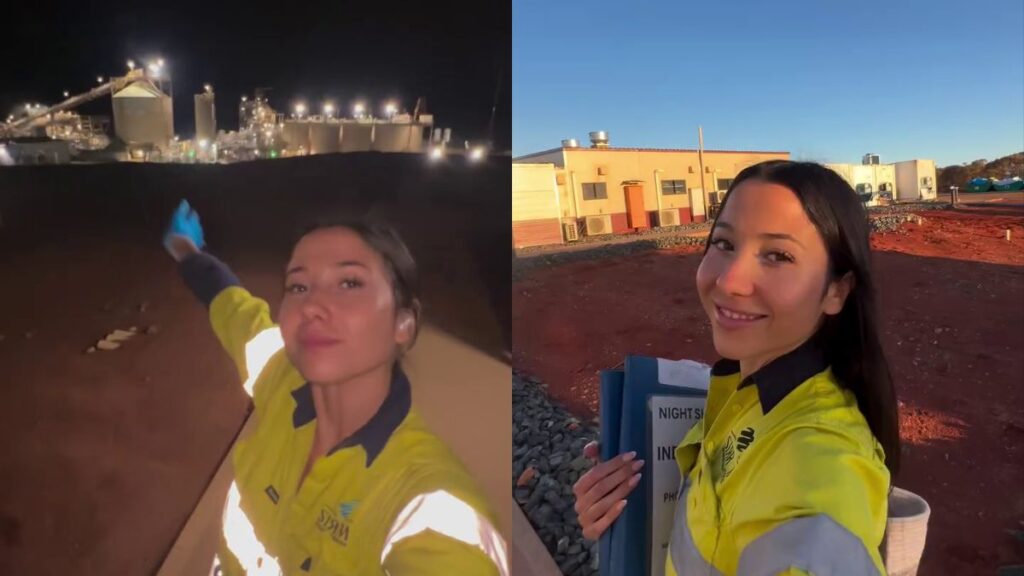




For decades, Australia has had a powerful mining industry, one of the engines of its economy, which needs both specialized workers and personnel for more basic tasks. Salaries, much higher than in similar jobs in Europe, attract many young foreigners with temporary visas.
This is the case of Marta Socorro, a Canary Islands woman who has shared “the reality” of her work cleaning mines in Australia on social media. The young woman highlights that, although she offers very high salaries, in return she imposes a strong physical and emotional strain. “Mines either destroy you or make you stronger,” he says.
You may be interested

Father ‘Roque’, about salaries in the Church: “A priest earns about 800 fixed euros in payroll, but it is complemented with 300 for masses and each three-year period they raise you 10 euros per month”

Yolanda Díaz and the unions will sign the increase in the SMI this Monday and the Government plans to approve it on Tuesday in the Council of Ministers
As he explains, a casual worker, known in Australia as casualyou can earn about 2,500 net Australian dollars per week (approximately 1,480 euros), and even up to 3,000 in some companies. It is a high salary, but it does not guarantee stability. “When he doesn’t work, he doesn’t get paid anything,” he emphasizes.
Furthermore, as he explains, with this type of contract they do not have paid vacations, they do not get paid during the rest weeks and they do not earn anything if they get sick, since “they send them home” and they stop earning money.
The difference with full-time employees (full time) is clear. They have a fixed shift schedule, the so-called rosterand guaranteed work, although they earn less each week. On the other hand, contingent workers depend on the needs of the company and their own performance.
“There are months when I have worked three weeks and others only one,” explains Socorro. The most common thing is to work two weeks and rest one, but in your case that week of rest is not paid.
Physical demand, “extreme” heat and isolation
Aside from the salary, what most marks his experience is the hardness of the work. In Australian mines there are 14 days in a row with shifts of 11 hours a day. “Many people think that it is just cleaning, but it is hard, very hard work,” he says. Their job consists of cleaning tasks within the mining complex, including the most unpleasant ones, in a demanding and physically exhausting industrial environment.
The environment also makes the work harder. In summer, “the temperatures are extreme” and the mines are in isolated areas, far from the cities, which increases the feeling of loneliness. “There are days when I don’t really talk to anyone,” he says. Furthermore, “it’s full of flies, they stick all over your face. You have to put a net over your head,” he explains.
Isolation is a common characteristic of mining in Australia. Even in mines that are very far from cities, workers have to live temporarily in camps set up by the companies themselves while the intensive shifts last.
In short, despite the hardness of the days and the isolation, this experience for Marta is being transformative. “I have decided to take it as an opportunity,” he says. During periods of intensive work, listen to podcasts, go to the gym and try to maintain healthy habits. “It has made me invincible,” he maintains. “It is not easy to work in the mines in Australia, but it is worth it.”