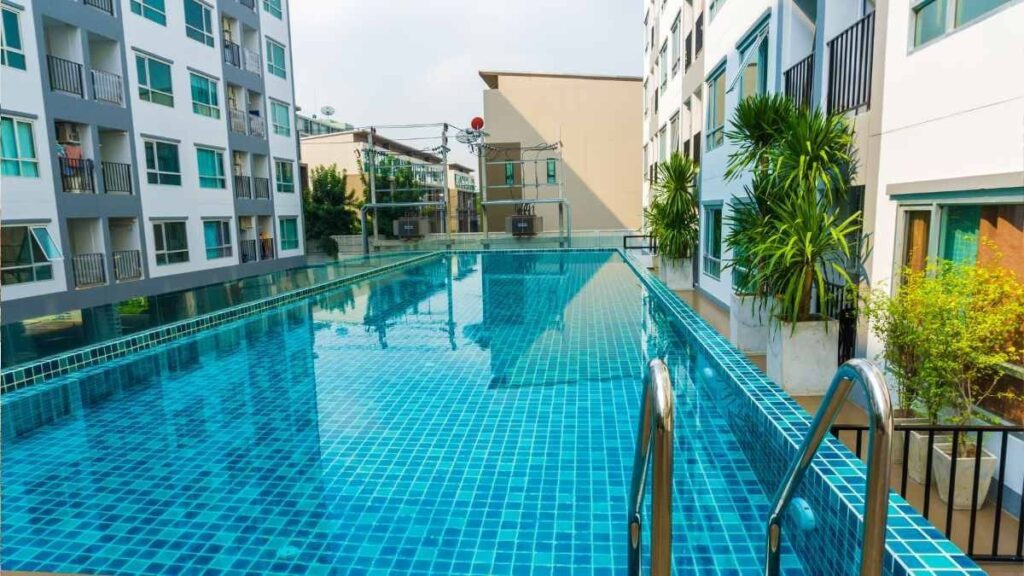
The Provincial Court of Madrid has ruled in favor of a community of owners who agreed to build a swimming pool in a common area despite the opposition of several neighbors, who claimed that putting the pool It was going to leave them unable to use those common spaces and garden areas. The court considers that, after carrying out the works, they would still have 208.16 square meters of green area left, in addition to the rest of the patio, so they were not substantially deprived of being able to use the common spaces.
According to the ruling of May 7, 2026, the community held a extraordinary meeting in May 2019 in which they agreed to build a swimming pool in the garden area of the interior patio. The agreement went ahead with the favorable vote of three-fifths of the owners and the participation fees, and subsequently the project, the budget and the way to finance the work were approved.
A group of 25 owners challenged the board’s agreements taking them to court when they considered that the pool would occupy common areas and that anyone who did not participate in its construction could no longer use those spaces. The Court of First Instance number 5 of Madrid rejected the claim and the owners appealed to the Provincial Court.
Unanimity is not necessary even if the pool occupies part of a common area
Article 17.4 of the Horizontal Property Law (LPH) allows, with the favorable vote of three-fifths of the total owners, who in turn represent three-fifths of the participation fees, to approve certain new facilities or improvements.
The Court recalls the jurisprudence of the Supreme Court in its ruling 586/2018, of October 18, and reiterated in 590/2020, of November 11, in which it is determined that the construction of a new swimming pool in a community area is subject to this majority and not unanimity.
Now, the law itself establishes a limit and that is that actions cannot be carried out that make any part of the building unusable for the use and enjoyment of an owner without his or her express consent.
Therefore, for the Court, in this case the question was determining whether the construction of the pool deprived them in a relevant and substantial way of the use of the community patio. As the garden area had an area of 359.16 square meters, while the pool and its annexes would occupy 151 square meters, after the work there would be another 208.16 square meters of green area, in addition to the rest of the patio, and the project also contemplated the transplant of the affected trees.
This meant, according to the ruling, that the owners who did not agree with the construction of the pool could continue using a good part of the garden areas.
Neighbors who do not pay for the pool will not be able to use it
Another point that the ruling addressed is what would happen to the owners who voted against the construction of the pool. In this sense, the LPH allows that, when it is a non-necessary improvement that exceeds the cost of three ordinary monthly payments of common expenses, the dissident owner does not have to pay for it.
In the community agreement it was precisely agreed that the owners who did not want to participate in the construction of the pool would not have to do so and would not pay, but they would not be able to use it or the fenced area that would surround it as long as they did not assume their part of the construction and maintenance expenses.
He buys a home without a parking space and sues his community of neighbors for prohibiting him from parking in the parking circulation areas: Justice agrees with the neighbors

María Cristina Clemente, notary: “All communities of owners are very attentive to the reform of the Horizontal Property Law that comes into force on October 23”
For all these reasons, the agreements adopted by the owners’ meeting were considered valid, although the sentence (SAP M 6660/2026) could be appealed in cassation.