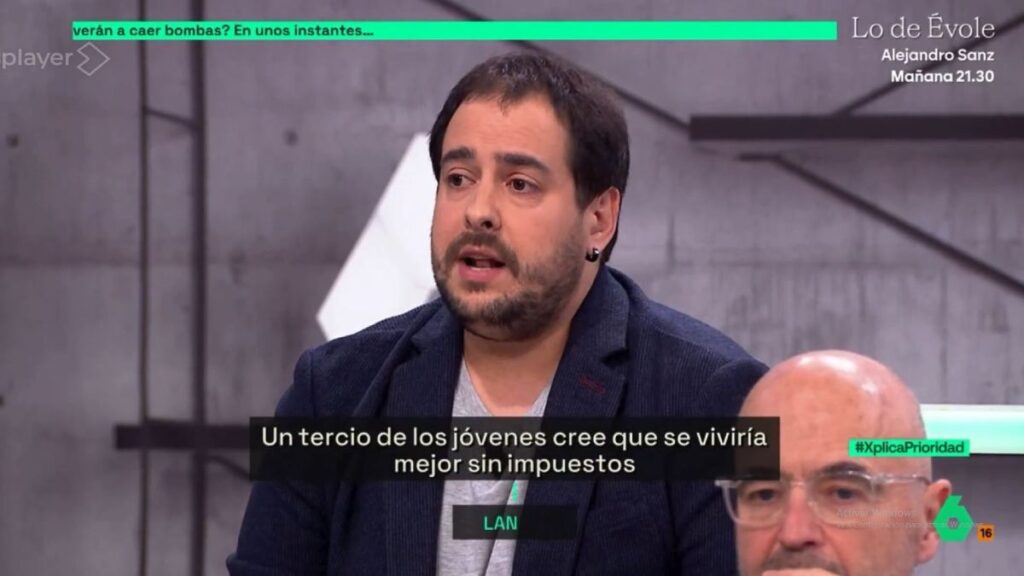
The debate on tax pressure in Spain is back on the table. While some speeches point to a supposed “fiscal hell,” economists like Julen Bollain put figures on the table to dismantle that idea. As Bollain explains, official data show a very different reality, especially for workers with lower incomes.
One of the clearest examples is that of the interprofessional minimum wage. Bollain highlights that “a worker who receives the current SMI (about 17,094 euros per year), discounting inflation, would have paid personal income tax: in 2012, 1,112 euros; in 2018, 679 euros; and in 2026, 0 euros,” as detailed in a recent post on his official X account. This change responds directly to fiscal measures aimed at alleviating the burden on the lowest incomes, as the economist clarifies.
Spain, below Europe in fiscal pressure
The professor at Mondragón University also uses data from international organizations to contextualize the debate. “The average tax pressure in the European Union is 40.4%. In Spain it is 37.3% in 2024,” he detailed in an intervention in the La Sexta Xplica program, making it clear that the tax level in Spain is below the community average.
Furthermore, it introduces a relevant political comparison. During the years of Mariano Rajoy’s government, fiscal pressure increased significantly. “In six years, Rajoy increased the tax pressure in relative terms by 11%”, compared to “7% in eight years” during Pedro Sánchez’s mandate. A difference that, according to Bollain, is also reflected in absolute terms.
In this context, he recalls key measures from the past: “In 2012, the personal income tax was raised, the VAT was raised and the tax amnesty was introduced”, at a time marked by the high public deficit.
Less taxes for low incomes
One of the central points of his analysis is the change in the progressivity of the tax system. According to a recent OECD report (Taxing Wages 2026), Spain has strengthened tax protection for the lowest salaries.
“The introduction of the deduction for work income has contributed to reducing the tax burden and has increased progressivity, mainly in the lower part of income,” he points out. This explains why currently a worker with SMI does not pay personal income tax, something unthinkable just a decade ago.
Furthermore, Bollain emphasizes that the total fiscal effort, which also includes social contributions, is now at moderate levels when compared to other countries in the world. “What the worker pays in personal income tax and contributions in Spain is below the OECD average and well below the European Union average,” he says.
The key is not how much you pay, but what you receive
Beyond the numbers, the economist introduces a key element into the debate: the social perception of taxes. As he explains, there is a paradox in developed countries.
“In countries with greater fiscal pressure there are lower levels of tax disenchantment,” he points out. The reason, in his opinion, is clear: “The legitimacy of the tax system is not based on how much is collected, but on the services received in exchange.”
This opens a broader debate about the tax model in Spain and its comparison with Europe. Bollain raises a direct question: if the objective is to improve public services such as health or education, perhaps the focus should be placed on other income levels.
The debate: raise taxes… on whom?
The economist concludes with a reflection on the future of the Spanish tax system and its convergence with Europe. “If we want to converge in salaries, productivity and quality of services, why don’t we increase the tax pressure on the highest incomes and capital income?” he asks.
According to their analysis, it is precisely in these sections where Spain has a greater margin compared to other European countries. A debate that, far from being closed, will continue to mark the economic agenda in the coming years.