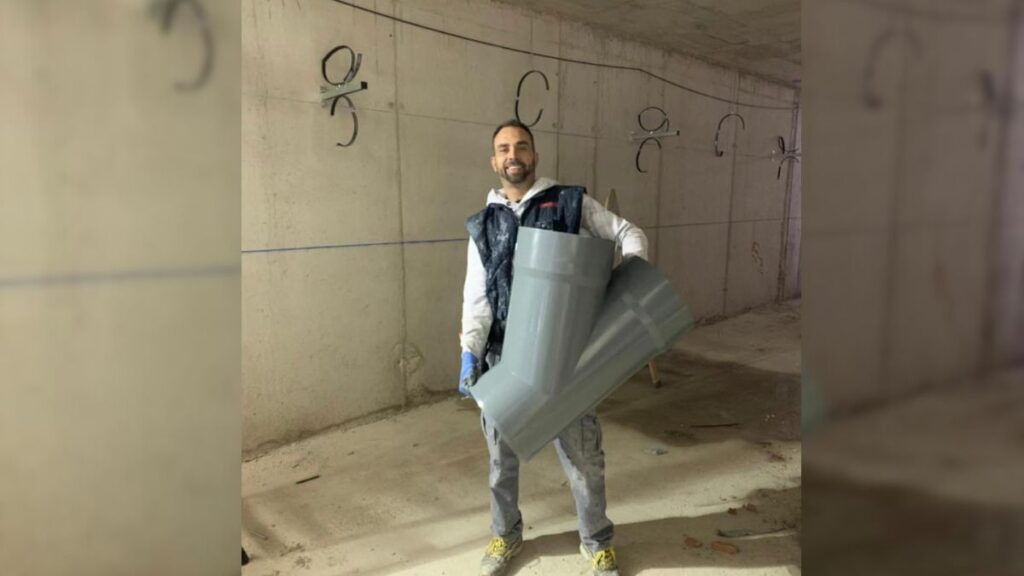


In the current labor context, traditional trades such as plumbing maintain their essential role in the market. However, generational change is one of the main challenges faced by these sectors, where the demand for qualified professionals exceeds the supply of labor, in addition to the existence of certain prejudices and the lack of attractiveness for young people.
This is what Javier Donoso, a self-employed plumber from Ciudad Real, who at 43 years old has spent 23 years working in the trade in Madrid, explained during an interview for NewsWork in which he talks about the need to dignify the trade and combat the prejudices that still persist around his profession, in addition to highlighting how technology has transformed a traditional trade and although, despite this, he continues to find difficulties in attracting new generations.
You may be interested

Emiliana, a parcel delivery girl, speaks clearly about what she charges: “They pay me 0.90 euros per package. If I deliver 50, I charge about 990 euros per month. But if there is a package with an incident, they don’t pay me.”

Sara (22 years old), Spanish who works in a supermarket in Switzerland: “I will never work for 1,000 euros a month again”
“The materials and tools are becoming more and more advanced and the profession is becoming easier,” Javier emphasizes, highlighting that the evolution of materials and tools has made daily work significantly easier.
Prejudices and ignorance of the sector
The professional, specialized in the installation of garages in buildings, recognizes that “there are certain jobs that can be slightly complicated,” but insists that most of the activity “is easy to learn” and that, with interest and dedication, “In a short time you can be making money”he points out, emphasizing the need for motivation.
“What you have to have is desire and, above all, don’t give little money so that people don’t stay at home.”
Regarding the stigmas that still surround the profession, Javi recognizes that the value of a plumber’s work is not always understood in society. “If a plumber comes and charges you so much to stay for a while, people complain, but they don’t know what’s behind it. You learn the trade and do it yourself,” he points out, emphasizing continuous training and the technical complexity that the trade requires. “We have to constantly learn and people don’t understand that. New materials, tools, toilets, taps… We have to be up to date,” he says.
The economic situation of plumbing is also often unknown to those who are not familiar with the sector. Javier points out that in a month he can bill up to 10,000 euros, “but of those 10,000 you have 6,000 left.” An income that, however, is not exempt from the tax pressure and instability associated with self-employment.