


In recent weeks, the expansion of new outbreaks of avian flu in Europe and Spain has forced birds to be slaughtered and stricter controls on farms, which has further strained the sector. Added to this health pressure is the rise in the price of eggs, which has led to significant increases and has made a dozen more expensive in supermarkets. The result is an unstable market in which interest grows in knowing where exactly they come from. the eggs that are consumed.
Mercadona recently detailed the progress of its plan so that all the fresh eggs it sells come from hens raised outside of cages, a commitment made in 2018 and that the company reaffirms at this time of uncertainty for the poultry industry. According to the data released by the company65% of the fresh eggs it sells already come from cage-free systems, both from free-range and free-range hens.
You may be interested

Mercadona now has the product most desired by its customers for Christmas on sale

El Corte Inglés, Mercadona, Lidl and Alcampo: four supermarkets looking for hundreds of workers with and without experience
However, this Wednesday, Juan Roig’s channel has indicated that “due to the outbreak of avian flu and the sanitary measures applied to protect animal health, the percentage of 65% that we had reached has been temporarily reduced”, although it insists that it is a “punctual” adjustment and that it plans to recover the usual levels “as soon as possible.”
The transformation process and the origin of the eggs
From the end of 2024, Mercadona offers eggs from cage-free hens in all its stores. In December of that year, the company placed this percentage at 55%, but the increase in capacity achieved in recent months has allowed it to be raised to 65% in July 2025. Even so, the chain recognizes that the transformation “is still underway” and that the growth in demand of 12% more in the last two years forces it to continue expanding the facilities.
The company emphasizes that the reconversion process is developed together with its suppliers, who have already invested more than 200 million euros in adapting systems, facilities and farm management. The forecast, according to Mercadona, is that the accumulated figure will reach 400 million euros when the change is total.
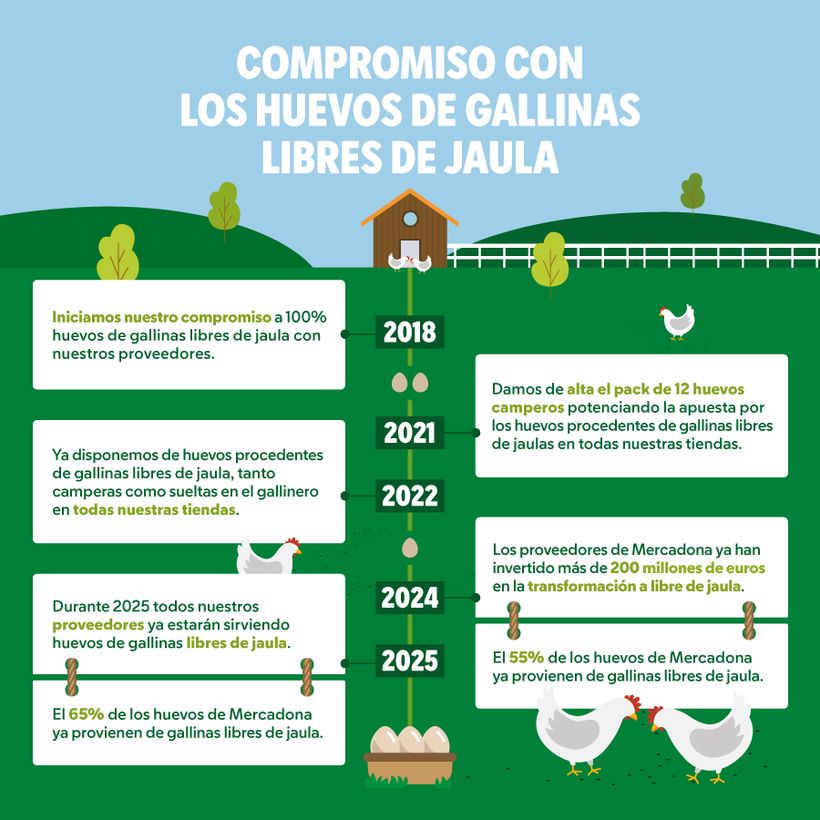
This is one of the largest recent transformations in the Spanish poultry sector, which combines modifications of mixed systems to convert them into 100% cage-free models with the opening of new specific farms.
Among the notable projects are the expansions of Huevos Guillén, one of the main suppliers of the chain, in Utiel (Valencia), with capacity for 250,000 hens, and in Gáldar (Gran Canaria), with another 100,000. New farms have also been incorporated in Bullas (Murcia) and Abárzuza (Navarra), which total 150,000 hens raised without cages, in addition to the Avícola Barco facilities, which operates with 320,000 hens loose in chicken coops.
This is, therefore, the origin of the eggs that Mercadona sells today: Spanish farms in the process of conversion towards cage-free models, with a notable presence in the Valencian Community, the Canary Islands, Murcia and Navarra.
Has that origin changed due to avian flu?
Since November 13, the Ministry of Agriculture ordered the confinement of all farmed birds in Spain, including free-range and organic production. The measure, published in the Official State Gazetteresponds to the increased risk of spread of avian influenza and the presence of 14 outbreaks registered since July in Spanish farms. According to the Ministry, the objective is to avoid contact between poultry and migratory birds, considered the main carriers of the virus.
The measure has raised doubts about whether the origin or supply of fresh eggs in Mercadona has been altered. The chain has detailed NewsWork that they are “aware of the prevention measure applied by the Government” and adapt “to the circumstances of the market and the industry”, stating that they guarantee supply at all times. The company details that the confinement means a temporary reduction in the percentage of eggs from cage-free hens, but the supply remains normal.
“It is one thing to be out of a cage and another to be free”
Sector sources consulted by NewsWork indicate that the confinement of free-range hens does not have to modify the origin of the eggs, but only the daily handling of the birds, which must remain inside the barn for the duration of the sanitary measure. These sources emphasize that the sector had been prepared for a similar situation for some time and knew that “measures of this type could occur”, which is why they assure that the majority of farms have sufficient facilities to keep the hens indoors without altering the continuity of the production system.

The sector points out that confinement helps to reinforce biosecurity at a time when it seeks to prevent poultry from coming into contact with wild birds. Sources recall that “it is one thing for a hen to be out of a cage and quite another for it to be outdoors,” and that a good part of cage-free farms normally operate in closed buildings, except for free-range farms that require access to the outside. In the latter case, the measure implies only a temporary limitation.
On the other hand, the general director of the Interprofessional organization of eggs and their products (Inprovo), Mar Fernández, reminds NewsWork that the outbreaks recorded since summer affect different poultry species and not exclusively laying hens. The organization points out that the affected farms correspond to a very small part of the total.
Same origin, temporary adaptations and a supply without alterations
In short, the origin of the eggs sold by Mercadona has not changed as a result of the avian flu. The chain maintains the same map of suppliers, although with a temporary pause in its transition to cage-free systems. According to both the company and sources in the sector, the health measure has not altered the supply and the market functions normally.
The sources call “for calm and zero concern” and emphasize that the situation “should not generate alarm” because “we are talking about a condition affecting a limited number of chickens that in any case will be back in production in a few months.” In addition, they remember that after several weeks without new outbreaks, the sector considers the evolution “good news.”